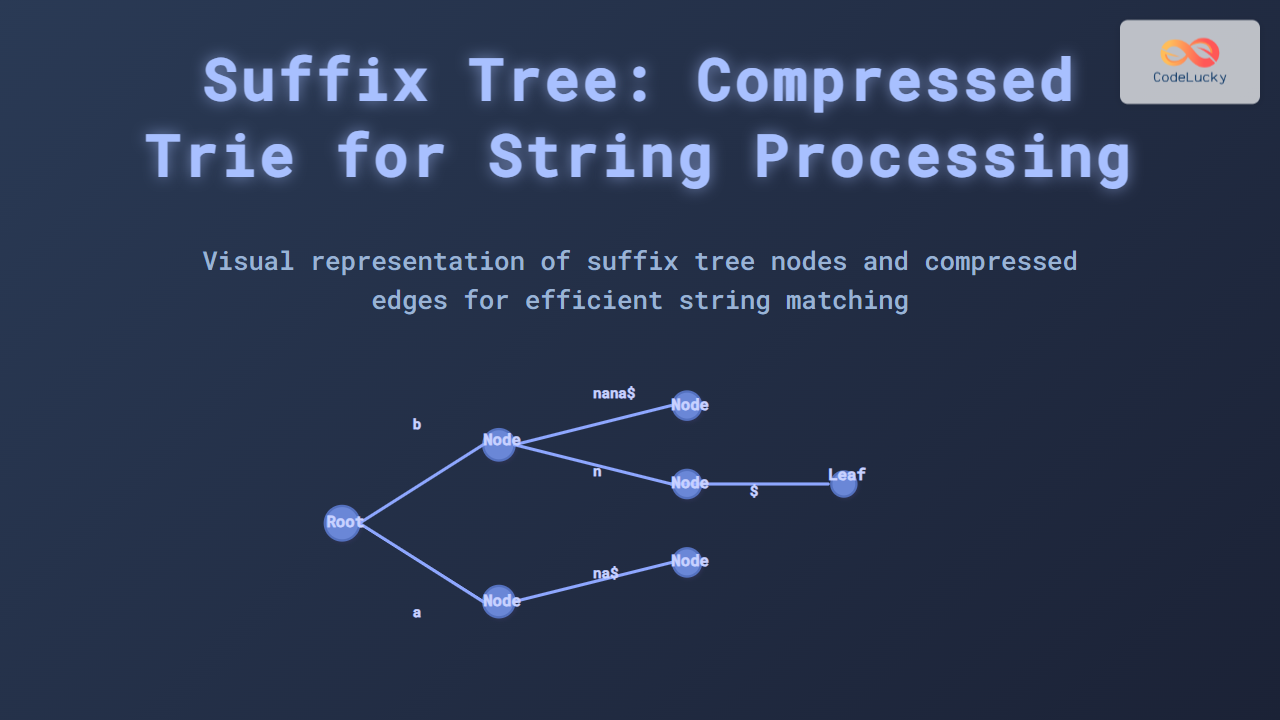
In computer science, string processing plays a crucial role in applications such as text editors, bioinformatics, search engines, and database systems. One of the most powerful tools for string-related problems is the Suffix Tree, also known as a compressed trie of all suffixes of a given string. It provides fast solutions for substring, pattern matching, and longest common substring problems with efficient time complexities.
What is a Suffix Tree?
A suffix tree is a compressed trie that represents all suffixes of a given string. Unlike a normal trie, which would store each character individually, a suffix tree compresses chains of nodes into single edges labeled with substrings. This compression drastically reduces storage requirements and enhances query performance.
Key Properties of Suffix Trees
- Contains all suffixes of the original string as its paths from root to leaf.
- Edges are labeled with substrings, not just single characters.
- Space complexity: O(n), where n is the length of the string.
- Construction time: O(n) for linear-time algorithms (e.g., Ukkonen’s algorithm).
- Enables substring, pattern occurrence, and longest repeated substring operations in O(m) time, where m is the query length.
Building a Suffix Tree
Consider the string S = "banana$", where the special symbol $ signifies the end of the string to ensure uniqueness of suffixes.

The above diagram represents the naive trie of suffixes. To create a suffix tree, we compress chains of single-child nodes into edges labeled with substrings.

This compressed version efficiently represents all suffixes with fewer edges and nodes.
Example: Substring Search with Suffix Tree
Suppose we want to check whether the substring "ana" exists in "banana". In a suffix tree:
- Start at the root.
- Follow edges labeled starting with “a”.
- Check if “ana” can be matched along the path.
Since such a path exists, the substring “ana” occurs in “banana”.
Applications of Suffix Trees
- Exact Substring Search: Check if a substring exists in O(m) time.
- Pattern Matching: Find all occurrences of a pattern quickly.
- Longest Repeated Substring: Useful for compression and textual analysis.
- Longest Common Substring: Efficient when comparing multiple strings (via Generalized Suffix Trees).
- Bioinformatics: DNA sequence analysis relies heavily on suffix trees for genome alignment.
Interactive Example: Python Implementation
Here’s a simple example of building a suffix tree using a naive implementation in Python:
class SuffixTreeNode:
    def __init__(self):
        self.children = {}
        self.index = []

class SuffixTree:
    def __init__(self, text):
        self.root = SuffixTreeNode()
        self.text = text
        for i in range(len(text)):
            self.insert_suffix(text[i:], i)

    def insert_suffix(self, suffix, index):
        node = self.root
        for char in suffix:
            if char not in node.children:
                node.children[char] = SuffixTreeNode()
            node = node.children[char]
        node.index.append(index)

    def search(self, pattern):
        node = self.root
        for char in pattern:
            if char not in node.children:
                return []
            node = node.children[char]
        return node.index

# Example usage
st = SuffixTree("banana$")
print(st.search("ana"))  # Output: [1,3]
This interactive implementation allows you to trace whether a substring exists and capture positions of its occurrences.
Suffix Tree vs Suffix Array
| Suffix Tree | Suffix Array |
|---|---|
| Tree-based structure with nodes and edges. | Flat array of suffix indices sorted lexicographically. |
| Faster for substring-related queries (direct traversal). | Requires additional LCP (Longest Common Prefix) array for similar efficiency. |
| More memory intensive. | Memory efficient with O(n) space. |
| Construction in O(n) with optimized algorithms. | Sorting-based construction in O(n log n) or O(n). |
Conclusion
A suffix tree is a powerful data structure that compresses a trie of all suffixes into an efficient form for advanced string processing. From substring searches to bioinformatics analysis, suffix trees provide speed and flexibility unmatched by simpler data structures. Despite their higher memory usage, they remain a cornerstone in string algorithms and continue to influence modern approaches like suffix arrays and suffix automata.