Subordinating conjunctions are one of the most powerful tools in English sentence building. They help create complex sentences that express relationships such as cause, time, condition, contrast, and purpose. Understanding how to use them makes your writing smoother, more connected, and far more expressive.
What Are Subordinating Conjunctions?
A subordinating conjunction connects an independent clause (a complete sentence) with a dependent clause (an incomplete idea). The dependent clause usually cannot stand alone—it depends on the main clause to form a complete thought.
Example:
I went home early because I was feeling tired.
Here, the subordinating conjunction because links the reason (dependent idea) to the main action.

Why Subordinating Conjunctions Matter
- They connect ideas logically and clearly.
- They help show cause, contrast, or time relationships between events.
- They make your writing more professional and fluent.
- They help avoid choppy or repetitive short sentences.
Common Subordinating Conjunctions by Type
| Purpose | Conjunctions | Example |
|---|---|---|
| Cause / Reason | because, since, as | I stayed inside because it was raining. |
| Time | after, before, when, while, until, since | After you finish your work, we’ll go out. |
| Condition | if, unless, provided that, as long as | You can join us if you complete your homework. |
| Contrast | although, though, whereas, even though | Although he was late, he apologized sincerely. |
| Purpose | so that, in order that | He speaks slowly so that everyone can understand. |
Sentence Building with Subordinating Conjunctions
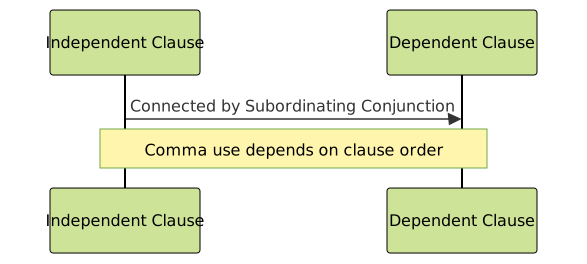
A subordinating conjunction joins two clauses in a specific order. It can appear at the beginning, middle, or end, but the meaning and punctuation may vary.
1. At the Beginning of the Sentence
When the dependent clause comes first, use a comma before the main clause.
Example: Although it was raining, we decided to go hiking.
2. In the Middle of the Sentence
When the main clause comes first, usually no comma is needed.
Example: We decided to go hiking although it was raining.
Interactive Tip: Practice Sentence Connection
Try this: Choose two sentences and combine them using a subordinating conjunction.
1. She studied all night. She wanted to pass the exam.
→ She studied all night because she wanted to pass the exam.
You can try others like:
- He didn’t go out. It was snowing. → He didn’t go out because it was snowing.
- We’ll start. You arrive. → We’ll start when you arrive.
Placement and Punctuation Rules
- When a dependent clause begins a sentence, add a comma.
- When it follows the main clause, no comma is usually needed.
- Avoid fragment sentences — every dependent clause must connect to a main clause.

Common Mistakes to Avoid
Writers often misuse subordinating conjunctions or forget to complete a dependent clause. Here are a few frequent issues:
- Fragment error: “Because I was late.” (needs a main clause)
- Comma misuse: “I was late, because traffic was heavy.” (comma unnecessary here)
- Wrong conjunction: “Although the rain stopped, but we stayed inside.” (avoid using both although and but)
Advanced Usage: Varying Sentence Rhythm
Mixing the position of your dependent clauses changes the rhythm of your writing. Try alternating sentence openings with different conjunctions to keep the reader’s interest.

Quick Reference Chart
| Relationship | Connector | Example |
|---|---|---|
| Time | before, after, when | We’ll leave after lunch. |
| Reason | because, since | She stayed quiet because she knew the answer. |
| Contrast | though, although | Although tired, he kept working. |
| Purpose | so that | He works hard so that his parents are proud. |
| Condition | if, unless | We’ll win if we practice daily. |
In Summary
Subordinating conjunctions transform simple ideas into well-connected, meaningful sentences. They help writers build logical flow, express complex thoughts, and show precise relationships between events or conditions.
Keep a list of common conjunctions handy, practice combining short sentences, and read your sentences aloud to check flow and balance. Within weeks, your English writing will become smoother and more natural.
Next in the CodeLucky English Learning Series: Coordinating Conjunctions and Parallel Sentence Harmony