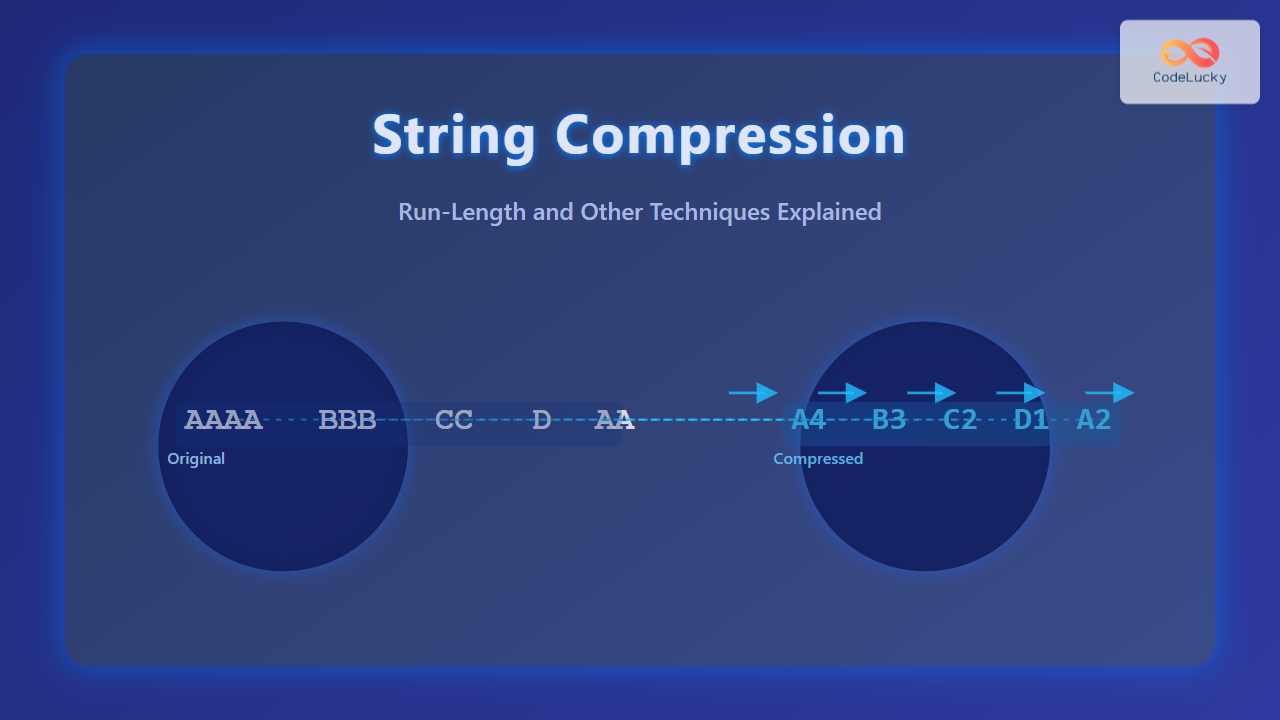
String compression is a fundamental concept in computer science, widely used in data storage, efficient transmission, and optimizing performance. At its core, string compression reduces the size of data by removing redundancies while still allowing the original to be reconstructed. One of the simplest forms of string compression is Run-Length Encoding (RLE), along with advanced techniques such as Huffman Coding and dictionary-based methods.
Why String Compression Matters
Large amounts of textual and binary data require efficient storage and fast transmission. Compression helps to:
- Reduce memory usage
- Optimize file storage and disk space
- Improve network transfer speeds
- Enable efficient algorithmic operations
Run-Length Encoding (RLE)
Run-Length Encoding compresses strings by replacing consecutive repeated characters with a single instance of the character followed by the count of repetitions. It works best on data with many repeating patterns (such as images with uniform color or spaces in text).
Example of RLE
Original String:  AAAABBBCCDAA
Compressed Form: A4B3C2D1A2
Here, instead of storing repeated sequences explicitly, we store character-count pairs. While RLE significantly reduces size for repetitive data, it may even increase size if the input lacks repetitions (e.g., “ABC” → “A1B1C1”).

Python Implementation of RLE
def run_length_encode(s: str) -> str:
    if not s:
        return ""
    encoded = []
    count = 1
    for i in range(1, len(s)):
        if s[i] == s[i-1]:
            count += 1
        else:
            encoded.append(s[i-1] + str(count))
            count = 1
    encoded.append(s[-1] + str(count))
    return "".join(encoded)

print(run_length_encode("AAAABBBCCDAA"))  # Output: A4B3C2D1A2
RLE Decoding in Python
def run_length_decode(s: str) -> str:
    decoded = []
    i = 0
    while i < len(s):
        char = s[i]
        j = i + 1
        count = ""
        while j < len(s) and s[j].isdigit():
            count += s[j]
            j += 1
        decoded.append(char * int(count))
        i = j
    return "".join(decoded)

print(run_length_decode("A4B3C2D1A2"))  # Output: AAAABBBCCDAA
Other String Compression Techniques
While RLE is simple, it is not universally effective. More sophisticated techniques provide better compression rates:
1. Huffman Coding
Huffman Coding is an entropy-based technique that assigns shorter binary codes to frequent characters and longer codes to rare ones. It produces a variable-length prefix code, ensuring no code is a prefix of another.

2. Dictionary-Based (Lempel-Ziv)
Dictionary-based compression techniques, like LZW (Lempel–Ziv–Welch), build a dictionary of substrings encountered and replace repeating patterns with dictionary references. These techniques are widely used in formats like GIF, PNG, and ZIP files.
3. Burrows-Wheeler Transform (BWT)
The Burrows-Wheeler Transform is a block-sorting algorithm that rearranges a string into a form particularly suited for run-length and entropy-based compression techniques. It is the backbone of modern compression algorithms like bzip2.

Comparing Compression Techniques
| Technique | Best For | Compression Ratio | Complexity |
|---|---|---|---|
| Run-Length Encoding | Highly repetitive data | Low to High | O(n) |
| Huffman Coding | General textual data | Medium | O(n log n) |
| LZW / Dictionary Based | Files with repeated substrings (e.g., images, text) | High | O(n) |
| Burrows-Wheeler + Huffman | Block data compression | Very High | O(n log n) |
Interactive Visualization
Let’s try a step-by-step breakdown of how RLE works:
Step 1: Input = "AAAABBBCCDAA"
Step 2: Group consecutive symbols → [AAAA], [BBB], [CC], [D], [AA]
Step 3: Count each → A4, B3, C2, D1, A2
Step 4: Output = "A4B3C2D1A2"
Applications of String Compression
String compression has real-world use cases such as:
- File Storage: Reducing text and image size improves disk efficiency.
- Data Transmission: Speeds up network transfer.
- Databases: Compressed storage improves query performance.
- Search Engines: Store large indexes in compressed formats for faster lookups.
Conclusion
String compression techniques, from simple Run-Length Encoding to advanced algorithms like Huffman Coding and LZW, are at the heart of modern computing. Choosing the right algorithm depends on the nature of the data and the expected compression ratio. While RLE is excellent for repeated patterns, entropy- and dictionary-based compression excel for diverse text and multimedia data. A solid understanding of these methods enables developers to optimize storage, transmission, and computational efficiency.