Matrix multiplication is fundamental in computer science and mathematics, widely used in graphics, simulations, and scientific computing. The classical method for multiplying two n x n matrices has a time complexity of O(n³), which can be prohibitively slow for large matrices.
Strassen’s algorithm, discovered by Volker Strassen in 1969, revolutionized matrix multiplication by breaking this O(n³) barrier using a clever divide-and-conquer approach. This article will explore the intuition, mathematics, and implementation of Strassen’s algorithm with detailed examples and visual guides that help demystify its process.
Why Strassen’s Algorithm?
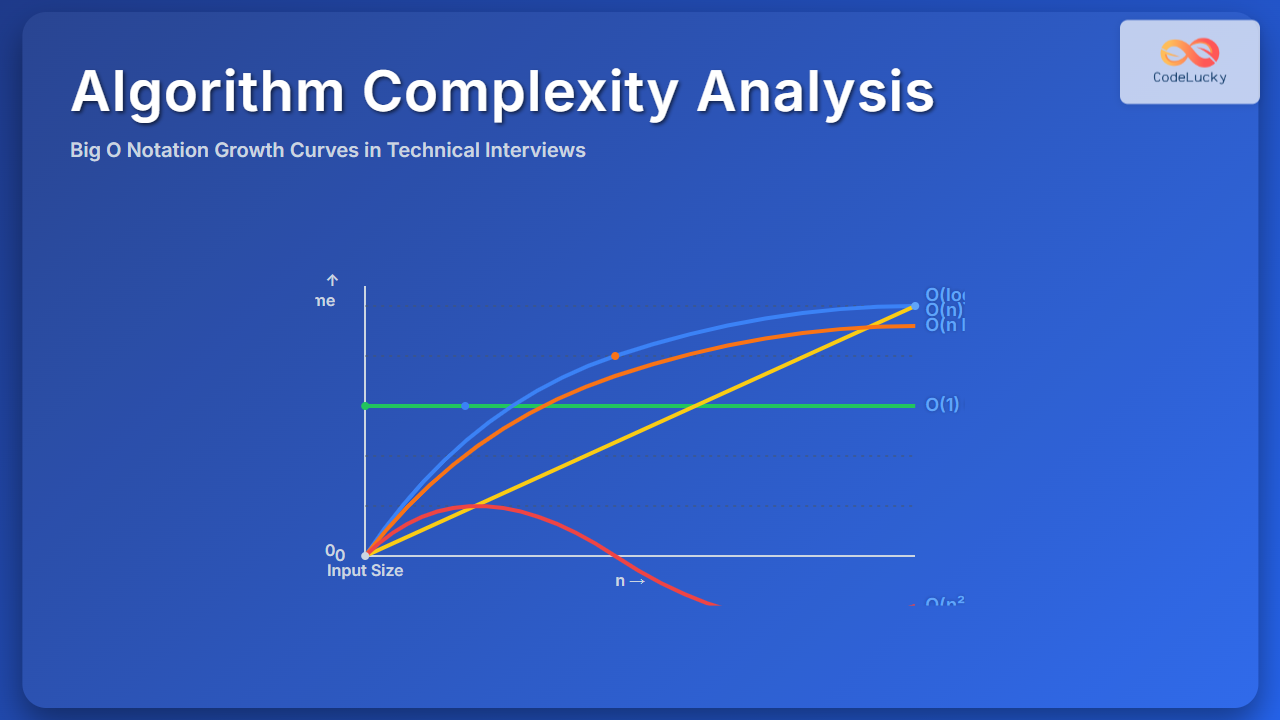
The classical matrix multiplication for two matrices A and B each of size n x n performs n³ scalar multiplications, iterating through rows and columns in a triple nested loop. This cubic complexity limits performance for large-scale applications.
Strassen’s method improves upon this by reducing the number of multiplications at the cost of additional additions and subtractions. The algorithm achieves a complexity of approximately O(n^2.81), making it asymptotically faster.
Intuition: Divide and Conquer
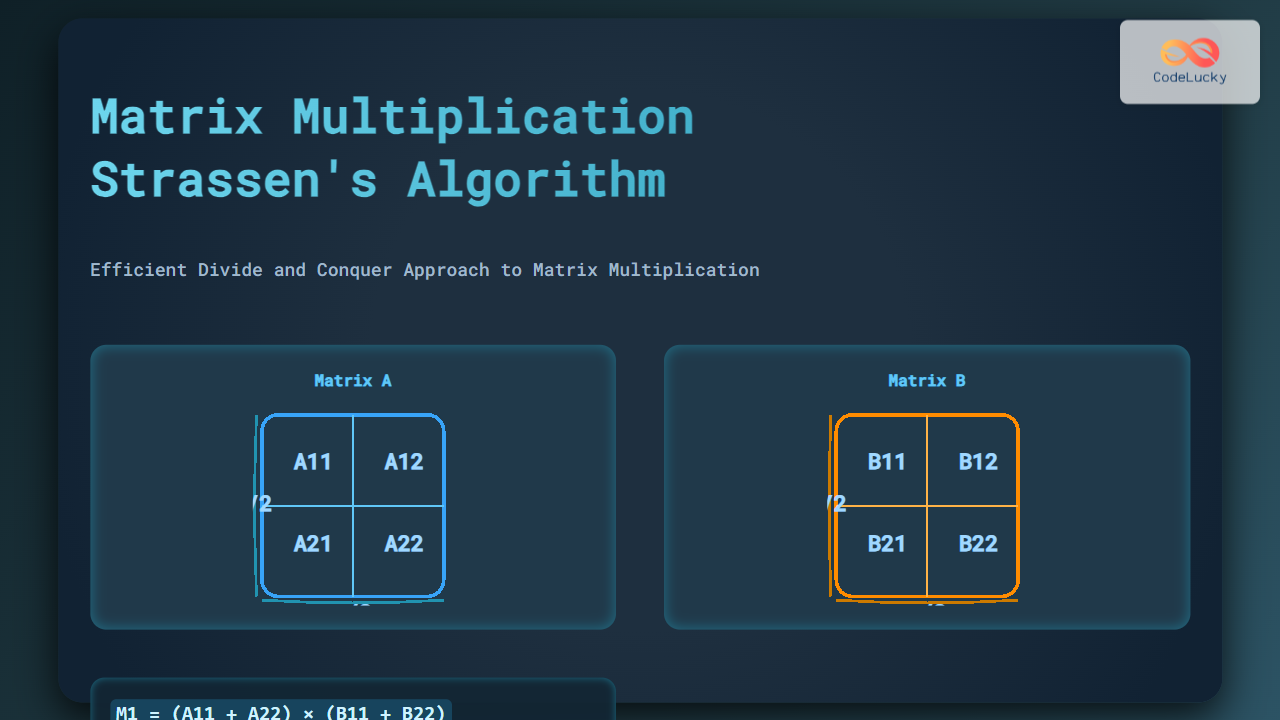
Strassen’s algorithm splits each matrix into four equal-sized submatrices:

Each of these submatrices has size n/2 x n/2. Instead of performing 8 recursive multiplications (like the naive divide-and-conquer approach), Strassen found a way to calculate the product using only 7 multiplications through a clever combination of additions and subtractions.
Step-by-Step Algorithm
For two input matrices A and B split as:
A = | A11  A12 |
    | A21  A22 |

B = | B11  B12 |
    | B21  B22 |
Strassen’s algorithm computes seven products M1 through M7:
M1 = (A11 + A22) × (B11 + B22)M2 = (A21 + A22) × B11M3 = A11 × (B12 − B22)M4 = A22 × (B21 − B11)M5 = (A11 + A12) × B22M6 = (A21 − A11) × (B11 + B12)M7 = (A12 − A22) × (B21 + B22)
The resulting submatrices of the product matrix C are computed as:
C11 = M1 + M4 − M5 + M7C12 = M3 + M5C21 = M2 + M4C22 = M1 − M2 + M3 + M6
Example: Multiplying 2×2 Matrices
Consider:
A = |1  3|
    |7  5|

B = |6  8|
    |4  2|
Split matrices into sub-blocks (each element is itself a 1×1 matrix):
A11=1, A12=3, A21=7, A22=5B11=6, B12=8, B21=4, B22=2
Compute the 7 products:
M1 = (1 + 5) × (6 + 2) = 6 × 8 = 48M2 = (7 + 5) × 6 = 12 × 6 = 72M3 = 1 × (8 − 2) = 1 × 6 = 6M4 = 5 × (4 − 6) = 5 × (−2) = −10M5 = (1 + 3) × 2 = 4 × 2 = 8M6 = (7 − 1) × (6 + 8) = 6 × 14 = 84M7 = (3 − 5) × (4 + 2) = (−2) × 6 = −12
Calculate result submatrices:
C11 = 48 + (−10) − 8 + (−12) = 18C12 = 6 + 8 = 14C21 = 72 + (−10) = 62C22 = 48 − 72 + 6 + 84 = 66
So, multiplication product:
C = |18  14|
    |62  66|
Benefits and Limitations
Benefits:
- Reduces the number of recursive multiplications from 8 to 7.
- Asymptotically faster — particularly for very large matrices.
- Foundation for many fast matrix multiplication methods.
Limitations:
- More additions and subtractions lead to overhead for smaller matrices, making classical multiplication faster below certain sizes.
- Strassen applies primarily to square matrices with dimensions as powers of two; matrices are often padded to fit.
- Numerical stability can be worse compared to classical multiplication, so precision critical applications may require caution.
Interactive Visualization Concept
To better grasp how Strassen’s algorithm breaks down the multiplication, imagine an interface where two large matrices visually split towards their sub-blocks, recursively visualizing each multiplication and combination step, highlighting the seven recursive multiplications and the final recombination.
This interactive learning tool helps programmers and students see the division and conquer principle in action, clarifying the complexity savings.
Summary
Strassen’s algorithm offers a brilliant example of optimizing a classical problem using divide-and-conquer and algebraic insight. Understanding the submatrix partitions and the seven key multiplications can greatly enhance knowledge about algorithmic efficiency and pave the way to more advanced matrix multiplication techniques.
Consider implementing hybrid approaches: Strassen’s algorithm for large matrices and classical multiplication for base cases to achieve the best performance.