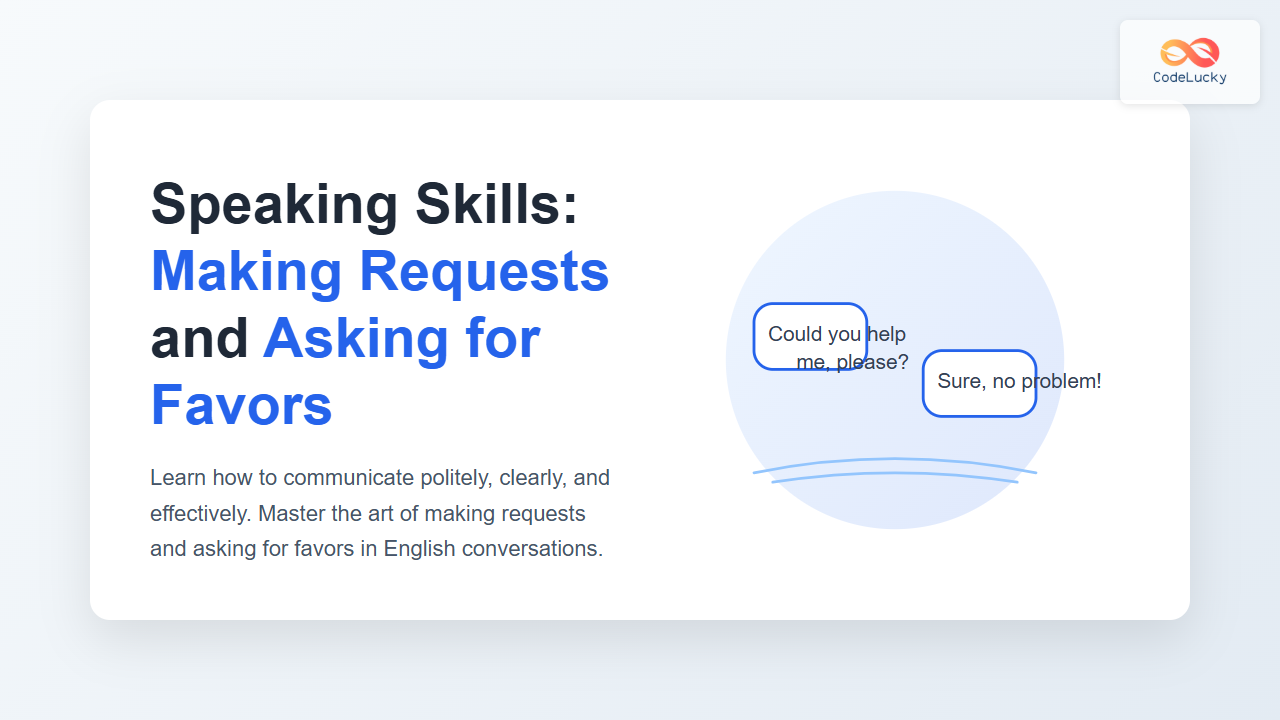
Speaking Skills play a crucial role in effective communication. Among the many areas of spoken English, making requests and asking for favors are essential for both personal and professional interactions. Whether you are talking to friends, colleagues, or strangers, learning how to ask politely can help you sound more confident, respectful, and fluent.
1. Understanding the Difference Between Requests and Favors
Requests are polite ways of asking someone to do something that is typically expected or reasonable.
Favors are personal or special requests that might require extra effort or kindness from the other person.

In simple terms, asking for a request is normal communication – for example, asking someone to pass the salt. Asking a favor feels more personal, like requesting someone to pick you up from the airport.
2. Basic Sentence Structures
Here are some common patterns for making polite requests and asking favors. Each one varies depending on how formal or indirect you want to sound.
| Form | Example | Context |
|---|---|---|
| Can you…? | Can you close the window? | Neutral and common among friends or colleagues. |
| Could you…? | Could you send me the file? | More polite and softens the tone. |
| Would you mind…? | Would you mind helping me with this? | Very polite; used when you want to sound especially courteous. |
| Do you think you could…? | Do you think you could drop me at the station? | Polite and tentative; shows respect for the other person’s time. |
| Would it be possible to…? | Would it be possible to extend the deadline? | Formal and business-like. |
3. Tone and Politeness Levels
The way you make a request depends on your relationship with the listener and the situation. Compare the examples below:
- Direct: “Lend me your pen.” (Sounds bossy)
- Polite: “Could you lend me your pen?” (Respectful)
- Formal: “Would it be possible for me to borrow your pen, please?” (Very courteous, professional setting)

4. Adding Softening Phrases
Softening words make your request sound even more natural and polite. Here are examples:
- “I was wondering if you could…”
- “Would you be able to…”
- “I’d really appreciate it if…”
- “Any chance you could…”
Example: “I was wondering if you could help me with my presentation?” sounds more polite than “Help me with my presentation.”
5. Responding to Requests and Favors
When someone makes a request, your response matters. You can either accept politely or refuse gently.
Accepting a Request
- Sure, no problem!
- Of course, I’d be happy to.
- Absolutely, leave it to me.
Refusing Politely
- I’d love to, but I’m afraid I can’t right now.
- I’m sorry, I have another commitment.
- I wish I could help, but I’m running out of time today.

6. Expressing Gratitude and Appreciation
Always end your request or favor with gratitude. This keeps your communication warm and respectful.
- “Thank you so much for your help.”
- “I really appreciate your time.”
- “That means a lot to me.”
You can even combine appreciation with future cooperation: “Thanks for doing this. Let me know if I can return the favor.”
7. Interactive Practice: Real-Life Dialogue
Try reading this aloud as a mini exercise:
A: Hey, could you help me move this box?
B: Sure! Where do you want it?
A: Just near the table, please. Thanks a lot!
B: No problem—happy to help.
Tip: Practice changing the level of politeness by rephrasing each line. Try saying it formally, then informally, to feel the tone difference.
8. Cultural Notes
In English-speaking cultures, polite requests usually include softeners and modal verbs like could or would. Using direct imperatives (“Do this,” “Give me that”) may sound rude unless it’s between close friends or in emergencies.

9. Common Mistakes to Avoid
- Being too direct – Use modals and polite forms instead.
- Forgetting “please” – This small word makes a big difference!
- Not thanking afterward – Always show appreciation.
- Over-apologizing – Be polite, not overly self-critical.
10. Quick Recap Table
| Scenario | Polite Expression |
|---|---|
| At work | Could you please review my report before 3 PM? |
| With a friend | Hey, any chance you could help me set up my laptop? |
| Customer service | Would it be possible to get a refund, please? |
| Asking a teacher | Would you mind explaining this part again? |
| Requesting permission | Is it okay if I borrow this for a day? |
11. Final Thoughts
Improving your speaking skills for making requests and asking for favors helps you sound more professional, kind, and fluent. It also builds trust and respect in your conversations. Remember to combine politeness, clarity, and gratitude — and practice regularly through roleplays or recordings.
At CodeLucky.com, we believe communication is the key to confidence. Keep practicing, and soon asking for help — or offering it — will feel natural and effortless!