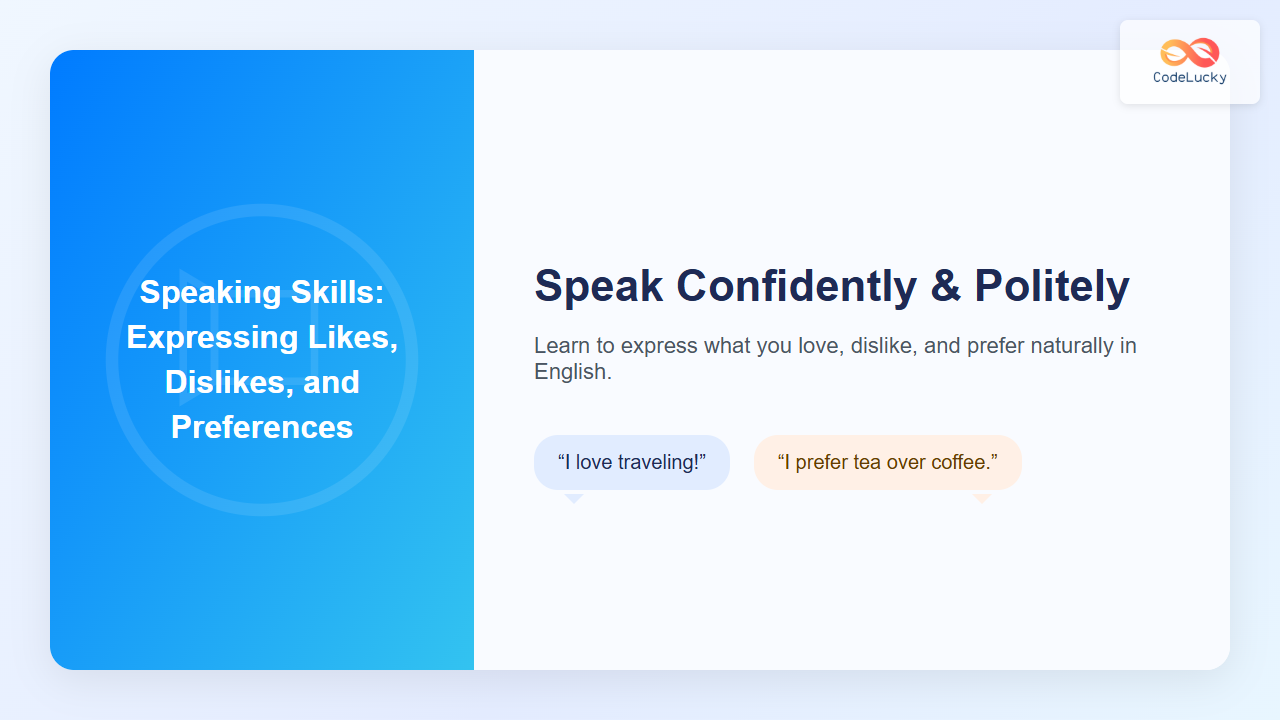
Speaking Skills: Expressing Likes, Dislikes, and Preferences is one of the most essential aspects of everyday conversation in English. Whether you’re talking about food, hobbies, music, or lifestyle, being able to express what you like, dislike, or prefer helps make your speech more natural and personal. This article will guide you step-by-step with clear examples, dialogue patterns, and visual breakdowns.
Why This Skill Matters
When you can talk about your preferences clearly, you communicate your personality and opinions. People connect better when you share your likes and dislikes politely and confidently. It also helps make small talk and new friendships easier, especially in workplaces or social settings where English is the medium of communication.
Common Verbs to Express Likes and Dislikes
Let’s look at some key verbs that help express personal feelings and attitudes:
- Like – shows pleasure or approval (e.g., I like swimming.)
- Love – indicates a strong positive feeling (e.g., I love Italian food.)
- Enjoy – used when expressing pleasure in an activity (e.g., I enjoy reading at night.)
- Prefer – shows choice between options (e.g., I prefer coffee to tea.)
- Hate – expresses a strong negative feeling (e.g., I hate waiting in long queues.)
- Don’t like – milder way to express dislike (e.g., I don’t like loud music.)
Sentence Patterns for Likes and Dislikes
Here are some helpful sentence patterns you can use:
| Expression | Example |
|---|---|
| I like / love / enjoy + verb-ing | I like dancing. |
| I hate / dislike + verb-ing | I dislike waiting for buses. |
| I prefer + noun + to + noun | I prefer tea to coffee. |
| I’m fond of / keen on + verb-ing | I’m fond of painting. |
| I’m not crazy about + noun | I’m not crazy about spicy food. |
How to Make It Sound Polite
When expressing dislikes, it’s important to sound polite, especially in professional or social settings. Instead of being too direct, use phrases that soften your tone:
- “I’m not a big fan of …”
- “I don’t really enjoy …”
- “It’s not my favorite.”
Visual Expression Flow
The following diagram explains how you can structure your thoughts when expressing preferences in English conversation:
Examples in Real Conversations
Example 1: Likes and Dislikes
A: Do you like playing football?
B: Yes, I love it! It keeps me active.
A: What about cricket?
B: I’m not really into cricket. It’s too long for me.
Example 2: Expressing Preferences
A: Would you like coffee or tea?
B: I’d prefer coffee, please.
A: With milk or black?
B: Black coffee is perfect for me.
Example 3: Group Discussion
A: Which season do you like the most?
B: I prefer winter. It’s peaceful and not too hot.
C: Really? I love summer because I can go swimming often.
A: I dislike the summer heat, personally.
Grammar Tip
After verbs like like, love, enjoy, dislike, hate, use the -ing form of the verb, not the infinitive (to + verb):
- ✔ I like swimming. (Correct)
- ✖ I like to swim. (Also acceptable in some cases, but less natural in conversation)
Interactive Practice
Try this quick practice activity on your own:
- Write five sentences about what you like doing on weekends.
- Write three polite ways to say you don’t enjoy something.
- Compare two things you prefer and explain why.
Example answer format:
I like watching movies on weekends. I prefer action films to romances because they are exciting. However, I’m not a big fan of horror movies — they scare me!
Visual Map of Expressions
Here’s another visual breakdown showing how you can move between expressing like, dislike, and preference in context:

Using Comparative Language
You can also combine preferences with comparative or contrastive phrases:
- rather than: I’d rather walk than drive.
- more than: I like coffee more than tea.
- better than: I think reading is better than watching TV.
Visual Sentence Builder

Polite vs. Direct Tone Comparison
| Direct Expression | Polite Expression |
|---|---|
| I hate pizza. | I’m not really a fan of pizza. |
| I don’t like your idea. | I prefer a different approach. |
| I love movies. | I really enjoy watching movies. |
Practice Activity: Fill the Gaps
Complete the sentences using the verbs like, dislike, prefer, enjoy, love:
- I ______ listening to music in the car.
- I ______ tea to coffee.
- I don’t ______ waking up early.
- I ______ cooking new dishes.
- I ______ staying at home during weekends.
Key Takeaways
- Use like/love/enjoy for positive feelings and don’t like/hate for negatives.
- Use prefer and would rather for showing choices.
- After these verbs, the -ing form is usually required.
- Politeness can make your opinion sound more natural.
Final Visual Summary

Learning how to express likes, dislikes, and preferences fluently helps you sound more confident, natural, and engaging in English. Practice these patterns daily by talking about your daily routine, hobbies, and food choices. The more you practice, the more spontaneous and expressive your spoken English will become.