Revision: Speaking and Listening Revision Guide is a complete resource for anyone preparing for English communication exams, interviews, or real-world conversations. This guide covers pronunciation, tone, clarity, and listening comprehension strategies with examples and interactive elements you can practice immediately.
Understanding the Importance of Speaking and Listening
Speaking and listening are two sides of effective communication. Speaking develops fluency, confidence, and persuasive power, while listening ensures comprehension and empathy. Together, they form the backbone of everyday interactions, professional interviews, and academic discussions.

Section 1: Key Areas to Revise in Speaking
1. Pronunciation and Accent Clarity
Focus on the clarity of sounds and syllable stress. Mispronunciation can change meaning entirely. For instance, “desert” (dry land) and “dessert” (sweet dish) differ only in stress placement.
Example:
Word: "Record"
Noun: REcord → I bought a REcord.
Verb: reCORD → Please reCORD the song.
2. Tone and Intonation
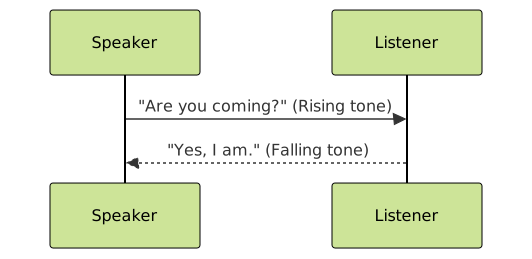
Intonation helps express mood and attitude. Rising tones usually indicate questions, while falling tones mark statements.
3. Fluency and Vocabulary Variety
Avoid fillers like “um,” “like,” or “you know.” Build fluency with topic-focused word lists and practice using them in context.
- Topic: Travel → words like “itinerary,” “destination,” “journey.”
- Topic: Technology → words like “innovation,” “artificial,” “platform.”
4. Interactive Speaking Practice
Try this quick exercise: Record yourself describing your morning routine for one minute. Then listen and note any pauses, unclear words, or repeated phrases. Adjust and rerecord for self-evaluation.
Section 2: Key Areas to Revise in Listening
1. Listening for Gist and Details
Train your ear to catch both the main idea and specific information. For example, if the audio says:
“The conference will start at 10 AM, followed by workshops at noon.”
Gist: It’s about an event schedule.
Detail: Conference time and workshop time matter for comprehension.
2. Recognizing Speaker Intent
Pay attention to context clues, tone, and key phrases. A polite question like “Could you open the window?” is actually a request, not a literal query.

3. Listening to Different Accents
Expose yourself to English accents from different regions — British, American, Indian, or Australian. Real-world communication involves diverse pronunciations. Platforms like YouTube or podcasts are great for this.
4. Interactive Listening Practice
Use a two-step self-check method:
- Listen to a 1-minute English clip (news or podcast).
- Summarize it in your own words in under 3 sentences.
Section 3: Combining Speaking and Listening for Real Conversations
Effective speakers are often empathetic listeners. Real conversations demand a smooth exchange of messages—speaking clearly while interpreting responses accurately.

Example Dialogue
Scenario: Ordering food at a café

Customer: Hi, could I have a cappuccino, please?
Barista: Sure! Would you like it hot or iced?
Customer: Hot, please. And maybe a small cookie too.
Barista: Coming right up!
Tip: Notice politeness markers (“could I,” “please”) and natural responses.
Section 4: Common Mistakes to Avoid
- Speaking too fast without clarity.
- Translating thoughts directly from your first language.
- Ignoring body language and tone support.
- Passive listening—failing to ask clarifying questions.
Section 5: Revision Checklist
Before exams or online interviews, practice with this quick checklist:
- ✅ Can I pronounce key vocabulary naturally?
- ✅ Can I express opinions clearly?
- ✅ Do I pause for understanding while listening?
- ✅ Can I paraphrase what others said correctly?
Section 6: Mini Practice Exercises
Exercise 1 – Quick Pronunciation Drill
Pair the words:
Live (verb) ↔ Live (adjective)
Wind (noun) ↔ Wind (verb)
Lead (verb) ↔ Lead (metal)
Exercise 2 – Listening Understanding
Listen to any short English speech clip. Afterward, answer:
- Who is speaking?
- What is the main message?
- What keywords were repeated?
Conclusion
Speaking and listening are dynamic, evolving skills that grow with consistent practice. This Speaking and Listening Revision Guide offers structured strategies, exercises, and examples to help learners prepare effectively for exams, interviews, and daily real-world communication.
Whether you’re a student, professional, or English enthusiast, build a daily routine: listen consciously, speak confidently, and reflect thoughtfully.