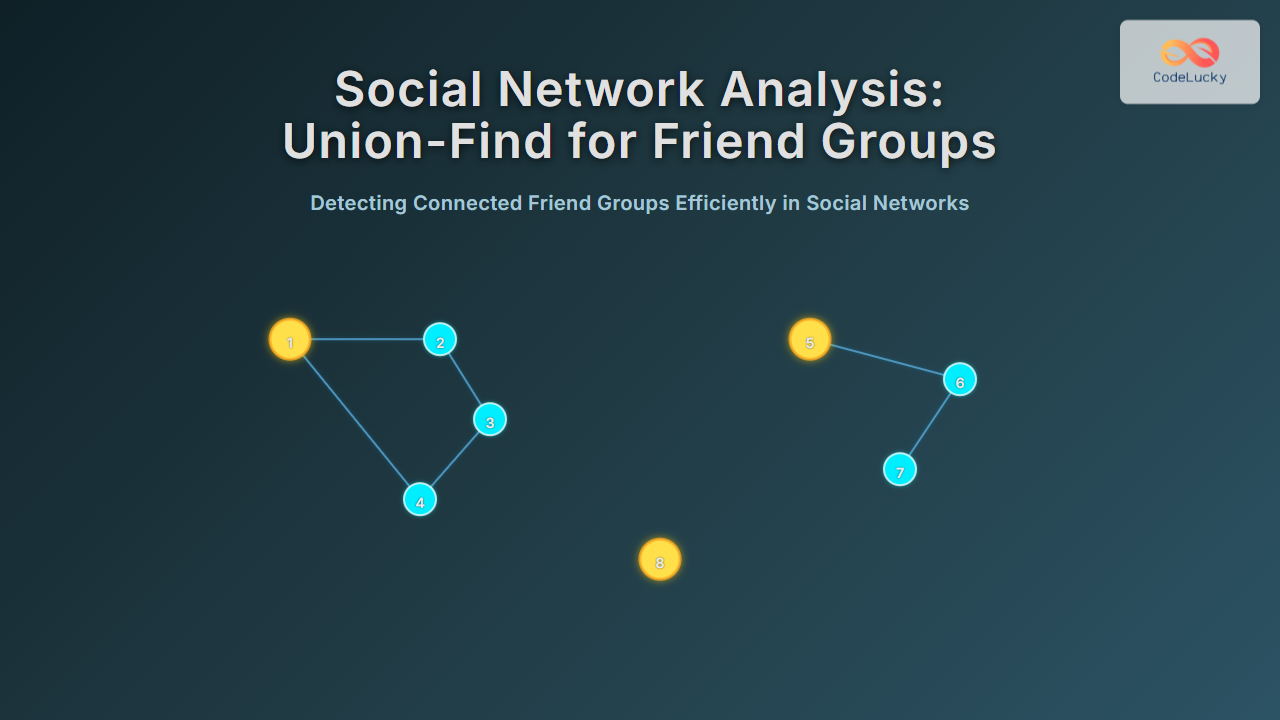
In the realm of social network analysis, understanding how to efficiently identify friend groups within a large network is vital. One of the most powerful and intuitive algorithms for this task is the Union-Find algorithm, also called the Disjoint Set Union (DSU) structure. This article dives deeply into the concept and application of Union-Find to detect friend groups, providing clear examples and valuable visual explanations using mermaid diagrams.
Understanding the Problem: Friend Groups in Social Networks
Social networks consist of individuals connected by relationships such as friendships, follows, or interactions. A fundamental problem is to find all distinct friend groups— clusters where everyone is connected directly or indirectly through mutual friends. For instance, if Alice and Bob are friends, and Bob and Carol are friends, then Alice, Bob, and Carol form one friend group. Efficiently identifying these groups in vast networks requires an algorithm designed to handle dynamic connectivity queries.
What is the Union-Find Algorithm?
The Union-Find algorithm is a classical data structure used to keep track of a partition of a set into disjoint subsets, supporting two operations efficiently:
- Find: Determine which subset a particular element belongs to.
- Union: Merge two subsets into a single subset.
These operations allow us to dynamically and efficiently maintain connectivity information—exactly what is needed to maintain friend groups as new friendship links form.

How Union-Find Works Step-by-Step
When applying Union-Find to social networks for friend groups, each person is initially in their own group. As friendships develop, their groups merge. Here’s a breakdown:
- Initialization: Each person is their own parent, representing their own group.
- Union Operation: When two friends become connected, merge their groups by linking their parents.
- Find Operation: Quickly find the group leader or root parent of a friend to check their group membership.

Example: Detecting Friend Groups Using Union-Find
Consider a social network of 6 people (IDs 1 to 6) with following friendships:
- 1 & 2
- 2 & 3
- 4 & 5
- 5 & 6
Applying Union-Find to find friend groups:
// Initialize Union-Find for 6 people
parent = [0,1,2,3,4,5,6]

function find(x):
    if parent[x] != x:
        parent[x] = find(parent[x])
    return parent[x]

function union(a,b):
    rootA = find(a)
    rootB = find(b)
    if rootA != rootB:
        parent[rootB] = rootA

union(1, 2) // Merge group of 1 and 2
union(2, 3) // Merge group with 3
union(4, 5) // Merge group of 4 and 5
union(5, 6) // Merge group with 6

// Check groups by finding root parents
groups = {}
for i in range(1,7):
    root = find(i)
    groups[root] = groups.get(root, []) + [i]

print(groups)
The output friend groups might look like this:
{1: [1, 2, 3], 4: [4, 5, 6]}This shows two friend groups: one composed of persons 1, 2, 3 and the other composed of 4, 5, 6.

Interactive Visualization of Union-Find Merging
The dynamic nature of Union-Find is often best understood interactively, but within static articles, stepwise explanations clarify the process. When a union occurs, one group’s root pointer is updated to the other’s root, effectively merging the sets. The find operation uses path compression to speed up future queries by pointing nodes directly to their root.
Time Complexity and Efficiency
Union-Find operations execute in near constant time, specifically \(O(\alpha(n))\), where \(\alpha\) is the inverse Ackermann function, which grows extremely slowly and is practically constant for all reasonable input sizes. This efficiency makes Union-Find ideal for large social networks with millions of users and connections.
Advanced Features: Path Compression & Union by Rank
Two common optimizations enhance Union-Find performance:
- Path Compression: During
find, directly attach nodes to the root to flatten the structure. - Union by Rank: When merging, attach the smaller tree under the root of the larger tree to keep trees shallow.
These improve speed and reduce memory overhead, reinforcing Union-Find’s suitability for real-time social network analysis.
Practical Use Cases Beyond Friend Groups
While friend group detection is a prime example, Union-Find also applies to:
- Network connectivity checks
- Image segmentation
- Clustering and component labeling
- Checking redundant connections in networks
Summary
The Union-Find algorithm is a foundational tool in social network analysis for detecting friend groups efficiently. It excels with its simplicity, speed, and capability to handle dynamic connections, supported by enhancements like path compression and union by rank. Whether analyzing small groups or massive social graphs, Union-Find is a reliable algorithmic choice.
Implementing Union-Find can significantly optimize friend group queries, enabling meaningful insights and scalable solutions in social platforms and beyond.