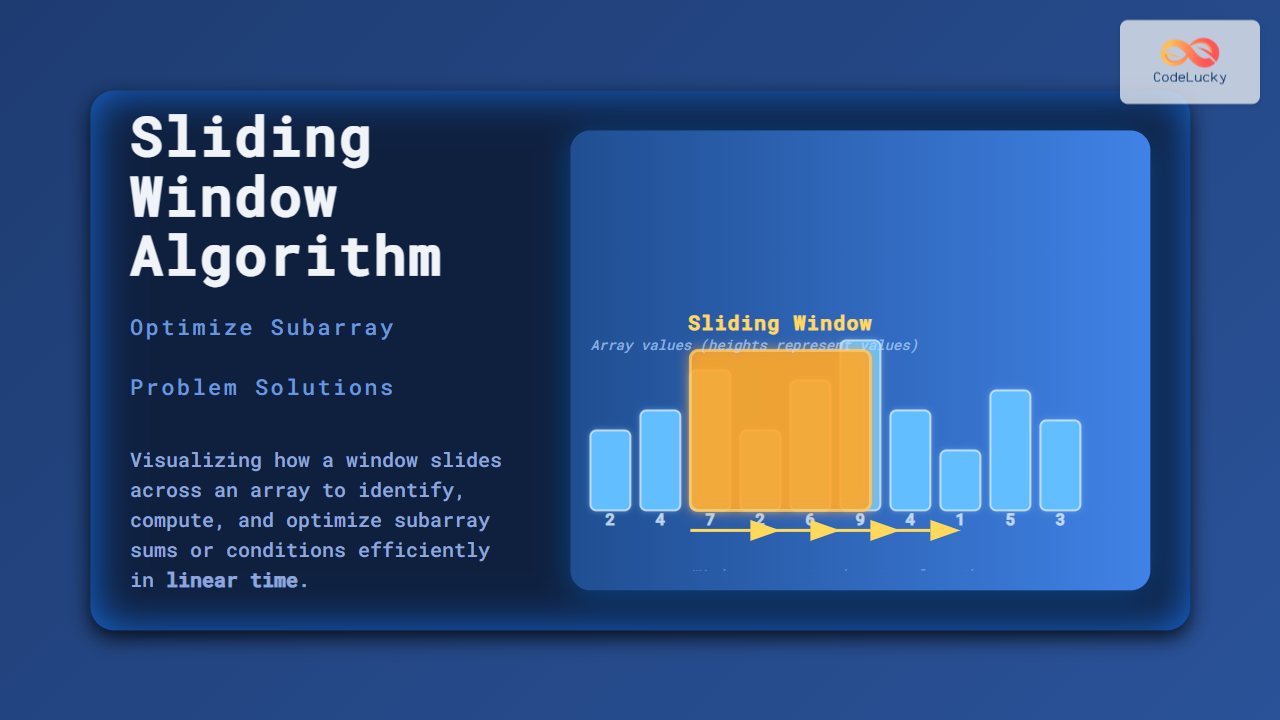
The Sliding Window Algorithm is a powerful technique that helps optimize solutions for array and string problems, especially those involving subarrays or substrings. Instead of recomputing results repeatedly, the algorithm slides a window across the data, reusing previous computations for efficiency. This approach is widely used in coding interviews and competitive programming to solve problems that require finding maximum, minimum, or specific conditions inside a subarray.
Why Use the Sliding Window Algorithm?
Naïve solutions for subarray problems often involve O(n²) computations, checking every possible subarray. Sliding Window reduces this down to O(n) by:
- Maintaining a window of elements that satisfy the condition.
- Reusing the result from the previous window when the window shifts.
- Performing constant-time updates at each step instead of recomputing.
Types of Sliding Windows
There are two main types of Sliding Window techniques:
- Fixed-Size Sliding Window: Window always maintains a fixed length, like finding the maximum sum of
kelements. - Variable-Size Sliding Window: Window expands and contracts dynamically, like finding the smallest subarray with sum at least
S.

Example 1: Maximum Sum of Subarray of Size K
Problem: Given an array of integers and a number k, find the maximum sum of any contiguous subarray of size k.
def max_sum_subarray(arr, k):
    n = len(arr)
    window_sum = sum(arr[:k])
    max_sum = window_sum

    for i in range(k, n):
        window_sum += arr[i] - arr[i-k]  # Slide window
        max_sum = max(max_sum, window_sum)

    return max_sum

# Example
arr = [2, 1, 5, 1, 3, 2]
k = 3
print("Maximum sum:", max_sum_subarray(arr, k))
Output:
Maximum sum: 9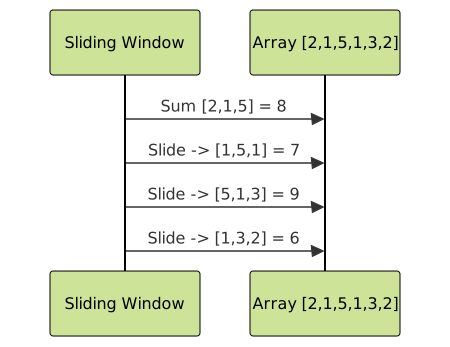
Example 2: Smallest Subarray With Sum ≥ S
Problem: Given an array of positive integers and a number S, find the length of the smallest contiguous subarray whose sum is at least S.
def min_subarray_len(target, arr):
    start, window_sum = 0, 0
    min_len = float("inf")

    for end in range(len(arr)):
        window_sum += arr[end]

        while window_sum >= target:
            min_len = min(min_len, end - start + 1)
            window_sum -= arr[start]
            start += 1

    return 0 if min_len == float("inf") else min_len

# Example
arr = [2, 3, 1, 2, 4, 3]
S = 7
print("Minimum length:", min_subarray_len(S, arr))
Output:
Minimum length: 2
Interactive Example: Sliding Window Simulation
Here is a simple interactive simulation in Python to visualize how the window slides and updates:
def sliding_window_visual(arr, k):
    n = len(arr)
    window_sum = sum(arr[:k])
    print(f"Initial Window: {arr[:k]} -> sum = {window_sum}")

    for i in range(k, n):
        window_sum += arr[i] - arr[i-k]
        print(f"Window: {arr[i-k+1:i+1]} -> sum = {window_sum}")

sliding_window_visual([2, 1, 5, 1, 3, 2], 3)
Output:
Initial Window: [2, 1, 5] -> sum = 8
Window: [1, 5, 1] -> sum = 7
Window: [5, 1, 3] -> sum = 9
Window: [1, 3, 2] -> sum = 6
Applications of Sliding Window Algorithm
- String Matching: Finding substrings within larger strings (e.g., anagrams, unique characters).
- Subarray Problems: Max/Min sum, minimum length, average of subarrays.
- Streaming Data: Efficiently processing continuous streams where full recomputation is expensive.
- Dynamic Problems: Managing moving averages, IoT sensor readings, or real-time analytics.
Complexity Analysis
- Time Complexity:
O(n), since each element enters and exits the window once. - Space Complexity:
O(1), as only a few extra variables are needed.
Key Takeaways
- The Sliding Window Algorithm transforms brute-force
O(n²)solutions into efficientO(n)solutions. - It works especially well for problems involving subarrays and substrings.
- Both fixed and variable window strategies cover a wide range of use cases.
- It is a must-know technique for coding interviews and real-world optimization problems.
By mastering the Sliding Window Algorithm, you will be able to optimize subarray and substring problems effectively. Whether it’s finding maximum sums, minimum lengths, or pattern matches, this technique allows you to write elegant, high-performance solutions.