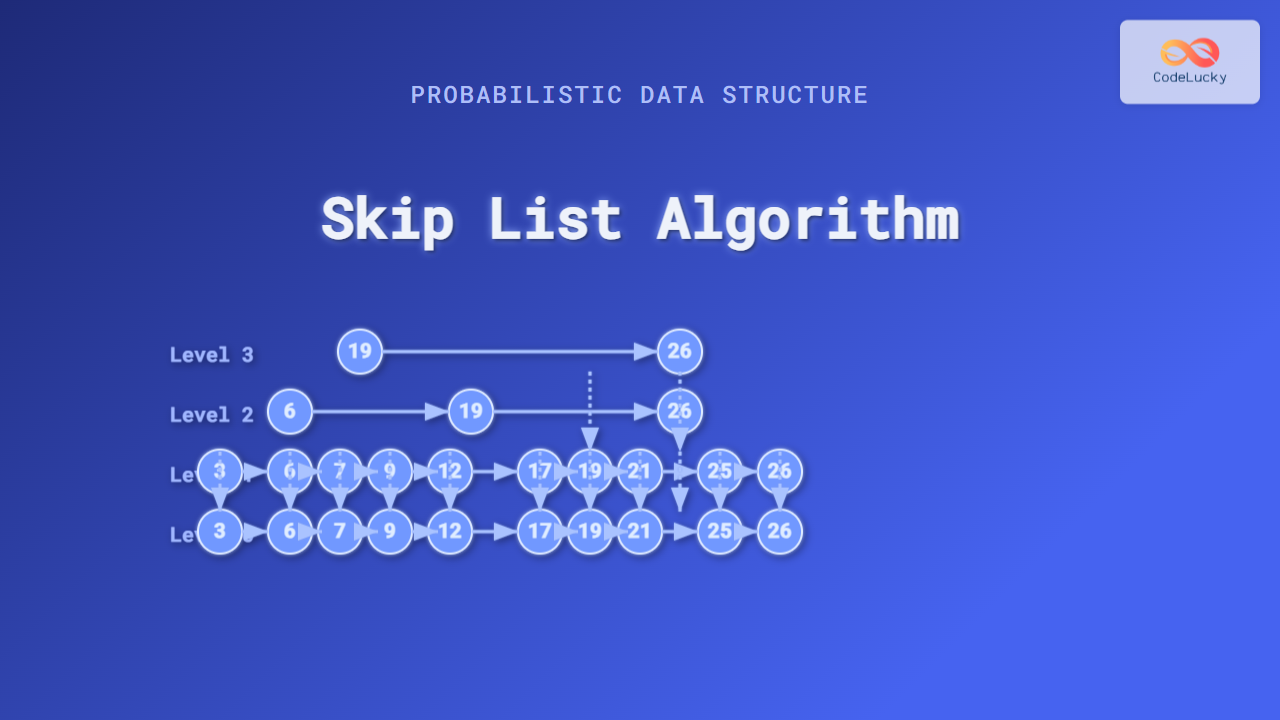
The Skip List is a fascinating and powerful probabilistic data structure that supports fast search, insertion, and deletion operations in an ordered sequence of elements. Developed by William Pugh in 1989, the skip list offers a simple yet efficient alternative to balanced trees like AVL or Red-Black Trees, by leveraging randomness to maintain multi-level linked lists that “skip” through elements for faster traversal.
This article dives deep into the skip list algorithm, illustrating its structure, operational principles, and providing practical examples with clear visualizations and interactive code where appropriate. This detailed guide is crafted for readers ranging from beginners to advanced algorithm enthusiasts and is optimized for SEO to maximize discoverability by developers searching for data structures and algorithms.
Understanding Skip List: What Is It?
A skip list is essentially a layered linked list where each higher layer acts as an express lane to speed up the search process. Instead of traversing the linked list one node at a time, the skip list allows jumping across multiple nodes, significantly reducing the average time complexity for operations.
The key idea: Each element belongs to multiple levels. The bottom-most level is a simple sorted linked list containing all elements. Higher levels contain a subset of the elements, typically selected randomly, providing shortcuts. By “jumping” from one level to another, skip lists achieve efficient logarithmic average search time.

Skip List Components
- Nodes: Each node stores a value and multiple forward pointers, one per level it belongs to.
- Levels: Hierarchical layers indexed from 1 (bottom) to max level (top).
- Probability Factor (p): The fraction determining the likelihood of a node being promoted to a higher level, commonly set to 0.5.
- Head and Tail Sentinels: Special nodes marking the start and the end of lists at all levels.
How Skip List Works: Search, Insert, and Delete
The strength of the skip list lies in the way it performs its fundamental operations—search, insert, and delete—by exploiting the shortcuts provided by multiple levels.
Search Operation
To search for a value:
- Start at the highest level of the head node.
- Traverse forward while the next node’s key is less than the target key.
- If no more forward movement is possible at a level, drop down one level and continue.
- Repeat until the bottom level is reached.
- If the next node matches the target, success; otherwise, not found.

Insert Operation
Insertion involves:
- Finding the position to insert using the search logic and keeping track of path at each level.
- Creating a new node with random level determined by probability
p. - Updating forward pointers at each relevant level to include the new node.
Delete Operation
Deletion mirrors the search operation to locate the node, then updates the forward pointers at each level to exclude the node from the list.
Example Implementation with Visual Output
Below is a concise JavaScript example implementing basic skip list functions with console visualizations of structure after insertions.
class Node {
  constructor(key, level) {
    this.key = key;
    this.forward = new Array(level + 1).fill(null);
  }
}

class SkipList {
  constructor(maxLevel, p) {
    this.maxLevel = maxLevel;
    this.p = p;
    this.level = 0;
    this.header = new Node(null, maxLevel);
  }

  randomLevel() {
    let lvl = 0;
    while (Math.random() < this.p && lvl < this.maxLevel) {
      lvl++;
    }
    return lvl;
  }

  insert(key) {
    let update = new Array(this.maxLevel + 1);
    let current = this.header;

    for (let i = this.level; i >= 0; i--) {
      while (current.forward[i] && current.forward[i].key < key) {
        current = current.forward[i];
      }
      update[i] = current;
    }

    current = current.forward[0];
    if (current == null || current.key !== key) {
      let rLvl = this.randomLevel();

      if (rLvl > this.level) {
        for (let i = this.level + 1; i <= rLvl; i++) {
          update[i] = this.header;
        }
        this.level = rLvl;
      }
      let newNode = new Node(key, rLvl);
      for (let i = 0; i <= rLvl; i++) {
        newNode.forward[i] = update[i].forward[i];
        update[i].forward[i] = newNode;
      }
    }
  }

  printList() {
    for (let i = this.level; i >= 0; i--) {
      let line = "Level " + i + ": ";
      let node = this.header.forward[i];
      while (node) {
        line += node.key + " -> ";
        node = node.forward[i];
      }
      line += "null";
      console.log(line);
    }
  }
}

// Example usage:
const sl = new SkipList(3, 0.5);
sl.insert(3);
sl.insert(6);
sl.insert(7);
sl.insert(9);
sl.insert(12);
sl.insert(19);
sl.insert(17);
sl.insert(26);
sl.insert(21);
sl.insert(25);
sl.printList();
The console output might visualize the list state across levels such as:
Level 3: 19 -> null
Level 2: 6 -> 19 -> 26 -> null
Level 1: 3 -> 6 -> 7 -> 9 -> 12 -> 17 -> 19 -> 21 -> 25 -> 26 -> null
Level 0: 3 -> 6 -> 7 -> 9 -> 12 -> 17 -> 19 -> 21 -> 25 -> 26 -> null
Why Use Skip Lists? Advantages and Applications
- Probabilistic balancing: Skip lists maintain balance through randomness, avoiding complex rebalancing required by trees.
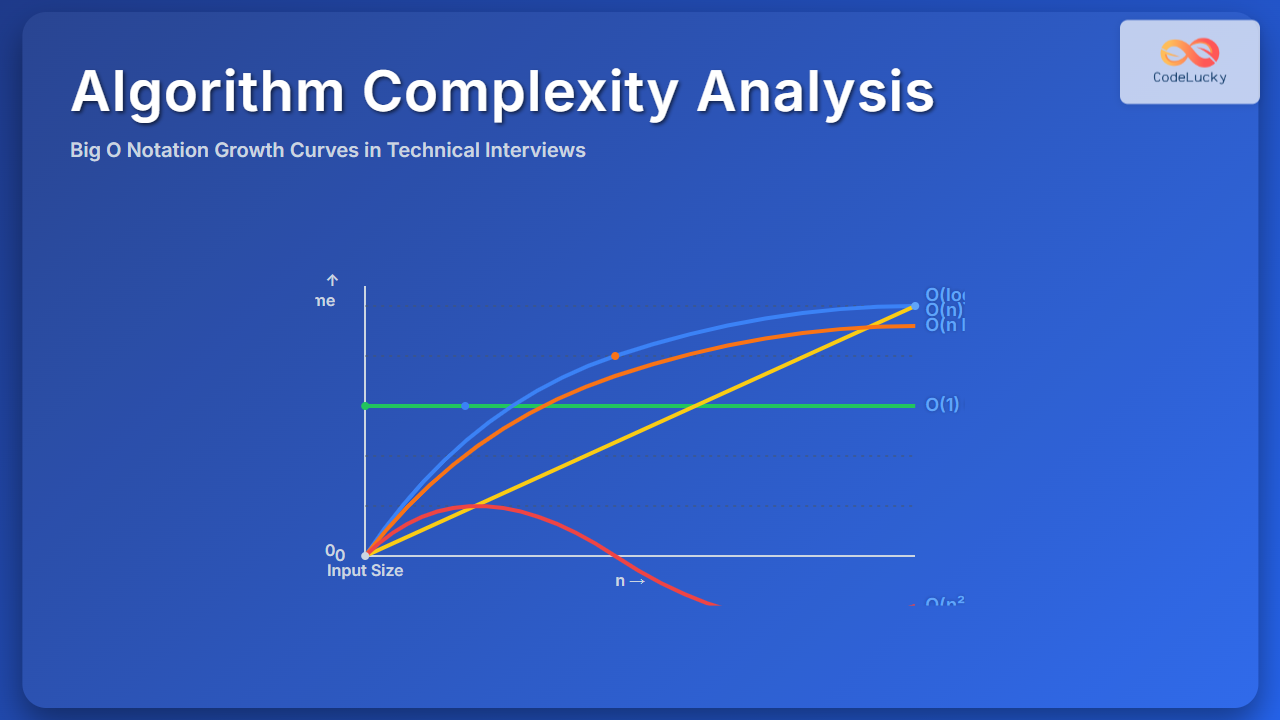
- Fast average operations: Search, insert, and delete achieve average time complexity of O(log n).
- Simple implementation: Easy to understand and implement compared to balanced trees.
- Concurrent-friendly: Suitable for concurrent access scenarios with lower locking complexity.
Summary
The Skip List algorithm is a compelling probabilistic data structure that provides an elegant and efficient way to handle dynamic ordered collections. Its layered approach dramatically speeds up operations by introducing shortcuts through multiple representing levels. The probabilistic nature makes it simpler to maintain than strict balancing trees while still offering comparable performance on average.
By understanding the structure, core operations, and implementing examples with clear visual representations, developers unlock another powerful tool for building performant data systems with balanced complexity.