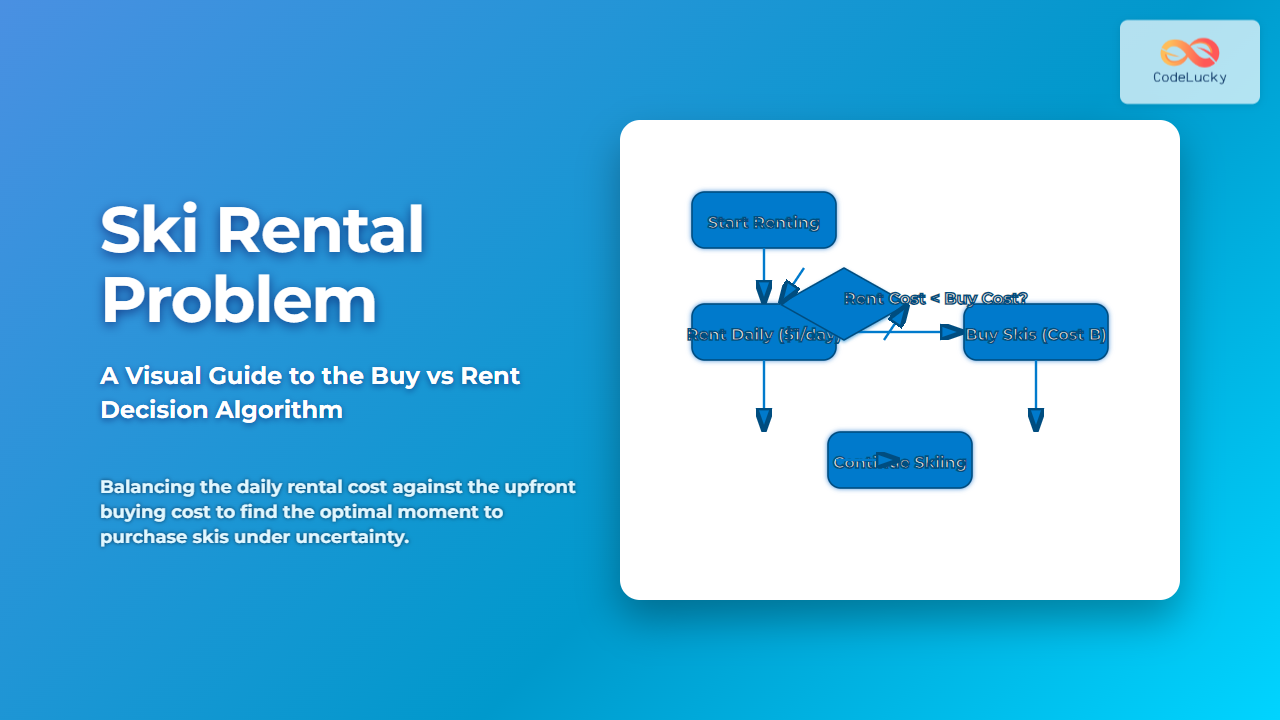
The Ski Rental Problem is a classic example in computer science and algorithm design that models the trade-off between renting and buying an item when future usage is uncertain. This problem is an archetype of online algorithms and forms a foundation for understanding competitive analysis, decision making under uncertainty, and cost optimization.
This detailed article unpacks the ski rental problem, explains the fundamental algorithm to decide when to buy versus rent, and provides clear examples and visual explanations, including mermaid diagrams for conceptual clarity. Interactive code samples are included to demonstrate the algorithm’s application dynamically.

Understanding the Ski Rental Problem
The problem can be formulated as follows: A skier needs skis but doesn’t know how many days they will ski. Renting skis costs a fixed amount r per day, and buying skis costs a one-time fee B (where B > r). The goal is to minimize the total cost without prior knowledge of the number of ski days.
In simpler terms:
- Rent cost per day: $1 (normalized for explanation)
- Buying cost: $B (greater than 1)
- Unknown total ski days:
D(unpredictable)
The dilemma is: Should the skier rent skis every day, or buy immediately, or rent for some days then buy? The optimal decision depends on balancing the cost of accumulating rental fees against the upfront cost of buying.
Classical Optimal Offline Solution
If the number of ski days D was known upfront, the decision is trivial:
- If
D \times r < B, then rent every day. - If
D \times r \geq B, then buy immediately.
However, when D is unknown (online scenario), the problem becomes a classic online algorithm scenario.
Online Algorithm for Ski Rental Problem
The well-known and widely studied online solution is:
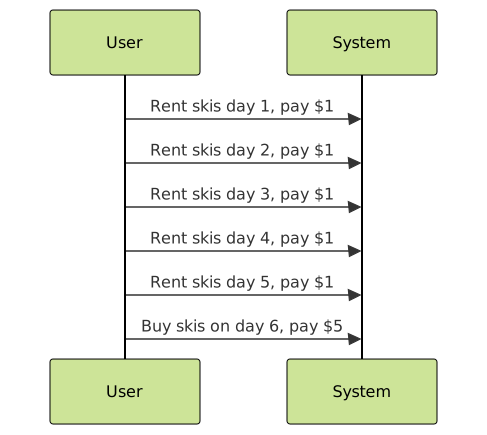
Rent skis every day until the total rental cost equals the buying cost B.
Then buy skis at once.
So if the buy cost is $B = 5, you rent for 5 days paying $1 each day, and if you still need skis on the 6th day, you buy for $5. This strategy balances the risk without knowing D.
Competitive Ratio Analysis
The efficiency of an online algorithm is often measured by competitive ratio, the worst-case ratio between the online algorithm’s cost and the optimal offline algorithm’s cost.
For the ski rental problem:
- The competitive ratio of this rental-then-buy algorithm is exactly 2 – \(\frac{1}{B}\).
- This means in the worst case, the algorithm costs less than twice the optimal cost.
This competitive ratio is proven to be the best possible for deterministic online algorithms solving the ski rental problem.
Example Scenario
Consider B=10 dollars to buy the skis and rental cost r=1 dollar per day:
| Day | Action | Cost Incurred | Total Cost | Comment |
|---|---|---|---|---|
| 1 to 10 | Rent skis daily | $1 per day | Incrementally from $1 to $10 | Keep renting as total cost < $10 |
| Day 11 | Buy Skis | $10 (one-time) | $20 (10 rent + 10 buy) | Buy after 10 days rented |
| Optimal Offline if D=11 days | Buy at start | $10 | $10 | Actual optimal cost |
Interactive Python Example (Code)
The following code snippet simulates the ski rental decision process interactively, allowing adjustments to the buying cost and number of days:
def ski_rental_simulation(B, total_days):
    cost = 0
    day = 0
    bought = False

    while day < total_days:
        if cost < B:
            cost += 1  # rent cost per day
            day += 1
            print(f"Day {day}: Rent skis, total cost = ${cost}")
        else:
            cost += B  # buy skis
            print(f"Day {day + 1}: Buy skis, total cost = ${cost}")
            bought = True
            break

    if not bought:
        print("Did not need to buy skis within the rental days.")
    else:
        day += 1

    for remaining_day in range(day, total_days):
        print(f"Day {remaining_day + 1}: Using owned skis, total cost = ${cost}")

# Example call
ski_rental_simulation(B=5, total_days=8)
Extensions and Variants
The ski rental problem generalizes to many real-world scenarios where a fixed upfront cost competes with repeated smaller costs:
- Cloud computing: Deciding between on-demand vs reserved instances.
- Car rental vs ownership.
- Subscription vs one-time software purchase.
More complex variants include randomized algorithms improving competitive ratios or multi-option rental/buy costs, but the fundamental principle remains a core foundation in online decision algorithms.

Summary
The Ski Rental Problem elegantly models the buy-vs-rent decision under uncertainty, with a simple but powerful online algorithm that ensures nearly optimal cost performance with minimal information. Implementing and understanding this algorithm provides foundational insight into online algorithms, competitive analysis, and real-world cost optimization problems.
By learning the ski rental problem, one gains a toolset for optimal decision-making strategies applicable across diverse domains where upfront commitment competes with incremental costs.