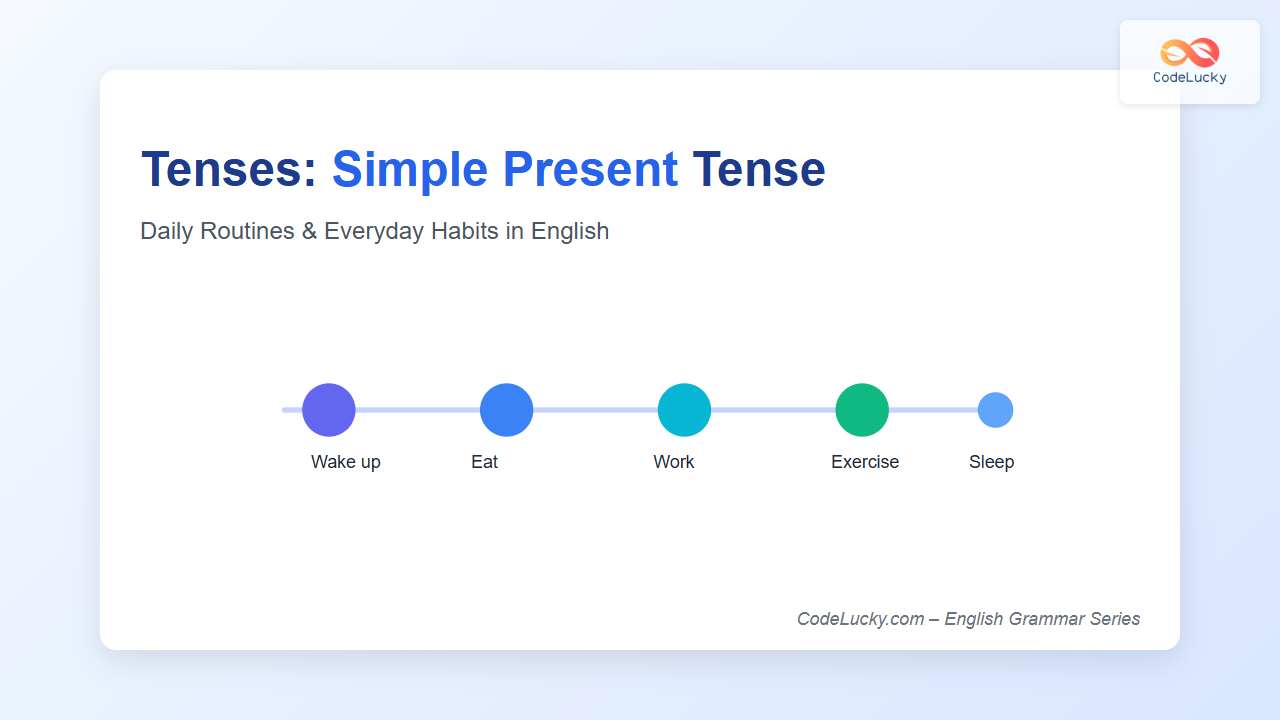
Simple Present Tense is one of the most commonly used tenses in English, especially when talking about daily routines, habits, facts, and general truths. Understanding this tense is key if you want to speak naturally and confidently in everyday conversations.
What is the Simple Present Tense?
The Simple Present Tense describes actions that happen regularly, facts that are always true, and routines we follow every day. It’s often used with adverbs of frequency such as always, usually, often, sometimes, and never.
Formula:
- For most verbs: Subject + Base Verb (+ s/es for third person singular)
- Example: I walk to school every day. / She walks to school every day.
Usage of Simple Present Tense
The tense is used in four main cases:
- Daily Routines or Habits: Actions you do regularly.
Example: I brush my teeth every morning. - General Truths: Facts that are always true.
Example: The sun rises in the east. - Scheduled Events: Future events that are part of a timetable.
Example: The train leaves at 9 PM. - Instructions or Directions: When giving directions or recipes.
Example: Add sugar and stir well.
Examples for Daily Routines
Here are some examples that show how to use the Simple Present Tense in daily life:
| Subject | Verb | Sentence Example |
|---|---|---|
| I | wake up | I wake up at 6 a.m. every day. |
| She | cooks | She cooks breakfast for her family. |
| We | go | We go to work by bus. |
| They | play | They play football in the evening. |
| He | reads | He reads the newspaper before going to bed. |
Visual Explanation of Simple Present Structure
Example: She drinks coffee every morning.
How to Make Negatives
To make a negative sentence, use do not (don’t) or does not (doesn’t) before the base verb.
- I don’t eat breakfast at 10 a.m.
- He doesn’t play guitar on weekdays.
Question Forms
To ask questions in the Simple Present, use do or does before the subject.
- Do you wake up early?
- Does she visit her grandparents on Sunday?

Example: Does he go to the gym every day?
Adverbs of Frequency
These words tell how often an action happens. They are often used with the Simple Present Tense.
- Always (100%)
- Usually (90%)
- Often (75%)
- Sometimes (50%)
- Rarely (20%)
- Never (0%)

Example: I usually take a walk after dinner.
Interactive Exercise
Try filling in the blanks. Practice speaking aloud or writing the correct form of the verb in the Simple Present Tense.
- She _______ (go) to the gym at 7 AM.
- They _______ (watch) TV after dinner.
- He _______ (not/eat) fast food.
- _______ you _______ (play) football on Sundays?
Answers: goes, watch, doesn’t eat, Do / play.
Visualization of Daily Routines Timeline

Common Mistakes
- ❌ He go to school everyday. → ✅ He goes to school every day.
- ❌ She don’t like tea. → ✅ She doesn’t like tea.
- ❌ Do he plays football? → ✅ Does he play football?
Quick Recap
The Simple Present Tense helps describe habits, routines, and truths. Always remember to add -s or -es for third person singular subjects (he, she, it).

Conclusion
Learning the Simple Present Tense is the first major step toward fluent English. It helps you build confidence while describing your daily activities, routines, and general facts. Practice every day using your own sentences like: “I start my day with a smile,” or “She studies English after dinner.”
Explore more grammar lessons on CodeLucky.com to strengthen your English learning journey.