Mastering tenses is one of the most important steps in English learning. Among all tenses, the Simple Past Tense is both fundamental and easy to grasp once you understand its clear structure and usage rules. This article from CodeLucky.com explains everything you need to know about the Simple Past Tense — structure, usage, examples, and a few quick exercises to test your understanding.
What Is the Simple Past Tense?
The Simple Past Tense describes an action that started and finished in the past. It is used when the time of the action is known or implied. It focuses on what happened, not necessarily the duration or continuity of the action.
Example:
- I visited the Taj Mahal last year.
- She watched a movie yesterday.
- They played football in the evening.
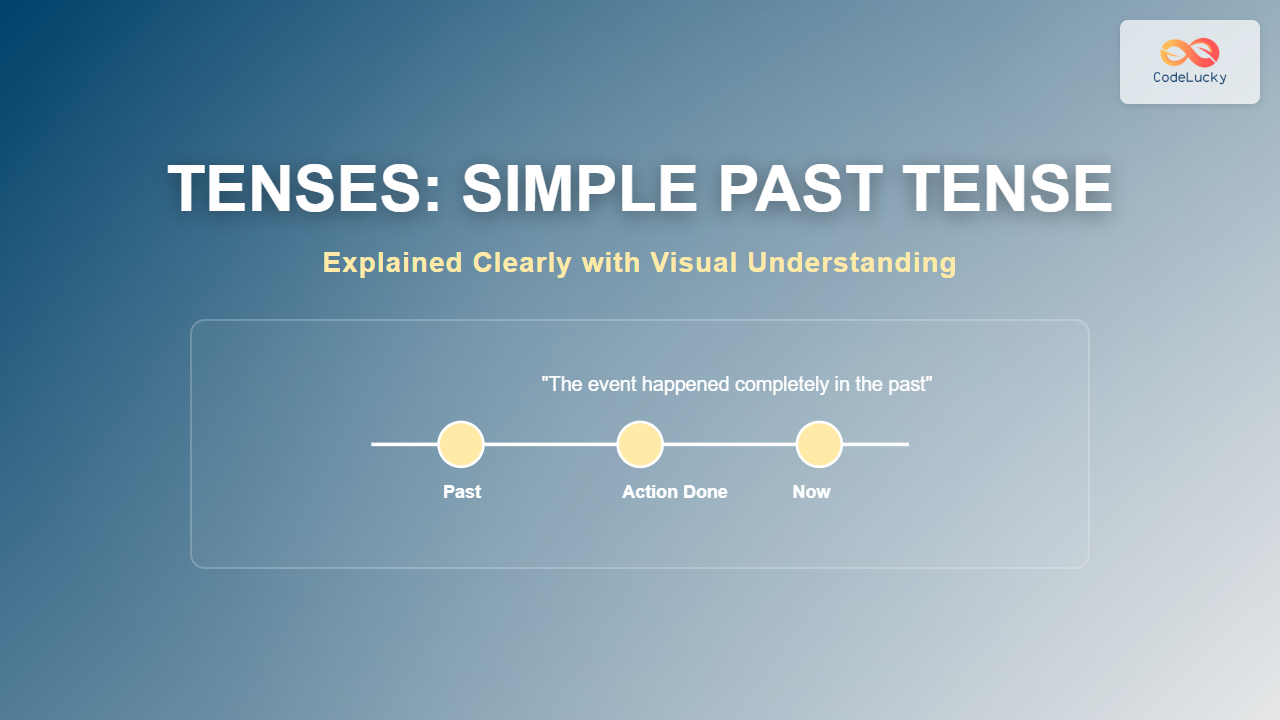
Quick Visual Timeline:

As illustrated above, the action occurs completely in the past and does not continue into the present.
Structure of the Simple Past Tense
The structure varies depending on whether the sentence is affirmative, negative, or interrogative.
1. Affirmative Sentences
Formula: Subject + Verb (past form) + Object
Example:
- He wrote an email.
- They played chess.
2. Negative Sentences
Formula: Subject + did not (didn’t) + Verb (base form) + Object
- He did not write an email.
- They did not play chess.
3. Interrogative Sentences
Formula: Did + Subject + Verb (base form) + Object + ?
- Did he write an email?
- Did they play chess?
Regular and Irregular Verbs
In Simple Past Tense, verbs change their forms to show that the action happened in the past. There are two types of verbs:
Regular Verbs
Regular verbs simply add -ed at the end.
- Play → Played
- Work → Worked
- Dance → Danced
Irregular Verbs
Irregular verbs have unique past forms that do not follow a fixed pattern.
- Go → Went
- Write → Wrote
- Buy → Bought
- See → Saw

When to Use the Simple Past Tense
- Completed actions in the past:
Example: She cooked dinner yesterday. - Series of completed actions:
Example: I finished work, walked home, and took a shower. - Past habits (often with “used to” or “often”):
Example: We played outside every evening. - Definite past time expressions:
Yesterday, two days ago, last night, in 2010, etc.

Common Time Expressions with Simple Past
- Yesterday
- Last night / last week / last month
- Two days ago
- In 1995 / In January
- A moment ago
These time markers clearly indicate that the event is over and belong to the past, which makes them perfect for the Simple Past Tense.
Interactive Exercise: Fill in the Blanks
Complete the sentences with the correct past form of the verbs in brackets.
- I ______ (go) to the park yesterday.
- She ______ (not eat) breakfast this morning.
- ______ you ______ (see) that movie last week?
- They ______ (finish) their homework before 8 PM.
Answers:
- went
- did not eat
- Did you see
- finished
Simple Past Tense vs. Present Perfect
Many learners confuse these two tenses. Here’s a simple comparison:
| Simple Past | Present Perfect |
|---|---|
| Action completed in the past with a specific time. | Action happened in the past but time is unspecified. |
| I visited Paris in 2019. | I have visited Paris. |

Common Mistakes to Avoid
- ❌ I did not went. → ✅ I did not go.
- ❌ He did cooked dinner. → ✅ He cooked dinner.
- ❌ Did she went there? → ✅ Did she go there?
Quick Recap Diagram

Try Creating Your Own Sentences
Choose a verb from below and make sentences in affirmative, negative, and interrogative forms:
- Travel
- Make
- Study
- Buy
- Meet
Example with “Travel”:
- Affirmative: I traveled to Goa last month.
- Negative: I did not travel to Goa last month.
- Interrogative: Did you travel to Goa last month?
Final Thoughts
The Simple Past Tense forms the foundation of English storytelling and communication about events that already happened. Once you understand the structure and practice both regular and irregular verbs, you’ll use it naturally in everyday speech and writing.
Tip: Use timelines and story sequences to make your sentences more vivid, as actions expressed in the past often bring clarity and context to your communication.
Keep visiting CodeLucky.com for more easy-to-understand English learning resources and interactive grammar guides!