Prime numbers are fundamental in computer science, cryptography, and mathematical computations. Efficiently generating prime numbers is crucial, and one of the oldest and most efficient algorithms to achieve this is the Sieve of Eratosthenes. This article dives deep into the algorithm details, with step-by-step examples, visualizations, and practical code demonstrations to master prime number generation.
What is the Sieve of Eratosthenes?
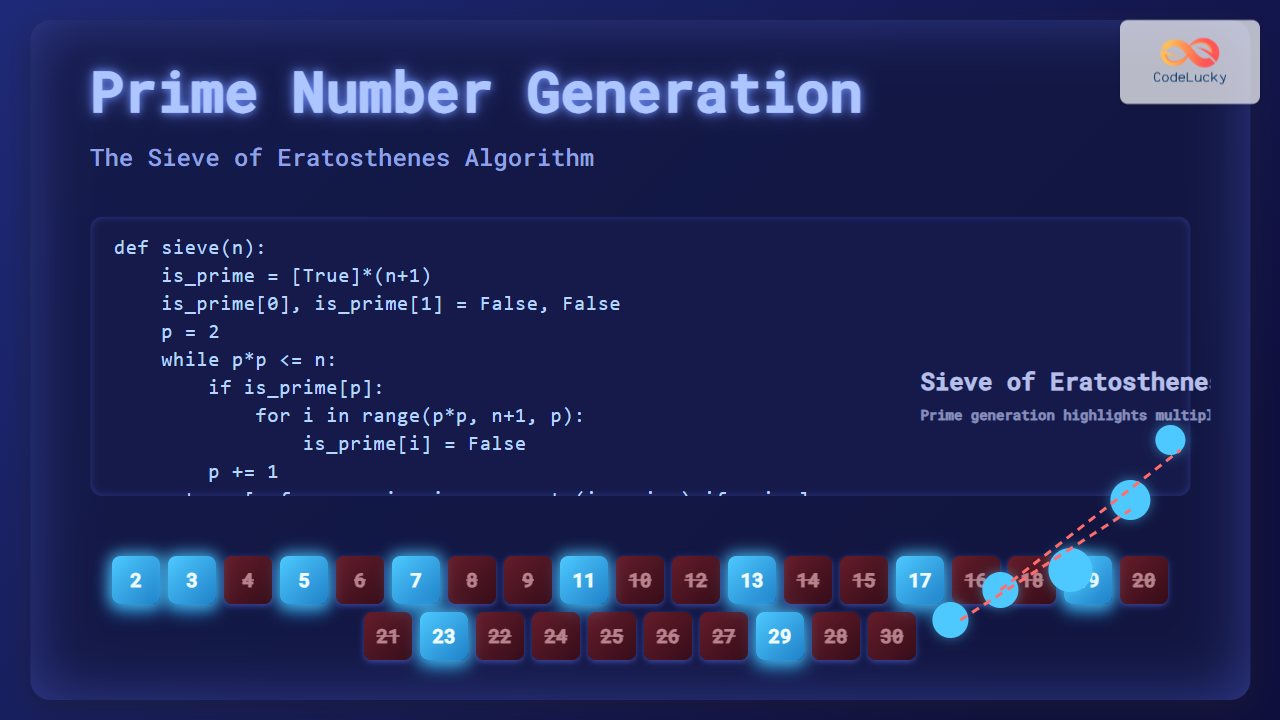
The Sieve of Eratosthenes is an ancient algorithm used to find all prime numbers up to a specified integer n. It systematically eliminates multiples of primes, starting from 2, by marking them as composite (non-prime). The numbers that remain unmarked after this process are primes.

How the Sieve Algorithm Works
Let’s break down the algorithm into simple steps:
- Create a list of consecutive integers from 2 through n.
- Start with the first number, p = 2.
- Mark all multiples of p (2p, 3p, 4p, …) up to n as composite.
- Find the next unmarked number greater than p and assign it as the new p.
- Repeat the process until p squared is greater than n.
- All unmarked numbers in the list are primes.
Example: Finding Primes up to 30
Consider the numbers 2 through 30. We apply the sieve as follows:
| Step | Action | Numbers Marked as Composite | Remaining Unmarked Numbers |
|---|---|---|---|
| Initialization | List numbers 2 to 30 | — | 2,3,4,5,6,7,…,30 |
| p = 2 | Mark multiples of 2 | 4,6,8,10,12,14,16,18,20,22,24,26,28,30 | 2,3,5,7,9,11,13,15,17,19,21,23,25,27,29 |
| p = 3 | Mark multiples of 3 | 6,9,12,15,18,21,24,27,30 (some already marked) | 2,3,5,7,11,13,17,19,23,25,29 |
| p = 5 | Mark multiples of 5 | 10,15,20,25,30 | 2,3,5,7,11,13,17,19,23,29 |
| p = 7 | Mark multiples of 7 (only 49 > 30, stop) | — | 2,3,5,7,11,13,17,19,23,29 |
The remaining unmarked numbers are all prime numbers up to 30.
Visual Explanation of the Algorithm
The prime generation can be visualized as a grid of numbers where composites get crossed out in rounds:

Optimizations to the Sieve
- Start marking multiples from p²: Smaller multiples of p will have been marked by smaller primes.
- Stop at √n: No need to mark multiples for primes greater than √n because their multiples would be out of range.
- Use Boolean arrays: Efficiently track prime status with simple true/false flags.
Python Implementation Example
Below is a Python code snippet implementing the Sieve of Eratosthenes algorithm:
def sieve_of_eratosthenes(n):
    is_prime = [True] * (n+1)
    is_prime[0], is_prime[1] = False, False

    p = 2
    while p * p <= n:
        if is_prime[p]:
            for multiple in range(p * p, n + 1, p):
                is_prime[multiple] = False
        p += 1

    primes = [num for num, prime in enumerate(is_prime) if prime]
    return primes

# Example usage:
primes_up_to_50 = sieve_of_eratosthenes(50)
print(primes_up_to_50)
Output:
[2, 3, 5, 7, 11, 13, 17, 19, 23, 29, 31, 37, 41, 43, 47]Interactive Demonstration Outline
To create an interactive experience on a webpage, visualize the marking of multiples dynamically using JavaScript or a visualization library. This allows users to see the numbers crossed out in real time as the sieve progresses. Implementing this helps deepen understanding.
Time Complexity and Space Complexity
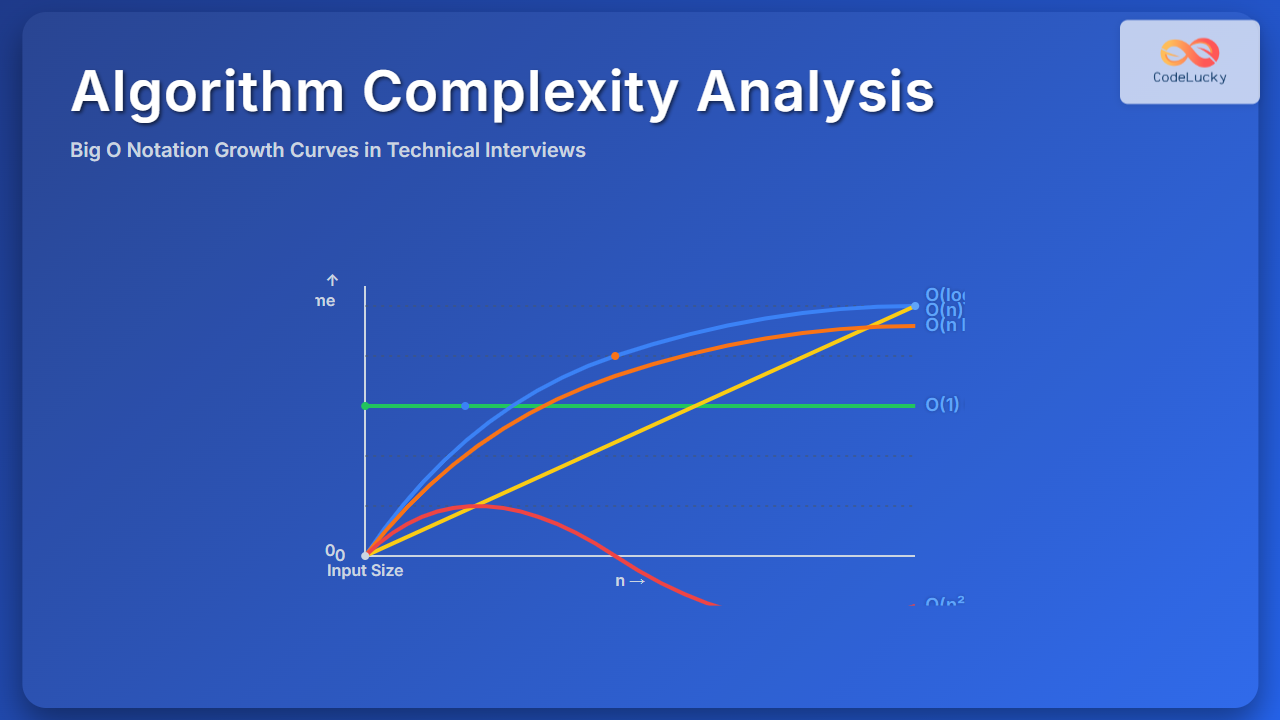
The Sieve of Eratosthenes operates with a time complexity of O(n log log n), which is efficient for generating primes up to large numbers. The space complexity is O(n) for storing the Boolean prime state array.
Applications of the Sieve of Eratosthenes
- Cryptography — generating prime numbers for encryption keys.
- Mathematical computations and proofs involving primes.
- Optimizations in algorithms requiring prime checks.
- Educational tools to teach prime number concepts.
Summary
The Sieve of Eratosthenes remains one of the most elegant and efficient methods for generating primes. This article covered the algorithm’s working principle, optimizations, code examples, and useful visualizations to effectively grasp the concept. For programmers and computer scientists, implementing this sieve is a foundational skill.