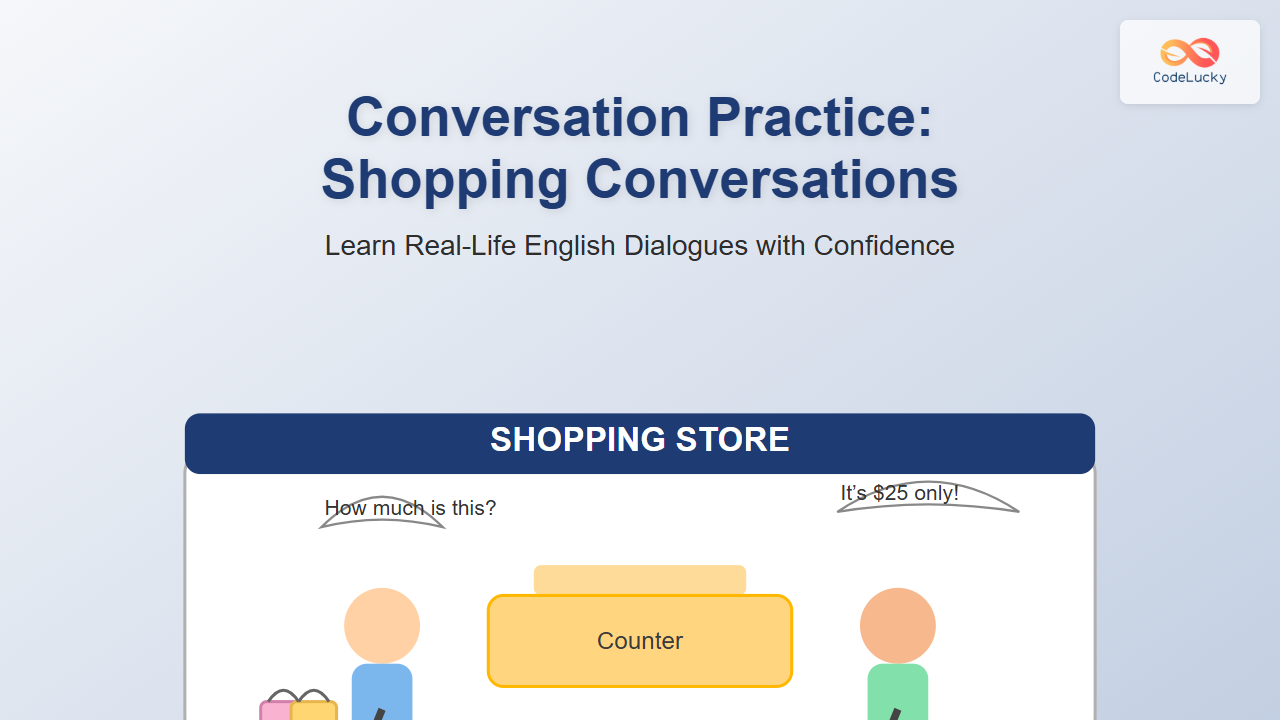
Shopping is one of the most common and useful topics when learning to speak English. Whether you are buying clothes, groceries, or electronics, knowing how to start and continue a conversation in a shop makes daily communication smooth and confident. In this article, you’ll learn essential shopping phrases, see realistic dialogue examples, and even try interactive role-play exercises to strengthen your speaking skills.
Why Practice Shopping Conversations?
Shopping conversations help learners build fluency in practical, real-life settings. You’ll learn how to ask for prices, request help, express preferences, and handle payments—all while using polite and natural English expressions.
- Learn how to start and end conversations politely.
- Understand real-world vocabulary like “receipt,” “cashier,” and “discount.”
- Gain confidence in both physical and online shopping settings.
Common English Phrases Used in Shopping
Below are some everyday expressions you’ll hear during shopping situations:
| Customer | Shop Assistant |
|---|---|
| How much is this? | It costs $20. |
| Can I try it on? | Sure, the changing room is over there. |
| Do you have this in a larger size? | Let me check for you. |
| Can I pay by card? | Yes, we accept all major cards. |
| I’m just looking, thanks. | No problem, take your time. |
Example 1: Buying Clothes
This example helps learners understand polite conversation when purchasing clothing items.
Customer: Excuse me, do you have this shirt in medium size?

Shop Assistant: Yes, we do. Would you like to try it on?

Customer: Yes, please. Where is the fitting room?

Shop Assistant: It’s right at the back.

Customer: Great, thank you! I’ll take it.

Shop Assistant: That will be $25. How would you like to pay?
Expressions to Remember
- “Do you have this in [size/color]?” – to check availability.
- “I’ll take it.” – when you decide to buy.
- “Can I pay by card?” – for asking payment method.
Example 2: Grocery Store Conversation
Useful when you need help finding items or handling checkout interactions.
Customer: Excuse me, where can I find the bread section?

Store Clerk: It’s in aisle three, next to the dairy products.

Customer: Thank you! And do you have any gluten-free bread?

Store Clerk: Yes, it’s on the top shelf in that section.

Customer: Perfect, I’ll take one.
Example 3: Online Shopping Support Chat
With digital shopping increasing, learning such dialogues is equally important.
Customer: Hi, I placed an order yesterday, but I haven’t received confirmation yet.

Support Agent: Can you please share your order ID?

Customer: Sure, it’s 7823AB.

Support Agent: Thank you. I see your order is being processed. You’ll get an email soon.
Interactive Practice: Try Speaking!
You can use this mini exercise for self-practice. Read aloud both roles or practice with a partner.
Situation: You want to buy a pair of shoes. Try saying what you would ask the shop assistant. Example prompts:
- Ask for your size
- Inquire about price
- Ask if there’s a sale
Write your conversation or record yourself reading aloud to improve pronunciation and fluency.
Vocabulary List for Shopping
- Receipt: A paper showing proof of purchase.
- Discount: A reduction in the price.
- Refund: Money returned if you return goods.
- Bargain: A good deal at a lower price.
- Cashier: Person who handles payment.
Mermaid Visualization: Shopping Conversation Flow

Tips for Effective Shopping Communication
- Be polite: Use “please,” “thank you,” and “excuse me.”
- Speak clearly: Articulate words slowly and naturally.
- Ask specific questions: Helps get accurate answers.
- Use gestures: Pointing or showing helps in noisy shops.
- Listen actively: Notice tone and phrasing of shop assistants.
Final Practice Challenge
Imagine you are in an electronics store buying headphones. Write or perform your own conversation using at least five expressions from this article. Practicing daily builds confidence and fluency faster than memorization alone.
Learning to shop in English is more than vocabulary—it’s communication practice in action. Keep exploring new dialogues and real situations to make your English sound natural and confident every time you shop!