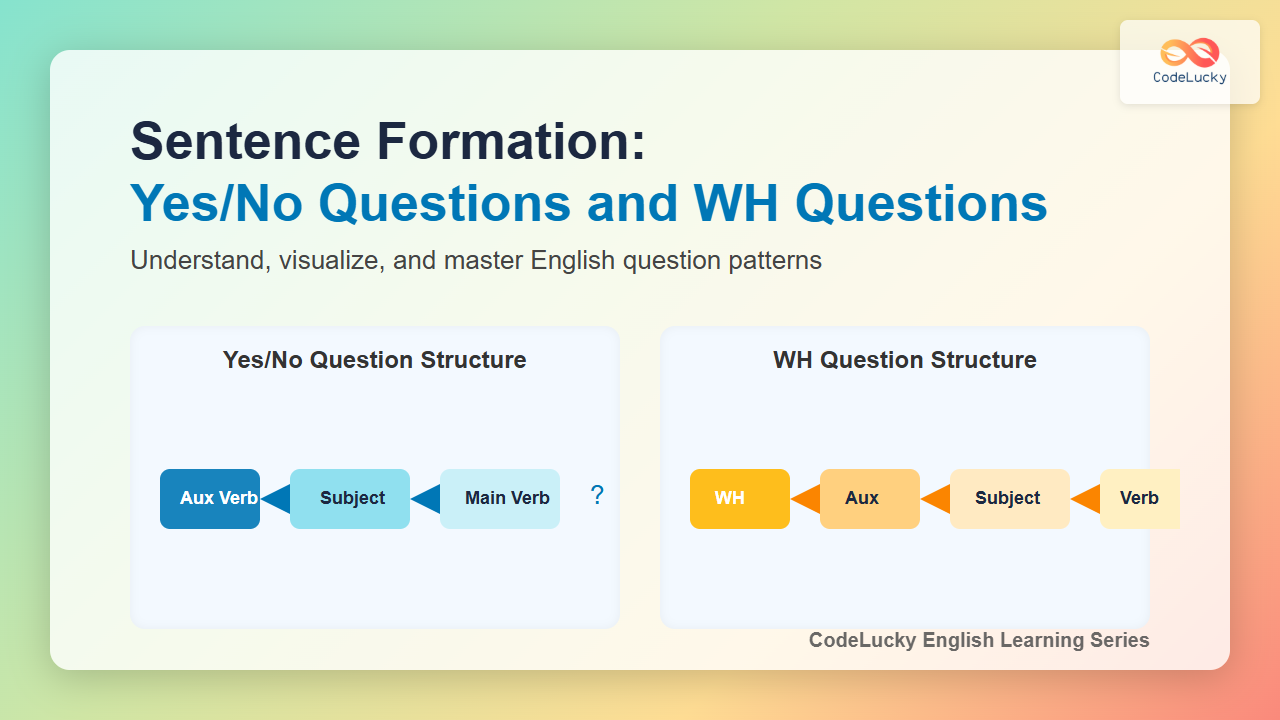
Sentence formation is one of the most essential parts of learning English. Among all types of sentences, questions play a vital role in communication because they help us seek information, confirm details, or clarify understanding.
In this article from CodeLucky.com’s English Learning Series, you’ll explore two major types of English questions — Yes/No Questions and WH Questions. We will break down their grammar structure, uses, and give interactive examples so you can form perfect questions easily.
1. What Are Questions?
Questions are sentences used to get information, confirmation, or opinions. In English, they are identified by an inverted order of words and end with a question mark (?).
There are two common patterns:
- Yes/No Questions: These are answerable with “yes” or “no.”
- WH Questions: These start with question words like who, what, when, where, why, how etc.
2. Yes/No Questions – Structure and Rules
Yes/No questions usually begin with an auxiliary verb such as is, am, are, do, does, did, have, has, can, will, etc. The basic formation rule is:
Auxiliary Verb + Subject + Main Verb + Rest of Sentence + ?
Example transformations:
| Statement | Question |
|---|---|
| You are a teacher. | Are you a teacher? |
| She plays tennis. | Does she play tennis? |
| They have finished the work. | Have they finished the work? |
Answer format:
- Short answer (Yes/No + Subject + Auxiliary): “Yes, she does.” / “No, they haven’t.”
Flowchart of Yes/No Question Formation

3. WH Questions – Structure and Rules
WH Questions begin with a question word (also called an interrogative word). These seek *specific* information, not just “yes” or “no.” Common WH words are:
- What – for objects or ideas
- Who – for persons
- Where – for places
- When – for time
- Why – for reason
- How – for method or degree
The general WH-question structure is:
Wh-word + Auxiliary Verb + Subject + Main Verb + Rest + ?
Examples:
| Question Type | Example | Expected Answer |
|---|---|---|
| What | What are you doing? | I am reading. |
| Where | Where does he live? | He lives in Delhi. |
| Why | Why are you late? | Because the bus was delayed. |
| How | How do you go to school? | I go by bus. |
Interactive Practice Tip:
To practice, write any statement and try to form both a Yes/No question and a WH question from it. Example:
Statement: “She is cooking dinner.”
Yes/No Question: “Is she cooking dinner?”
WH Question: “What is she cooking?”
WH Question Formation Diagram

4. Difference Between Yes/No and WH Questions
| Feature | Yes/No Question | WH Question |
|---|---|---|
| Purpose | To confirm something | To get specific information |
| Starts with | Auxiliary verb | Question word |
| Answer type | “Yes” or “No” | Detailed response |
| Example | Do you like coffee? | Why do you like coffee? |
Diagram: Comparing Structures

5. Common Mistakes and Tips
- Do not repeat “do” or “did” when you already have an auxiliary verb.
- Always use the correct auxiliary according to tense and subject.
- Capitalize the first word, even though it begins with an auxiliary or WH word.
- Avoid using wrong word order like “You are going where?” (should be “Where are you going?”)
6. Practice Exercises
Try forming questions from these sentences:
- He is reading a book.
- You like chocolate.
- They will visit us soon.
Now compare your answers:
- Yes/No: Is he reading a book?
- WH: What is he reading?
- Yes/No: Do you like chocolate?
- WH: Why do you like chocolate?
- Yes/No: Will they visit us soon?
- WH: When will they visit us?
Question Formation Logic Diagram

7. Conclusion
Understanding how to form Yes/No questions and WH questions improves your confidence in English conversations. The key is to follow correct word order and choose the right auxiliary or WH word. Continuous practice will make your question forming natural and fluent.
For more guides in this English Series, continue exploring CodeLucky.com’s Sentence Formation Lessons to build a strong grammar foundation one step at a time.