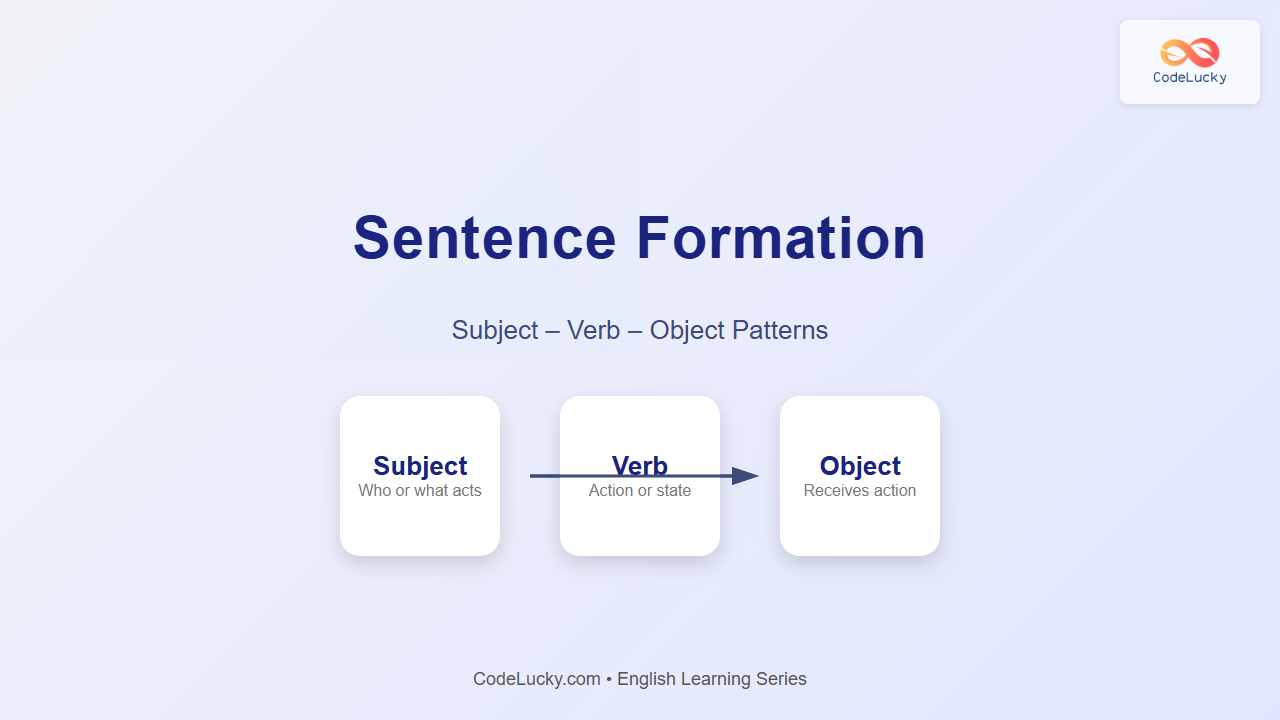
Sentence formation forms the backbone of English communication. Every clear sentence follows a logical pattern where a subject performs an action (verb) often directed at an object. This simple yet powerful structure—called the SVO pattern (Subject-Verb-Object)—is the foundation of English grammar.
In this lesson from CodeLucky’s English Learning Series, you’ll discover how SVO patterns work, how to identify each component, and how to build error-free sentences that make sense to your readers.
Understanding the Core Components
1. Subject (S)
The subject is the person or thing that performs the action. It answers the question: Who or what is doing something?
Examples:
- She runs every morning.
- The teacher explains the lesson.
2. Verb (V)
The verb is the action or state of being. It tells what the subject is doing or what condition it’s in.
Examples:
- She runs every morning.
- The teacher explains the lesson.
3. Object (O)
The object receives the action of the verb. It answers the question: Who or what is affected by the action?
Examples:
- She reads a book.
- The teacher explains the lesson.
The Basic English Sentence Pattern (SVO)
The Subject-Verb-Object structure is the most common pattern in English. It ensures clarity and organizes ideas logically.
Example:
John (S) eats (V) apples (O).
Here, John is performing the action eats, and the action is directed at apples.
Other Common Sentence Patterns
Although SVO is most common, there are several other useful patterns in English:
1. Subject + Verb (SV)
This pattern does not require an object.
- Birds fly.
- He sleeps.

2. Subject + Verb + Object + Adverb (SVOA)
An adverb adds details about when, where, or how something happens.
- She reads books quietly.
- They played football yesterday.

3. Subject + Verb + Complement (SVC)
Complements complete the meaning of linking verbs (like is, seem, become).
- She is a doctor.
- The sky became dark.

4. Subject + Verb + Indirect Object + Direct Object (SVIDO)
This pattern includes two types of objects: indirect (who receives) and direct (what is given).
- He gave her a gift.
- She told me a story.

Interactive Practice Activity
Try this simple exercise to practice sentence formation:
- Pick a subject (e.g., “The cat”).
- Add a verb (e.g., “chased”).
- Add an object (e.g., “the mouse”).
Your sentence: The cat chased the mouse.
Now try changing components:
| Subject | Verb | Object |
|---|---|---|
| The dog | ate | the biscuit |
| Children | watched | a cartoon |
| He | painted | a wall |
Tips for Strong Sentence Formation
- Always ensure every sentence has at least one subject and one verb.
- Keep sentence structure consistent to maintain clarity.
- Use objects to make your sentences more informative.
- Avoid sentence fragments (missing subject or verb).
- Use adverbs and adjectives carefully to enrich meaning.
Visual Overview of Sentence Types

Conclusion
Understanding Subject-Verb-Object patterns is the starting point of mastering English sentence formation. Once you grasp how the parts connect, you can form any type of sentence with confidence. Practice transforming simple SVO sentences into more complex ones using adverbs, complements, and additional objects. With time, sentence construction will feel effortless and natural.
Stay tuned at CodeLucky.com’s English Learning Series for more grammar and writing guides designed to enhance your communication skills—step by step.