Sentence Formation is one of the foundational skills in English grammar. Understanding how to build simple, compound, and complex sentences helps you write clearly, express ideas accurately, and organize thoughts with logic and flow. This guide explains each type step by step with examples, visual diagrams, and easy-to-grasp explanations.
What Is Sentence Formation?
Sentence formation refers to the method of arranging words in a structured and grammatically correct manner to express a complete idea. Every sentence has two essential parts:
- Subject – who or what the sentence is about.
- Predicate – what the subject does or what happens to it.
For example:
She sings. → “She” is the subject; “sings” is the predicate.
Types of Sentences Based on Structure
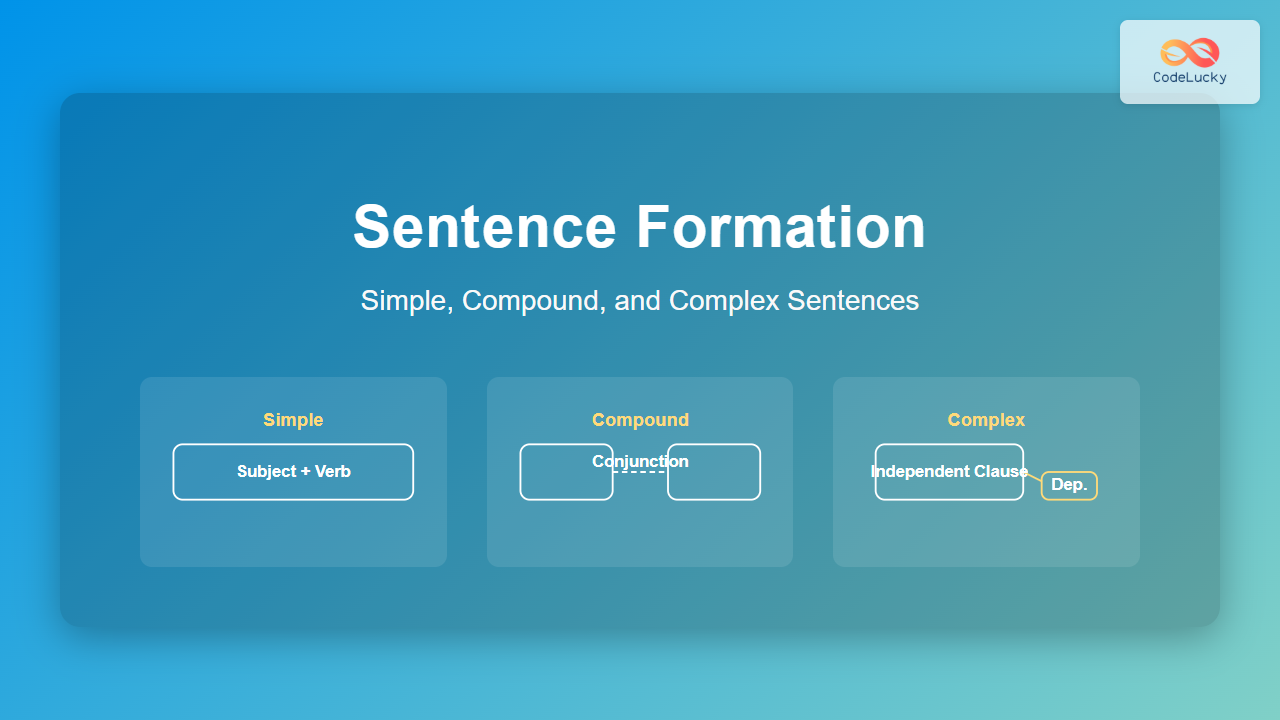
English sentences are classified into three main types based on their structure:
- Simple Sentence
- Compound Sentence
- Complex Sentence
1. Simple Sentence
A simple sentence contains only one independent clause. It expresses one complete idea. Although it can have compound subjects or predicates, it remains one single clause.
Structure: Subject + Verb (+ Object)
Examples:
- Ravi plays football.
- The sun rises in the east.
- Children laugh loudly.
All these sentences have one independent clause — that’s what makes them simple sentences.
Visual Diagram of a Simple Sentence:

2. Compound Sentence
A compound sentence combines two or more independent clauses joined by a coordinating conjunction. Each clause could stand alone as a separate sentence.
Coordinating Conjunctions (FANBOYS): for, and, nor, but, or, yet, so.
Structure: Independent Clause + Conjunction + Independent Clause
Examples:
- Ravi plays football, and his friends watch him.
- I wanted to go out, but it started raining.
- She cooked dinner, so we ate together.
Visual Diagram of a Compound Sentence:

Interactive Tip:
Try transforming a simple sentence into a compound one. Example —
Simple: “I read books.”
Compound: “I read books, and I write notes.”
This exercise builds awareness of how independent ideas connect naturally.
3. Complex Sentence
A complex sentence contains one independent clause and at least one dependent (subordinate) clause. Dependent clauses cannot stand alone because they depend on the main clause for meaning.
Subordinating Conjunctions: because, although, since, when, while, if, unless, though, etc.
Structure:
Independent Clause + Subordinating Conjunction + Dependent Clause
Examples:
- I stayed home because it was raining.
- When the bell rang, the students rushed out.
- Although he was tired, he finished his work.
Visual Diagram of a Complex Sentence:

Practice: Identify Clauses
In the sentence “Because she was late, she missed the bus.”:
- Dependent clause: Because she was late
- Independent clause: she missed the bus
Simple vs Compound vs Complex Sentences
This table highlights the core difference among the three types.
| Type | Definition | Number of Clauses | Example |
|---|---|---|---|
| Simple | Contains one independent clause. | 1 | He drives fast. |
| Compound | Contains two or more independent clauses joined by a conjunction. | 2+ | He drives fast, but she drives carefully. |
| Complex | Contains one independent and one or more dependent clauses. | 1 + (1 or more dependent) | He drives fast because he is late. |
Visual Flow Comparison
Combining Sentences: Step-by-Step
Let’s practice how simple sentences evolve into compound and complex forms through stepwise transformation.
Step 1: Start with a Simple Sentence
She writes daily.
Step 2: Make It Compound
Add another independent clause with a coordinating conjunction.
She writes daily, and she posts her stories online.
Step 3: Make It Complex
Add a dependent clause with a subordinating conjunction.
She writes daily because writing improves her focus.
Each sentence keeps the same subject but adds different layers of meaning and complexity.
Diagram: Evolution of Sentence Structure

Interactive Grammar Drill
Try these self-check tasks:
- Turn “They study” into a compound sentence.
- Turn “He runs” into a complex sentence using “although”.
- Identify the main clause in “Because it was noisy, I left early.”
Tip: Always ensure each compound or complex sentence keeps at least one independent clause to retain grammatical completeness.
Common Mistakes to Avoid
- Run-on sentences: Forgetting to use conjunctions or punctuation between independent clauses.
- Fragment sentences: Using dependent clauses alone without a main clause.
- Overuse of conjunctions: Too many connectors can confuse meaning.
Conclusion
Mastering sentence formation is not only about grammar rules — it’s about clarity, rhythm, and connection. By understanding the difference between simple, compound, and complex sentences, you can vary your writing style, make your communication engaging, and build confidence in both spoken and written English.
Practice daily: start small, combine ideas logically, and experiment with clauses. Over time, your sentence crafting becomes naturally fluent and expressive.