Building sentences is like constructing a house—you need the right foundation, materials, and structure to create something solid. Sentence formation is the cornerstone of effective English communication, whether you’re writing an email, crafting a story, or having a conversation. This comprehensive guide breaks down everything you need to know about creating well-formed English sentences.
What Is a Sentence?
A sentence is a group of words that expresses a complete thought. It must contain at least a subject (who or what the sentence is about) and a predicate (what the subject does or is). Every proper sentence begins with a capital letter and ends with appropriate punctuation—a period, question mark, or exclamation point.
Consider these examples:
- Complete sentence: The cat sleeps.
- Incomplete: The cat (missing predicate)
- Incomplete: Sleeps on the couch (missing subject)
The Two Essential Parts of Every Sentence
The Subject
The subject tells us who or what the sentence is about. It can be a noun, pronoun, or noun phrase. The subject is the performer of the action or the topic being described.
Examples of subjects:
- John writes code every day.
- The beautiful garden needs watering.
- They arrived late to the meeting.
- Learning English takes practice.
The Predicate
The predicate tells us what the subject does or is. It always contains a verb and may include objects, complements, or modifiers that provide additional information.
Examples of predicates:
- John writes code every day.
- The beautiful garden needs watering.
- They arrived late to the meeting.
- Learning English takes practice.

Basic Sentence Patterns
English sentences follow several fundamental patterns. Understanding these patterns helps you construct grammatically correct sentences and recognize sentence structures when reading.
Pattern 1: Subject + Verb (S-V)
The simplest sentence pattern contains just a subject and an intransitive verb (a verb that doesn’t need an object).
Examples:
- Birds fly.
- The baby cries.
- Students study.
- Time passes.
Pattern 2: Subject + Verb + Object (S-V-O)
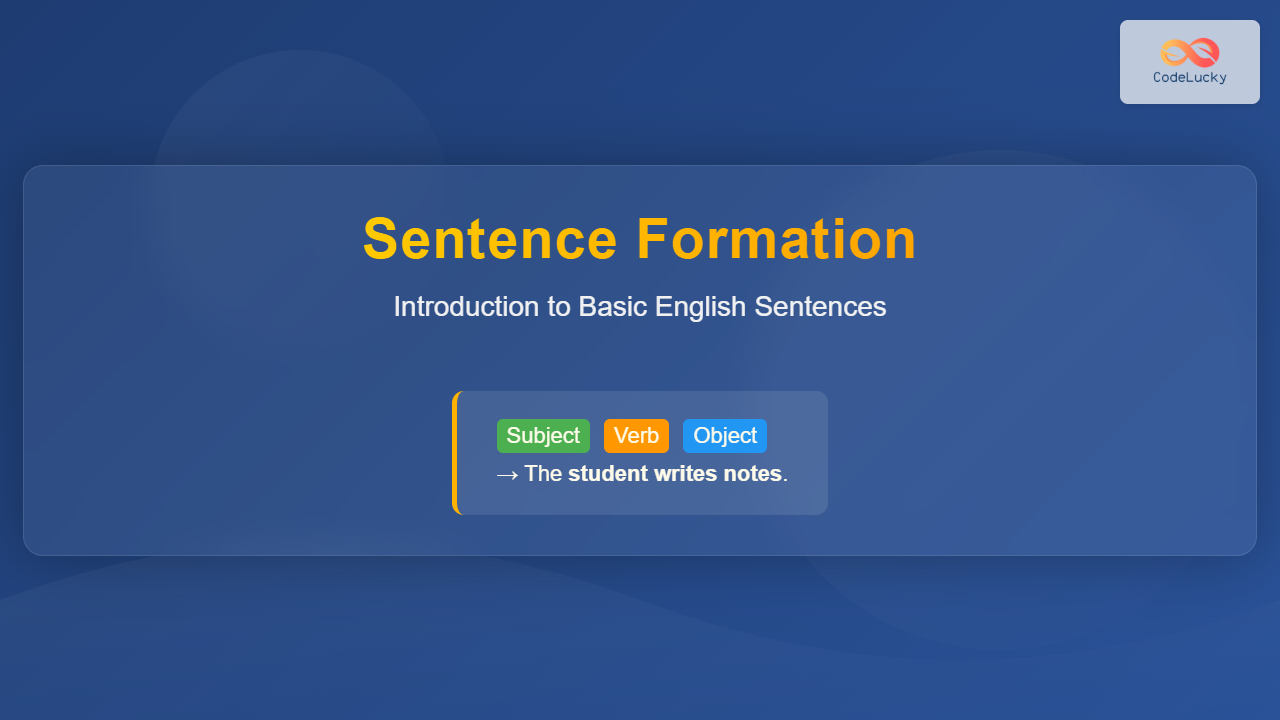
This pattern includes a direct object—the person or thing receiving the action of the verb.
Examples:
- She reads books.
- The chef prepares delicious meals.
- They built a new website.
- I love programming.
Pattern 3: Subject + Verb + Complement (S-V-C)
A complement describes or renames the subject. This pattern uses linking verbs like “is,” “am,” “are,” “was,” “were,” “become,” “seem,” etc.
Examples:
- She is a teacher.
- The soup tastes delicious.
- He became famous.
- They seem happy.
Pattern 4: Subject + Verb + Indirect Object + Direct Object (S-V-IO-DO)
Some sentences have both an indirect object (to/for whom) and a direct object (what).
Examples:
- She gave him a gift.
- The teacher taught us grammar.
- I sent my friend an email.
- They offered me a job.
Pattern 5: Subject + Verb + Object + Complement (S-V-O-C)
In this pattern, the complement describes or renames the object, not the subject.
Examples:
- They elected her president.
- The news made everyone happy.
- We painted the walls blue.
- The team chose him captain.
Four Types of Sentences by Purpose
Sentences serve different purposes in communication. Understanding these types helps you use the right sentence for your intended message.
Declarative Sentences
Declarative sentences make statements or express opinions. They’re the most common sentence type and end with a period.
Examples:
- The sun rises in the east.
- Python is a popular programming language.
- I enjoy learning new skills.
Interrogative Sentences
Interrogative sentences ask questions and end with a question mark. They often begin with question words (who, what, when, where, why, how) or helping verbs.
Examples:
- What time does the meeting start?
- Do you understand the concept?
- Where did you learn to code?
Imperative Sentences
Imperative sentences give commands, make requests, or offer invitations. The subject (you) is usually implied rather than stated. They typically end with a period but can use an exclamation point for emphasis.
Examples:
- Close the door.
- Please send me the report.
- Try this new feature.
- Never give up!
Exclamatory Sentences
Exclamatory sentences express strong emotion or excitement and end with an exclamation point.
Examples:
- What a beautiful sunset!
- That’s incredible!
- I can’t believe we won!

Four Types of Sentences by Structure
Beyond purpose, sentences are classified by their grammatical structure—how many clauses they contain and how those clauses relate to each other.
Simple Sentences
A simple sentence contains one independent clause (a group of words with a subject and verb that expresses a complete thought). It may have compound subjects, compound verbs, or both, but only one main clause.
Examples:
- The dog barks.
- Sarah and Tom work at the same company.
- The developer codes and tests applications.
- My brother and I studied hard and passed the exam.
Compound Sentences
Compound sentences contain two or more independent clauses joined by coordinating conjunctions (for, and, nor, but, or, yet, so) or semicolons. Each clause could stand alone as a complete sentence.
Examples:
- I wanted to go for a walk, but it started raining.
- She loves programming, and she practices every day.
- You can stay here, or you can come with us.
- The project was challenging; we completed it on time.
Complex Sentences
Complex sentences contain one independent clause and at least one dependent clause (a clause that cannot stand alone). Dependent clauses begin with subordinating conjunctions like “because,” “although,” “when,” “if,” “since,” “while,” etc.
Examples:
- Because it was raining, we stayed inside.
- She will succeed if she works hard.
- Although the task was difficult, they finished it.
- When the sun sets, the temperature drops.
Compound-Complex Sentences
These sentences combine elements of both compound and complex sentences. They contain at least two independent clauses and at least one dependent clause.
Examples:
- Although I was tired, I finished my work, and I went to bed early.
- She studied hard because the exam was important, but she still felt nervous.
- When the meeting ended, everyone left the office, and the lights were turned off.

Common Mistakes in Sentence Formation
Sentence Fragments
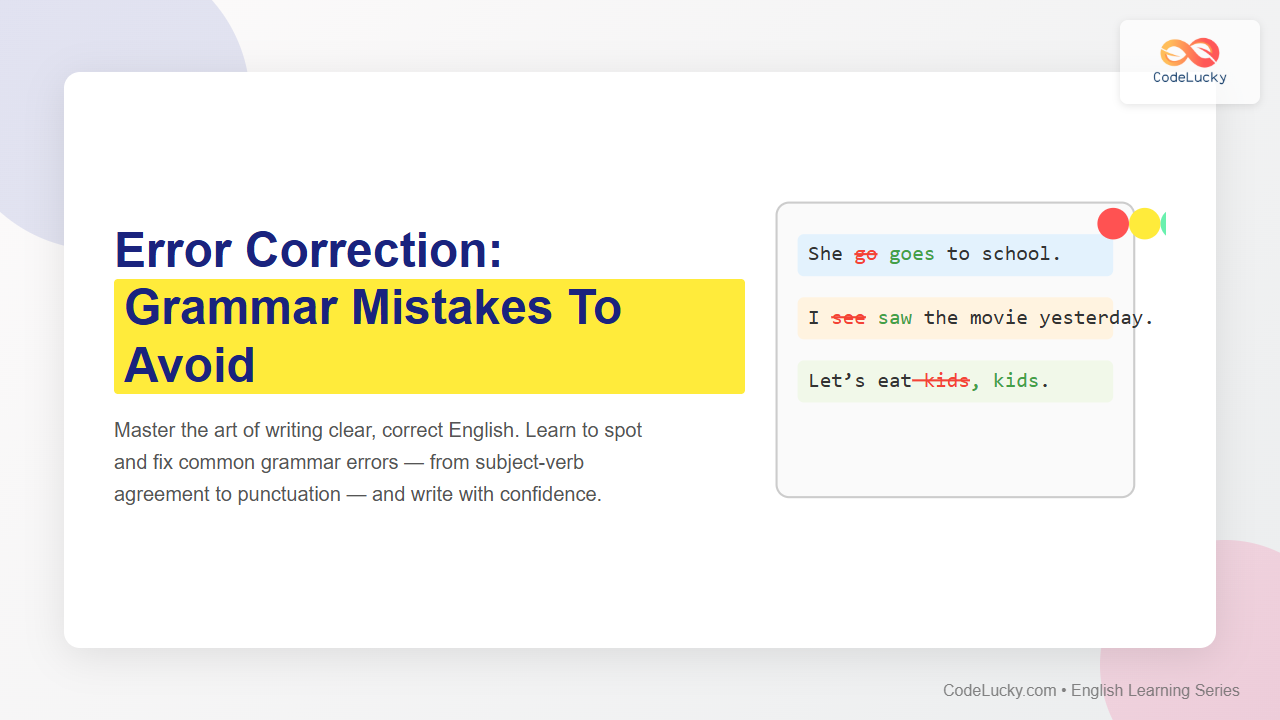
A fragment is an incomplete sentence that lacks either a subject, a verb, or doesn’t express a complete thought.
Incorrect: Because I was tired. (dependent clause alone)
Correct: I went to bed early because I was tired.
Incorrect: Running through the park. (missing subject)
Correct: She enjoys running through the park.
Run-on Sentences
Run-on sentences occur when two or more independent clauses are joined without proper punctuation or conjunctions.
Incorrect: I love coding it’s my passion.
Correct: I love coding. It’s my passion.
Also Correct: I love coding, and it’s my passion.
Comma Splices
A comma splice happens when two independent clauses are joined with only a comma.
Incorrect: She studied hard, she passed the exam.
Correct: She studied hard, so she passed the exam.
Also Correct: She studied hard; she passed the exam.
Subject-Verb Agreement Errors
The subject and verb must agree in number (singular or plural).
Incorrect: The team are winning. (team is singular)
Correct: The team is winning.
Incorrect: Each of the students have a laptop. (each is singular)
Correct: Each of the students has a laptop.
Building Longer Sentences
Once you master basic sentences, you can expand them by adding modifiers, phrases, and clauses. This makes your writing more detailed and interesting.
Adding Adjectives and Adverbs
Basic: The dog barks.
Expanded: The large, brown dog barks loudly.
Adding Prepositional Phrases
Basic: She walks.
Expanded: She walks through the park in the morning.
Adding Dependent Clauses
Basic: I will help you.
Expanded: I will help you if you need assistance.
Combining Sentences
Two simple sentences: The weather was cold. We stayed inside.
Combined: Because the weather was cold, we stayed inside.
Practice Exercise
Try identifying the parts and types of these sentences:
- The programmer writes clean code.
- Did you finish the assignment?
- Practice every day!
- Although it was late, she continued working, and she completed the project.
- The sun shines brightly.
Click to see answers
- Simple declarative sentence – Subject: The programmer, Predicate: writes clean code
- Simple interrogative sentence – Subject: you, Predicate: Did finish the assignment
- Simple imperative sentence – Subject: (you implied), Predicate: Practice every day
- Compound-complex declarative sentence – Contains dependent clause “Although it was late” and two independent clauses
- Simple declarative sentence – Subject: The sun, Predicate: shines brightly
Tips for Effective Sentence Formation
Start with simple sentences: Master basic sentence structure before moving to complex forms. Even professional writers use simple sentences frequently for clarity and impact.
Vary your sentence length: Mix short, medium, and long sentences to create rhythm and maintain reader interest. Too many long sentences can be exhausting; too many short ones can sound choppy.
Use active voice: Active voice (subject performs action) is usually clearer and more direct than passive voice. For example, “The developer wrote the code” is stronger than “The code was written by the developer.”
Read your sentences aloud: This helps you catch awkward phrasing, missing words, or run-on sentences. If you run out of breath, the sentence is probably too long.
Practice regularly: Like any skill, sentence formation improves with practice. Write daily, even if it’s just a few sentences about your day.
Moving Forward
Sentence formation is the foundation of all English writing. By understanding subjects, predicates, sentence types, and common patterns, you’ve equipped yourself with essential tools for clear communication. Remember that even complex ideas can be expressed through well-constructed simple sentences.
Start by writing simple sentences correctly, then gradually incorporate more complex structures as you become comfortable. Pay attention to how professional writers construct their sentences when you read articles, books, or other materials. With consistent practice and attention to these principles, you’ll develop a natural feel for creating effective English sentences that communicate your ideas clearly and powerfully.