Understanding Select-Object in PowerShell
The Select-Object cmdlet is one of PowerShell’s most versatile tools for manipulating object output. It allows you to choose specific properties from objects, limit the number of objects returned, create custom properties, and expand nested properties. Understanding how to effectively use Select-Object is essential for writing efficient PowerShell scripts and working with complex data structures.
When you run commands in PowerShell, they typically return objects with multiple properties. Often, you only need a subset of these properties, or you need to transform the data in specific ways. This is where Select-Object becomes invaluable.
Basic Property Selection
The most common use of Select-Object is selecting specific properties from objects. Instead of displaying all properties, you can choose only the ones you need.
Selecting Single Properties
# Get only the Name property from processes
Get-Process | Select-Object -Property Name

# Output:
# Name
# ----
# ApplicationFrameHost
# audiodg
# chrome
# ... (continues)
Selecting Multiple Properties
# Select multiple properties
Get-Process | Select-Object -Property Name, Id, CPU | Select-Object -First 5

# Output:
# Name                       Id        CPU
# ----                       --        ---
# ApplicationFrameHost     1234      12.34
# audiodg                  5678       2.11
# chrome                   9012     145.67
# conhost                  3456       0.89
# csrss                    7890       5.23
Understanding Property Types
PowerShell objects contain different types of properties, and understanding these types is crucial when working with Select-Object.
Simple vs Complex Properties
# View all properties of a service object
Get-Service | Select-Object -First 1 | Format-List *

# Output shows:
# Name          : AdobeARMservice
# RequiredServices : {}
# CanPauseAndContinue : False
# CanShutdown   : False
# CanStop       : True
# DisplayName   : Adobe Acrobat Update Service
# DependentServices : {}
# MachineName   : .
# ServiceName   : AdobeARMservice
# ServicesDependedOn : {}
# ServiceHandle : SafeServiceHandle
# Status        : Running
# ServiceType   : Win32OwnProcess
# StartType     : Automatic
# Site          :
# Container     :
Notice that some properties like RequiredServices and DependentServices are collections (arrays) rather than simple values. This is where property expansion becomes important.
The ExpandProperty Parameter
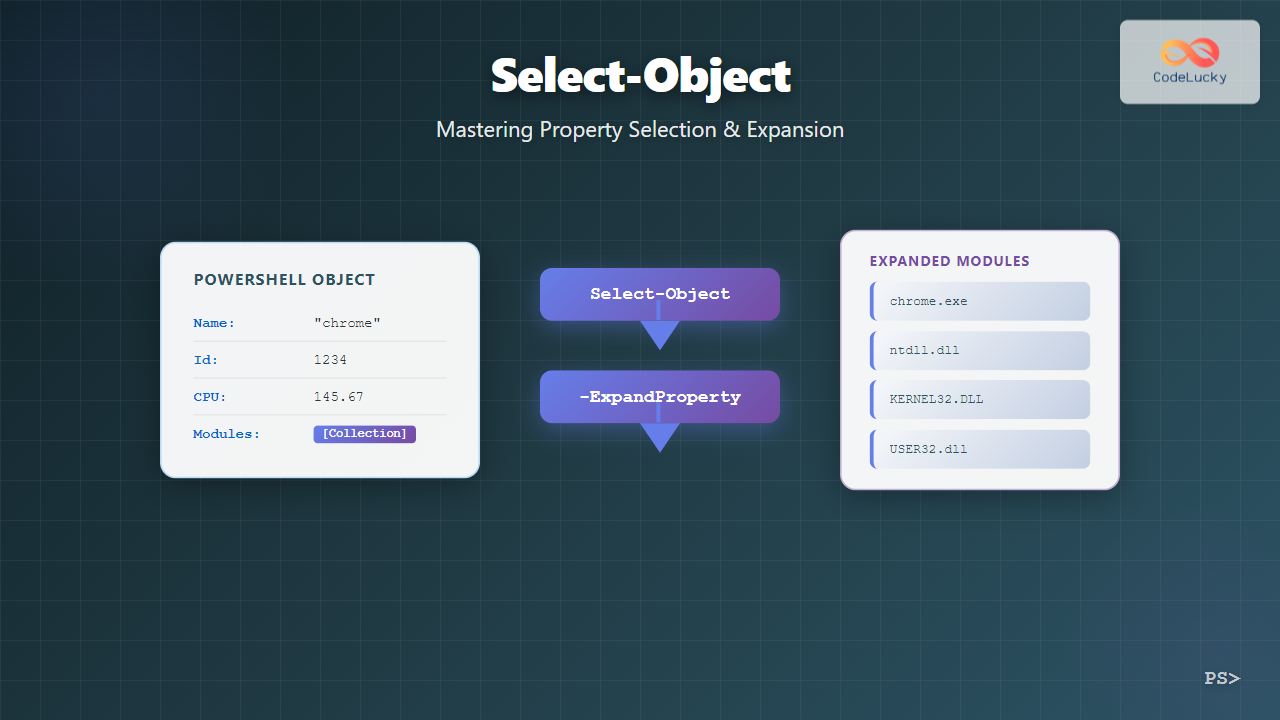
The -ExpandProperty parameter is a powerful feature that “unwraps” a property, returning its contents directly rather than as a property of an object. This is particularly useful when dealing with nested objects or collections.
Without ExpandProperty
# Select a property normally
Get-Process -Name "chrome" | Select-Object -Property Modules | Select-Object -First 1

# Output:
# Modules
# -------
# System.Diagnostics.ProcessModuleCollection
This returns an object with a Modules property that contains a collection. The actual module data is still wrapped inside the property.
With ExpandProperty
# Expand the Modules property
Get-Process -Name "chrome" | Select-Object -ExpandProperty Modules | Select-Object -First 3

# Output:
# Size(K) ModuleName                        FileName
# ------- ----------                        --------
#    2432 chrome.exe                        C:\Program Files\Google\Chrome\chrome.exe
#    1856 ntdll.dll                         C:\Windows\SYSTEM32\ntdll.dll
#     832 KERNEL32.DLL                      C:\Windows\System32\KERNEL32.DLL
Now you get the actual module objects directly, not wrapped in a parent object.

Practical Examples of ExpandProperty
Getting Service Dependencies
# Without ExpandProperty - returns an object with a property
Get-Service -Name "wuauserv" | Select-Object -Property ServicesDependedOn

# Output:
# ServicesDependedOn
# ------------------
# {rpcss}

# With ExpandProperty - returns the actual service objects
Get-Service -Name "wuauserv" | Select-Object -ExpandProperty ServicesDependedOn

# Output:
# Status   Name               DisplayName
# ------   ----               -----------
# Running  rpcss              Remote Procedure Call (RPC)
Working with File Properties
# Get directory info without expansion
Get-ChildItem -Path "C:\Windows" -Directory | Select-Object -Property Parent | Select-Object -First 1

# Output:
# Parent
# ------
# C:\

# With expansion - get the actual DirectoryInfo object
Get-ChildItem -Path "C:\Windows" -Directory | Select-Object -ExpandProperty Parent | Select-Object -First 1

# Output:
# Mode                 LastWriteTime         Length Name
# ----                 -------------         ------ ----
# d----          10/15/2025   3:42 PM                C:\
Combining Property Selection with ExpandProperty
You cannot use -Property and -ExpandProperty together in the same Select-Object command. However, you can chain multiple Select-Object commands to achieve complex transformations.
# This WILL NOT work - you'll get an error
# Get-Process | Select-Object -Property Name -ExpandProperty Modules

# Instead, chain Select-Object commands
Get-Process -Name "chrome" |
    Select-Object -First 1 |
    Select-Object -Property Name -ExpandProperty Modules |
    Select-Object -First 3

# Or use calculated properties (covered later)
Get-Process -Name "chrome" | Select-Object -First 1 | ForEach-Object {
    $processName = $_.Name
    $_.Modules | Select-Object @{Name='ProcessName';Expression={$processName}}, ModuleName -First 3
}

# Output:
# ProcessName ModuleName
# ----------- ----------
# chrome      chrome.exe
# chrome      ntdll.dll
# chrome      KERNEL32.DLL
Creating Calculated Properties
Calculated properties allow you to create custom properties on the fly using hashtables. This is extremely powerful for transforming and enriching data.
Basic Calculated Property Syntax
# Create a custom property
Get-Process | Select-Object Name,
    @{Name='MemoryMB';Expression={[math]::Round($_.WorkingSet / 1MB, 2)}} |
    Sort-Object MemoryMB -Descending |
    Select-Object -First 5

# Output:
# Name                     MemoryMB
# ----                     --------
# chrome                     512.34
# firefox                    389.67
# Code                       256.12
# Slack                      198.45
# Teams                      145.78
Using Aliases for Shorter Syntax
# 'Name' can be abbreviated as 'N' or 'Label' as 'L'
# 'Expression' can be abbreviated as 'E'
Get-Service | Select-Object Name,
    @{N='Running';E={$_.Status -eq 'Running'}} |
    Select-Object -First 5

# Output:
# Name                  Running
# ----                  -------
# AdobeARMservice          True
# ALG                     False
# AppIDSvc                False
# Appinfo                 False
# AppMgmt                 False
Advanced Selection Techniques
Selecting First and Last Objects
# Get first 5 processes
Get-Process | Select-Object -First 5

# Get last 3 services
Get-Service | Select-Object -Last 3

# Skip first 10 and take next 5
Get-Process | Select-Object -Skip 10 -First 5
Selecting Unique Values
# Get unique process names
Get-Process | Select-Object -Property Name -Unique

# With ExpandProperty to get just the values
Get-Process | Select-Object -ExpandProperty Name -Unique

# Output:
# ApplicationFrameHost
# audiodg
# chrome
# Code
# conhost
# ... (unique names only)
Using Wildcards in Property Selection
# Select all properties starting with 'Service'
Get-Service | Select-Object Service* | Select-Object -First 1

# Output:
# ServiceName      : AdobeARMservice
# ServicesDependedOn : {}
# ServiceHandle    : SafeServiceHandle
# ServiceType      : Win32OwnProcess
Real-World Use Cases
Filtering and Transforming File Information
# Get files with size in MB and formatted dates
Get-ChildItem -Path "C:\Users\YourName\Documents" -File |
    Select-Object Name,
        @{N='SizeMB';E={[math]::Round($_.Length / 1MB, 2)}},
        @{N='Modified';E={$_.LastWriteTime.ToString('yyyy-MM-dd')}},
        @{N='IsLarge';E={$_.Length -gt 10MB}} |
    Sort-Object SizeMB -Descending |
    Select-Object -First 10

# Output:
# Name                  SizeMB Modified   IsLarge
# ----                  ------ --------   -------
# video.mp4              523.45 2025-10-15    True
# presentation.pptx       45.67 2025-10-20    True
# document.docx            2.34 2025-10-22   False
# spreadsheet.xlsx         1.89 2025-10-21   False
Working with Network Adapters
# Get IP addresses from network adapters
Get-NetAdapter | Where-Object Status -eq 'Up' |
    Select-Object Name, Status -ExpandProperty InterfaceIndex |
    ForEach-Object {
        $adapter = $_
        Get-NetIPAddress -InterfaceIndex $adapter |
            Where-Object AddressFamily -eq 'IPv4' |
            Select-Object @{N='Adapter';E={$adapter.Name}}, IPAddress
    }

# Output:
# Adapter          IPAddress
# -------          ---------
# Ethernet         192.168.1.100
# Wi-Fi            192.168.1.101
Analyzing Process Memory Usage
# Create a detailed memory report
Get-Process |
    Select-Object Name,
        @{N='WorkingSetMB';E={[math]::Round($_.WorkingSet / 1MB, 2)}},
        @{N='PrivateMemoryMB';E={[math]::Round($_.PrivateMemorySize64 / 1MB, 2)}},
        @{N='VirtualMemoryMB';E={[math]::Round($_.VirtualMemorySize64 / 1MB, 2)}},
        @{N='MemoryCategory';E={
            if ($_.WorkingSet -gt 500MB) { 'High' }
            elseif ($_.WorkingSet -gt 100MB) { 'Medium' }
            else { 'Low' }
        }} |
    Sort-Object WorkingSetMB -Descending |
    Select-Object -First 10

# Output:
# Name     WorkingSetMB PrivateMemoryMB VirtualMemoryMB MemoryCategory
# ----     ------------ --------------- --------------- --------------
# chrome         512.34          489.12         2345.67           High
# firefox        389.67          356.23         1987.45           High
# Code           256.12          234.56         1654.32         Medium
# Slack          198.45          178.90         1234.56         Medium
Common Pitfalls and Best Practices
Pitfall: Mixing Property and ExpandProperty
# WRONG - This will cause an error
# Get-Service | Select-Object -Property Name -ExpandProperty ServicesDependedOn

# CORRECT - Use separate Select-Object calls or use ForEach-Object
Get-Service | Where-Object {$_.ServicesDependedOn.Count -gt 0} | ForEach-Object {
    $serviceName = $_.Name
    $_.ServicesDependedOn | Select-Object @{N='Parent';E={$serviceName}}, Name
} | Select-Object -First 5
Pitfall: Assuming ExpandProperty Returns Single Values
# Be careful - ExpandProperty can return multiple objects
$dependencies = Get-Service -Name "wuauserv" |
    Select-Object -ExpandProperty ServicesDependedOn

# $dependencies might be an array, not a single object
Write-Host "Type: $($dependencies.GetType().Name)"
# Output: Type: Object[] (if multiple dependencies exist)
Best Practice: Use -First for Performance
# INEFFICIENT - processes all objects before selecting
(Get-Process | Select-Object Name, CPU)[0]

# EFFICIENT - stops processing after finding the first object
Get-Process | Select-Object -First 1 Name, CPU
Performance Considerations
Early Filtering vs Late Filtering
# INEFFICIENT - Select-Object processes all objects
Get-Process |
    Select-Object Name, CPU |
    Where-Object CPU -gt 10

# MORE EFFICIENT - Where-Object filters first
Get-Process |
    Where-Object CPU -gt 10 |
    Select-Object Name, CPU

# MOST EFFICIENT - Filter at the source when possible
Get-Process |
    Where-Object {$_.CPU -gt 10} |
    Select-Object -Property Name, CPU -First 50
Memory Impact of ExpandProperty
# Be cautious with large collections
# This could use significant memory
$allModules = Get-Process | Select-Object -ExpandProperty Modules

# Better approach - process incrementally
Get-Process | ForEach-Object {
    $_.Modules | Select-Object -First 5 ModuleName
} | Select-Object -First 20
Combining with Other Cmdlets
Export and Select
# Select specific properties before exporting
Get-Process |
    Select-Object Name,
        @{N='MemoryMB';E={[math]::Round($_.WorkingSet / 1MB, 2)}},
        CPU |
    Export-Csv -Path "processes.csv" -NoTypeInformation

# Select and expand for XML export
Get-Service |
    Where-Object Status -eq 'Running' |
    Select-Object Name, DisplayName, Status,
        @{N='Dependencies';E={($_.ServicesDependedOn.Name) -join ', '}} |
    Export-Clixml -Path "services.xml"
Grouping with Selected Properties
# Group processes by memory category
Get-Process |
    Select-Object Name,
        @{N='MemoryCategory';E={
            if ($_.WorkingSet -gt 500MB) { 'High' }
            elseif ($_.WorkingSet -gt 100MB) { 'Medium' }
            else { 'Low' }
        }} |
    Group-Object MemoryCategory |
    Select-Object Name, Count

# Output:
# Name     Count
# ----     -----
# Low        145
# Medium      23
# High         8
Interactive Examples and Exercises
Exercise 1: Property Exploration
# Explore object properties step by step
# Step 1: Get a single service object
$service = Get-Service | Select-Object -First 1

# Step 2: View all properties
$service | Format-List *

# Step 3: Try selecting specific properties
$service | Select-Object Name, Status, StartType

# Step 4: Try expanding a collection property
$service | Select-Object -ExpandProperty DependentServices
Exercise 2: Building a Custom Report
# Create a comprehensive system report
$report = @{
    ComputerName = $env:COMPUTERNAME
    Processes = Get-Process |
        Select-Object Name,
            @{N='MemoryMB';E={[math]::Round($_.WorkingSet / 1MB, 2)}} |
        Sort-Object MemoryMB -Descending |
        Select-Object -First 10
    Services = Get-Service |
        Select-Object Name, Status, StartType |
        Group-Object Status |
        Select-Object Name, Count
    DiskSpace = Get-PSDrive -PSProvider FileSystem |
        Select-Object Name,
            @{N='UsedGB';E={[math]::Round($_.Used / 1GB, 2)}},
            @{N='FreeGB';E={[math]::Round($_.Free / 1GB, 2)}}
}

# Display the report
$report
Exercise 3: Data Transformation Pipeline
# Build a complex data transformation pipeline
Get-ChildItem -Path "C:\Windows\System32" -File |
    Where-Object Extension -eq ".dll" |
    Select-Object Name,
        @{N='SizeKB';E={[math]::Round($_.Length / 1KB, 2)}},
        @{N='Age';E={(Get-Date) - $_.CreationTime}},
        @{N='Category';E={
            if ($_.Length -gt 1MB) { 'Large' }
            elseif ($_.Length -gt 100KB) { 'Medium' }
            else { 'Small' }
        }} |
    Group-Object Category |
    Select-Object Name, Count,
        @{N='TotalSizeMB';E={[math]::Round(($_.Group | Measure-Object SizeKB -Sum).Sum / 1024, 2)}}

# Output:
# Name     Count TotalSizeMB
# ----     ----- -----------
# Large       45      234.56
# Medium     189       89.34
# Small     1023       34.12
Summary and Key Takeaways
Understanding Select-Object and its -ExpandProperty parameter is fundamental to effective PowerShell scripting. Here are the key points to remember:
- Property Selection: Use
-Propertyto choose specific properties from objects, reducing output and improving readability. - ExpandProperty: Use
-ExpandPropertyto unwrap collections and nested objects, returning their contents directly. - Calculated Properties: Create custom properties using hashtables with
NameandExpressionkeys for data transformation. - Performance: Apply filters early, use
-Firstand-Lastfor limiting results, and be mindful of memory when expanding large collections. - Limitations: You cannot combine
-Propertyand-ExpandPropertyin a single command; chain multipleSelect-Objectcalls instead. - Unique Values: Use
-Uniqueto get distinct property values, eliminating duplicates. - Wildcards: Select multiple properties efficiently using wildcard patterns like
Service*.
Mastering these concepts enables you to write more efficient scripts, create better reports, and manipulate data with precision. Practice these techniques with different cmdlets and scenarios to build your PowerShell expertise.