Efficiently scheduling jobs on machines is a foundational challenge in computer science and operations research. When exact solutions are computationally infeasible, approximation algorithms provide near-optimal solutions with performance guarantees. This article explores approximation techniques for job scheduling, illustrating key concepts, main approaches, and practical examples with clear visualizations for deep understanding.
Introduction to Job Scheduling Problems
Job scheduling involves allocating a set of jobs to resources (machines) over time to optimize objectives like minimizing total completion time, makespan, or weighted tardiness. Formally, jobs \(J = \{J_1, J_2, …, J_n\}\) each have processing times and possibly weights, release dates, or deadlines, and must be assigned to machines \(M = \{M_1, M_2, …, M_m\}\).
The complexity of scheduling increases with constraints, such as multiple machines, job dependencies, or preemptions allowed. Many scheduling problems quickly become NP-hard, making exact solutions infeasible for large inputs, which is where approximation strategies become invaluable.
Why Use Approximation Algorithms?
Exact algorithms guarantee optimality but often have exponential runtime. Approximation algorithms trade off guaranteed optimality for efficiency and scalability, providing performance guarantees within a factor \(\alpha\) of the optimal.
For scheduling, approximation algorithms help solve:
- Minimizing makespan on identical or unrelated parallel machines
- Minimizing weighted completion time
- Scheduling with precedence or release constraints
Classic Approximation Techniques for Job Scheduling
1. List Scheduling Algorithm (Graham’s Algorithm)
A simple heuristic for minimizing makespan on identical parallel machines. Jobs are scheduled in an arbitrary order, each assigned to the machine that becomes available the earliest.

Performance Guarantee: The makespan \(C_{\max}\) produced is at most \(2 – \frac{1}{m}\) times the optimal makespan, where \(m\) is the number of machines.
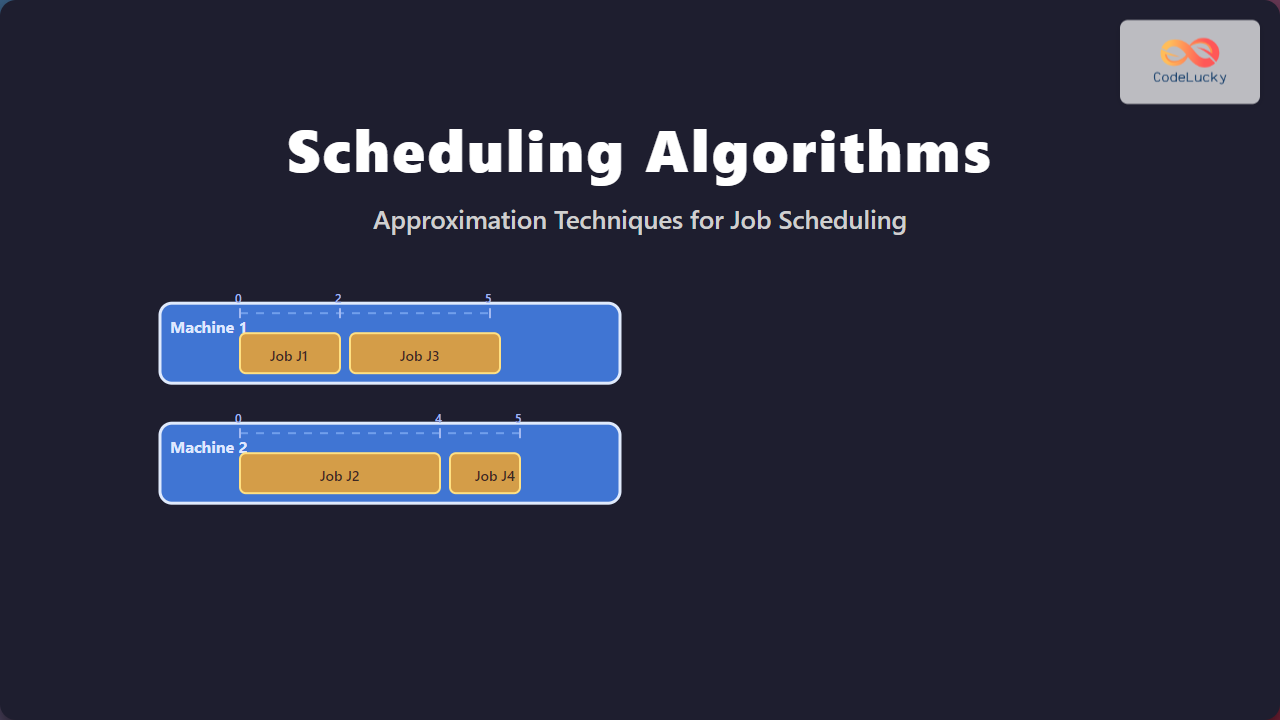
Example: Scheduling 4 Jobs on 2 Machines
| Job | Processing Time |
|---|---|
| J1 | 2 |
| J2 | 4 |
| J3 | 3 |
| J4 | 1 |
Assigning jobs in the order J1, J2, J3, J4:
- Machine 1 gets J1 (2 units)
- Machine 2 gets J2 (4 units)
- Next, J3 goes to Machine 1 (available at time 2), finishing at 5
- J4 goes to Machine 2 (available at time 4), finishing at 5
Makespan = 5, while lower bound is max(total processing/2, longest job) = max(10/2=5,4) = 5, which is optimal here.
2. Approximation for Unrelated Parallel Machines
When machines differ in processing capabilities (unrelated machines), each job \(j\) has a processing time \(p_{ij}\) on machine \(i\). The problem becomes harder, but a linear programming relaxation combined with rounding techniques offers a 2-approximation algorithm.

3. Approximation for Weighted Completion Time
For minimizing the sum of weighted completion times \(\sum w_j C_j\), algorithms exploit linear programming relaxations or greedy policies:
- Smith’s Rule: Sequence jobs in non-increasing order of \(w_j / p_j\), giving a heuristic optimal on a single machine.
- Multiplier-based rounding: Approximate on parallel machines by relaxing integrality, then rounding carefully to assign jobs.
Example: Weighted Completion Time on Single Machine
| Job | Processing Time \(p_j\) | Weight \(w_j\) | Ratio \(w_j/p_j\) |
|---|---|---|---|
| J1 | 3 | 6 | 2 |
| J2 | 1 | 2 | 2 |
| J3 | 4 | 4 | 1 |
Schedule J1 and J2 first (equal ratio), then J3. This reduces the weighted completion time sum.
Mermaid Diagram: Job Scheduling Flow

Advanced Approximation Techniques
- PTAS (Polynomial-Time Approximation Schemes): For certain scheduling problems (e.g., single machine with release dates), PTAS can produce solutions arbitrarily close to optimal.
- Local Search: Iteratively improving a candidate schedule by swapping jobs or reassigning them to reduce makespan or weighted completion.
- Primal-Dual Methods: Develop approximate primal and dual solutions simultaneously, yielding guaranteed bounds on the schedule quality.
Interactive Conceptual Example
Below is a simple interactive framework idea (to be implemented with JavaScript in a live environment) that lets users input job times and number of machines, then run the List Scheduling algorithm to see job assignments and makespan visualization.
<!-- Interactive pseudo-code -->
<script>
function listScheduling(jobs, m) {
  let machines = new Array(m).fill(0);
  let assignment = [];
  for(let j=0; j<jobs.length; j++) {
    let earliest = 0;
    for(let i=1; i<m; i++) {
      if(machines[i] < machines[earliest]) earliest=i;
    }
    assignment[j] = earliest;
    machines[earliest] += jobs[j];
  }
  return {assignment, makespan: Math.max(...machines)};
}
console.log(listScheduling([2,4,3,1], 2));
</script>
Summary
Approximation algorithms offer practical, scalable solutions for complex job scheduling challenges. This article covered fundamental algorithms like List Scheduling for makespan minimization, LP-based methods for unrelated machines, and heuristics for weighted completion time, reinforced with examples and mermaid visualizations.
Understanding and applying these techniques enables tackling large-scale scheduling problems with quality guarantees, crucial for manufacturing, cloud computing, and operational logistics.