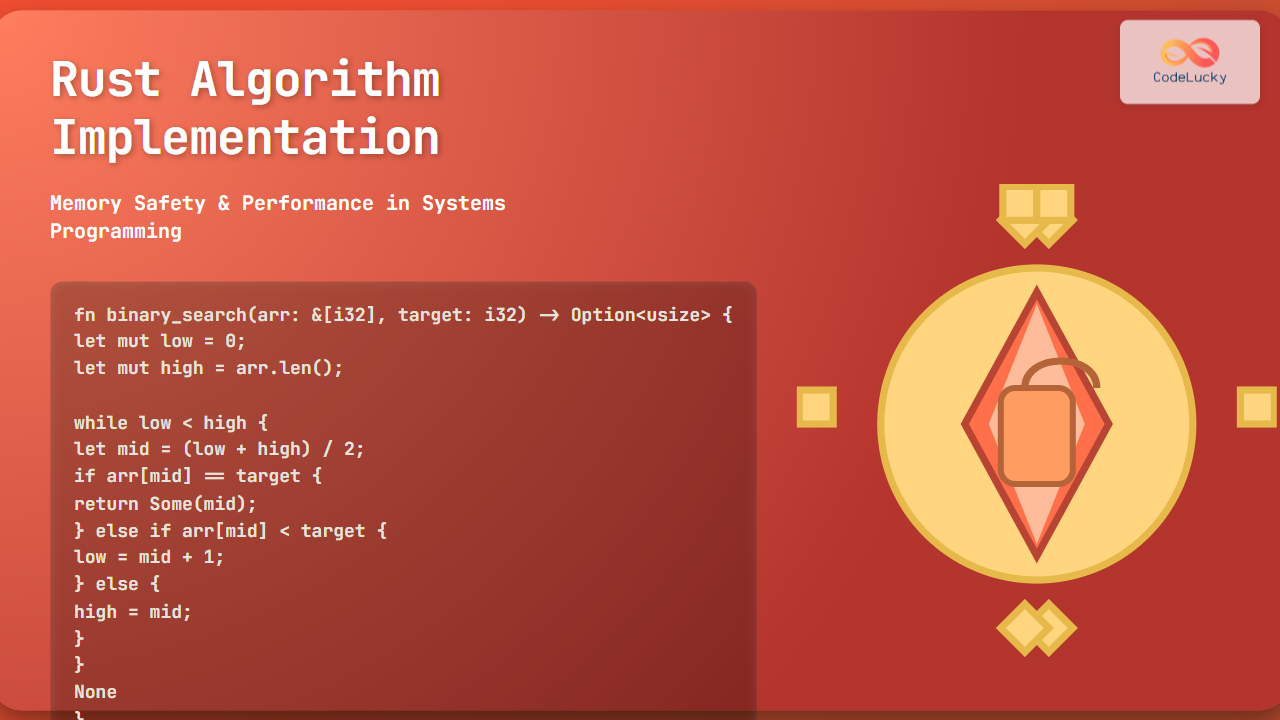
Rust has become a go-to language for developers who want to achieve low-level control without sacrificing safety and performance. Its unique ownership system ensures memory safety at compile-time, reducing the likelihood of bugs such as null pointer dereferencing, buffer overflows, or data races. This makes Rust incredibly valuable for algorithm implementation where both efficiency and correctness are critical.
Why Rust for Algorithms?
When implementing algorithms, developers often face a trade-off between safety and speed. Traditional languages like C and C++ provide excellent performance but require manual memory management. Higher-level languages like Python or Java are safer but often slower. Rust bridges this gap by offering:
- Memory Safety: Guaranteed at compile time through ownership, borrowing, and lifetimes.
- Zero-Cost Abstractions: High-level code translates into low-level optimized machine code.
- Concurrency without Data Races: Safe parallelism built directly into the language model.
- Performance Comparable to C++: Without the risks of undefined behavior.
Memory Safety in Algorithm Implementation
Consider a simple algorithm like Binary Search. In many languages, improper index handling can cause segmentation faults. Rust enforces bounds checking and ownership rules that prevent access errors:
fn binary_search(arr: &[i32], target: i32) -> Option {
    let mut low = 0;
    let mut high = arr.len();

    while low < high {
        let mid = (low + high) / 2;
        if arr[mid] == target {
            return Some(mid);
        } else if arr[mid] < target {
            low = mid + 1;
        } else {
            high = mid;
        }
    }
    None
}

fn main() {
    let data = vec![1, 3, 5, 7, 9, 11];
    if let Some(pos) = binary_search(&data, 7) {
        println!("Found at index: {}", pos);
    } else {
        println!("Not found");
    }
}
Output:
Found at index: 3
Visual Representation of Binary Search
Performance-Oriented Algorithms in Rust
When scaling up to complex algorithms such as Merge Sort or Parallel Matrix Multiplication, Rust’s borrow checker ensures that memory is safely shared across threads without data races. Below is an example of a parallel merge sort using rayon crate:
use rayon::prelude::*;

fn parallel_merge_sort(mut data: Vec<i32>) -> Vec<i32> {
    if data.len() <= 1 {
        return data;
    }
    let mid = data.len() / 2;
    let (left, right) = data.split_at_mut(mid);

    let (sorted_left, sorted_right): (Vec<i32>, Vec<i32>) =
        rayon::join(|| parallel_merge_sort(left.to_vec()),
                    || parallel_merge_sort(right.to_vec()));

    merge(sorted_left, sorted_right)
}

fn merge(left: Vec<i32>, right: Vec<i32>) -> Vec<i32> {
    let mut merged = Vec::new();
    let mut i = 0;
    let mut j = 0;
    while i < left.len() && j < right.len() {
        if left[i] <= right[j] {
            merged.push(left[i]);
            i += 1;
        } else {
            merged.push(right[j]);
            j += 1;
        }
    }
    merged.extend_from_slice(&left[i..]);
    merged.extend_from_slice(&right[j..]);
    merged
}

fn main() {
    let data = vec![32, 10, 55, 1, 89, 40];
    let result = parallel_merge_sort(data);
    println!("{:?}", result);
}
Output:
[1, 10, 32, 40, 55, 89]
Ownership and Borrowing in Algorithms
Rust’s ownership model ensures that algorithms avoid unnecessary memory copies. Instead of deep cloning, algorithms can borrow slices of data safely:
fn sum_of_elements(arr: &[i32]) -> i32 {
    arr.iter().sum()
}

fn main() {
    let numbers = vec![5, 10, 15, 20];
    let total = sum_of_elements(&numbers);
    println!("Sum = {}", total);
}
Output:
Sum = 50
How Rust Achieves Both Safety and Speed

Conclusion
Rust uniquely balances memory safety and performance, making it an excellent choice for implementing algorithms that must be both correct and efficient. By leveraging ownership, borrowing, and concurrency features, developers can implement data structures and algorithmic solutions that handle complex use cases safely. Whether you are building sorting algorithms, graph traversal methods, or parallel computations, Rust offers a safe and fast environment that minimizes runtime errors while maximizing execution speed.