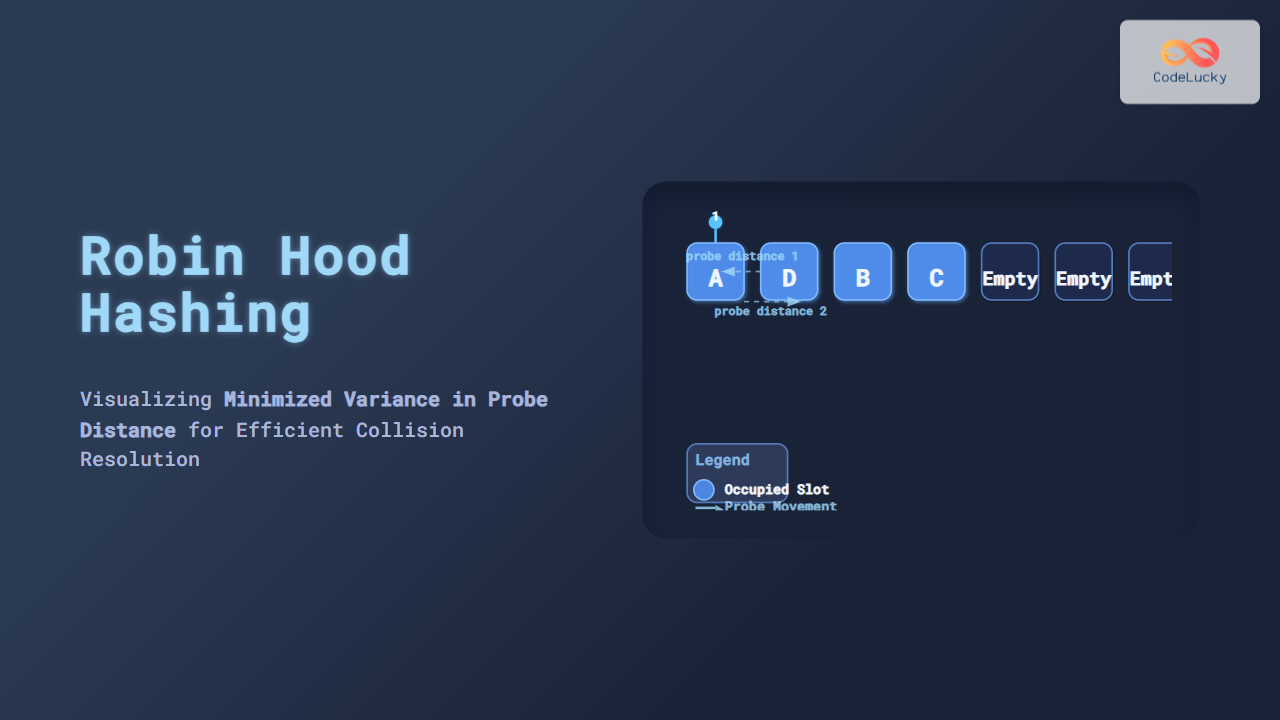
Hashing is a fundamental technique in computer science for implementing efficient lookup tables. However, hash collisions—when multiple keys map to the same position—significantly impact performance. Robin Hood Hashing is an advanced collision resolution strategy designed to minimize the variance in probe distances, leading to more consistent and efficient lookups.
What is Robin Hood Hashing?
Robin Hood Hashing is an open-addressing collision resolution method used in hash tables. Unlike traditional linear probing, which places the new key in the next available slot, Robin Hood Hashing tries to reduce the skew in probe lengths by displacing existing keys if the incoming key has traveled farther (probed more times) than the occupant. In essence, it “robs the rich and gives to the poor” by balancing probe distances, resulting in minimized variance.

How Robin Hood Hashing Works
When inserting a key:
- Calculate its hash index.
- If the slot is empty, store the key there.
- If the slot is occupied, compare the probe distance of the existing occupant with the incoming key’s probe distance.
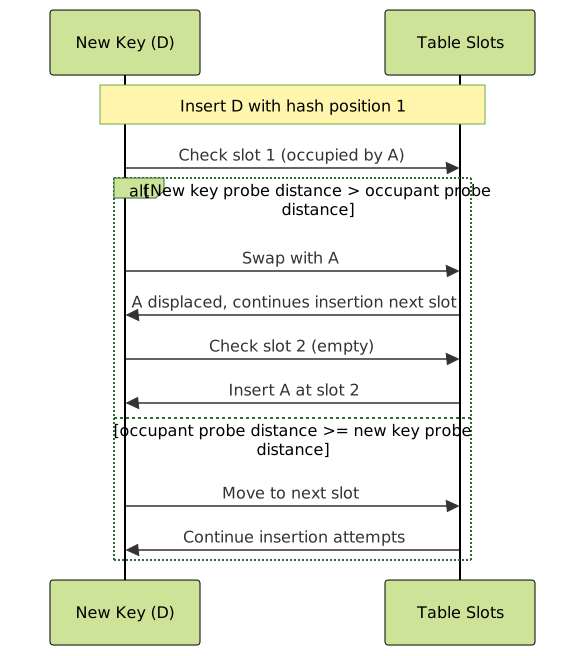
- If the incoming key has probed more times (indicating it’s “poorer”), displace the current occupant (“steal its spot”) and continue inserting the displaced key in subsequent slots.
- This process continues until an empty slot is found.
Probe Distance Concept
Probe distance for a key is the number of steps it’s away from its original hashed position. Minimizing variation in these distances enhances predictability and lookup speed.
Example: Robin Hood Hashing Insertion
Let’s consider a hash table of size 7 and insert keys with the following hash positions:
- Key A → hash 1
- Key B → hash 1 (collision)
- Key C → hash 3
- Key D → hash 1 (collision)
Using linear probing alone, insertion might look as follows:
| Index | 0 | 1 | 2 | 3 | 4 | 5 | 6 |
|---|---|---|---|---|---|---|---|
| Initial | |||||||
| Insert A | A | ||||||
| Insert B | A | B | |||||
| Insert C | A | B | C | ||||
| Insert D | A | B | C | D |
Using Robin Hood Hashing, the insertion attempts to minimize probe distances by displacing keys:
| Index | 0 | 1 | 2 | 3 | 4 | 5 | 6 |
|---|---|---|---|---|---|---|---|
| Initial | |||||||
| Insert A | A | ||||||
| Insert B | A | B | |||||
| Insert C | A | B | C | ||||
| Insert D | D | B | C |
Explanation:
- D has a hash position 1 but probes 0 steps initially; A is at position 1 with probe distance 0.
- D moves to index 1, displacing A that moves forward.
- This keeps probe distances balanced between keys B, C, D, and A.
Benefits of Robin Hood Hashing
- Reduced variance in probe lengths: Lookup times become more predictable and closer to average case.
- Improved cache locality: Because probes typically scatter less.
- More uniform distribution: Avoids clustering common in standard linear probing.
- Better worst-case behavior: Particularly important in high load factors.
Potential Downsides
- Insertion overhead: Due to swapping keys and potentially longer insert probes.
- Complexity in implementation: More intricate than simple linear probing.
Interactive Visualization
The following Mermaid sequence diagram shows a step-by-step insert of a key that displaces others in Robin Hood Hashing:
Summary
Robin Hood Hashing is a powerful hashing technique optimizing open-addressing by equalizing probe distances among keys. This minimization leads to better performance consistency and effective collision handling especially when the hash table load is high. Although insertions can be costlier, the trade-off typically benefits read-heavy applications.
Understanding and implementing Robin Hood Hashing can greatly enhance the efficiency of hash tables in systems where lookup speed and distribution uniformity are critical.