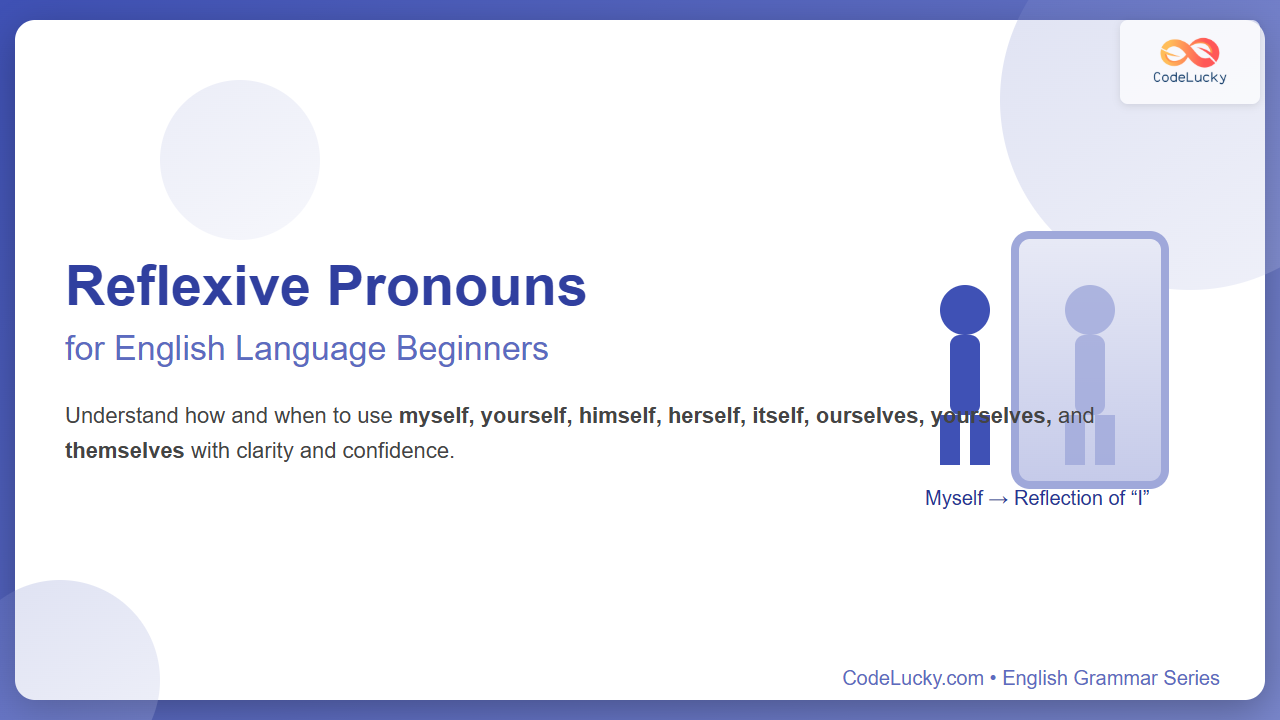
Reflexive pronouns are essential components of English grammar that refer back to the subject of a sentence. They end in -self (singular) or -selves (plural) and are used when the subject and object of a sentence are the same person or thing. Understanding reflexive pronouns helps you communicate more clearly and naturally in English.
What Are Reflexive Pronouns?
A reflexive pronoun reflects the action back to the subject. When someone does something to or for themselves, you use a reflexive pronoun. These pronouns show that the person performing the action is also receiving the action.
For example, in the sentence “She taught herself Spanish,” the word “herself” is a reflexive pronoun because the subject (she) is also the object (the person being taught).
Complete List of Reflexive Pronouns
| Subject Pronoun | Reflexive Pronoun | Example |
|---|---|---|
| I | myself | I prepared myself for the test. |
| You (singular) | yourself | You should believe in yourself. |
| He | himself | He cut himself while shaving. |
| She | herself | She made herself a cup of tea. |
| It | itself | The cat cleaned itself after eating. |
| We | ourselves | We enjoyed ourselves at the party. |
| You (plural) | yourselves | You all did the work yourselves. |
| They | themselves | They organized the event themselves. |
When to Use Reflexive Pronouns
Reflexive pronouns serve three main purposes in English sentences. Understanding these uses helps you apply them correctly in your writing and speaking.
1. When the Subject and Object Are the Same
Use a reflexive pronoun when the person or thing doing the action is also receiving the action. This is the primary and most common use of reflexive pronouns.
Examples:
- John hurt himself while playing football. (John did the hurting, and John received the hurt)
- The children dressed themselves for school. (The children both dressed and were dressed)
- I taught myself to play guitar. (I was both the teacher and the student)
- She reminded herself to buy milk. (She gave the reminder to herself)
2. For Emphasis
Reflexive pronouns can emphasize who performed an action, highlighting that someone did something personally without help from others. In this case, the reflexive pronoun can often be removed without changing the basic meaning.
Examples:
- The CEO himself answered my email. (Emphasizes that the CEO personally replied)
- I baked this cake myself. (Emphasizes that I did it alone, without help)
- The queen herself attended the ceremony. (Emphasizes the queen’s personal presence)
- We painted the house ourselves. (Emphasizes we did it without hiring painters)
3. After Prepositions Referring to the Subject
When a preposition is followed by a pronoun that refers back to the subject, use a reflexive pronoun rather than an object pronoun.
Examples:
- She was proud of herself. (Not “proud of her”)
- He kept the secret to himself. (Not “to him”)
- They were talking among themselves. (Not “among them”)
- Look after yourself while I’m gone. (Not “after you”)

Common Mistakes to Avoid
Many English learners make mistakes when using reflexive pronouns. Avoiding these errors will make your English sound more natural and grammatically correct.
Mistake 1: Using Reflexive Pronouns as Subjects
Never use a reflexive pronoun as the subject of a sentence. This is one of the most common errors.
❌ Incorrect:
- Myself and John went to the store.
- Himself completed the project on time.
✓ Correct:
- John and I went to the store.
- He completed the project on time.
Mistake 2: Using Object Pronouns Instead of Reflexive Pronouns
When the subject and object are the same, you must use a reflexive pronoun, not an object pronoun.
❌ Incorrect:
- She looked at her in the mirror.
- They blamed them for the mistake.
✓ Correct:
- She looked at herself in the mirror.
- They blamed themselves for the mistake.
Mistake 3: Overusing Reflexive Pronouns
Don’t use reflexive pronouns when the subject and object are different people or things.
❌ Incorrect:
- Please give the book to myself. (When someone else is giving you the book)
- She invited John and myself to dinner.
✓ Correct:
- Please give the book to me.
- She invited John and me to dinner.

Reflexive Pronouns vs. Intensive Pronouns
The same words that function as reflexive pronouns can also be used as intensive pronouns. While they look identical, they serve different purposes in sentences.
Reflexive pronouns are necessary for the sentence’s meaning—they show that the subject performs an action on itself. If you remove a reflexive pronoun, the sentence becomes incomplete or changes meaning.
Intensive pronouns emphasize a noun or pronoun but aren’t essential to the sentence’s meaning. You can remove an intensive pronoun, and the sentence still makes sense.
| Type | Example | Can Be Removed? |
|---|---|---|
| Reflexive | She taught herself French. | ❌ No (meaning changes) |
| Intensive | She herself taught the class. | ✓ Yes (meaning stays same) |
| Reflexive | They helped themselves to food. | ❌ No (sentence incomplete) |
| Intensive | The manager himself called me. | ✓ Yes (emphasis only) |
Common Expressions with Reflexive Pronouns
English has many fixed expressions and idioms that use reflexive pronouns. Learning these will help you sound more natural and fluent.
Common Reflexive Expressions:
- Help yourself – Take what you want (often with food or drinks)
- Enjoy yourself – Have a good time
- Behave yourself – Act properly and politely
- Make yourself at home – Feel comfortable and relaxed
- Express yourself – Communicate your thoughts and feelings
- Be yourself – Act naturally, don’t pretend
- Kill yourself (informal) – Work extremely hard
- Pride yourself on – Be proud of something you do well
- Beside yourself – Extremely emotional (angry, worried, etc.)
- By yourself – Alone, without others
- For yourself – For your own benefit or experience
- Among yourselves – Within a group, privately
Example Sentences with Expressions:
- Please help yourself to some cookies on the table.
- Did you enjoy yourself at the concert last night?
- The children need to behave themselves during the ceremony.
- Make yourself at home while you wait for Sarah.
- Art class allows students to express themselves creatively.
- Just be yourself during the job interview.
- She was beside herself with worry when her son didn’t call.
- I prefer to travel by myself rather than in a group.
- You should see for yourself how beautiful the mountains are.
- Discuss the project among yourselves and reach a decision.
Practice Exercise: Identifying Reflexive Pronouns
Test your understanding with this interactive exercise. Choose the correct pronoun to complete each sentence.
Exercise Questions:
- I made this lunch ______. (myself / me / I)
- Sarah looked at ______ in the mirror. (her / herself / she)
- The dog hurt ______ while running. (it / itself / its)
- We should ask ______ important questions. (ourselves / us / we)
- Did you and Tom enjoy ______ at the party? (yourself / yourselves / you)
- The students organized the event ______. (them / themselves / their)
- He talks to ______ when he’s nervous. (him / himself / he)
- They blamed ______ for the accident. (them / themselves / their)
Click to see answers
- myself – Same subject and object
- herself – Sarah is both looking and being looked at
- itself – The dog hurt the dog (same subject/object)
- ourselves – We should ask ourselves (reflexive after “ask”)
- yourselves – Plural “you” (you and Tom)
- themselves – Emphasis on students doing it personally
- himself – He talks to himself (same person)
- themselves – They blamed themselves (same group)
Reflexive Pronouns in Different Sentence Structures
Understanding how reflexive pronouns work in various sentence types helps you use them correctly in all situations.
In Simple Sentences
- Subject + Verb + Reflexive Pronoun: Tom introduced himself.
- Subject + Verb + Reflexive Pronoun + Prepositional Phrase: She looked at herself in the window.
In Compound Sentences
- Mary taught herself piano, and she became quite skilled.
- They prepared themselves for the exam, but it was harder than expected.
In Questions
- Did you hurt yourself during the game?
- Have they introduced themselves to the new neighbors?
- Can she take care of herself while you’re away?
In Negative Sentences
- He didn’t hurt himself in the accident.
- We shouldn’t blame ourselves for what happened.
- They haven’t prepared themselves properly for the trip.

Special Cases and Exceptions
Certain verbs and situations in English have special rules regarding reflexive pronouns. Understanding these exceptions prevents common errors.
Verbs That Don’t Need Reflexive Pronouns
Some actions that involve the subject acting on itself don’t require reflexive pronouns in English, even though they might in other languages.
Common verbs without reflexive pronouns:
- Wash, shave, dress, bathe – I washed and dressed quickly. (Not “washed myself”)
- Sit down, stand up, wake up – Please sit down. (Not “sit yourself down”)
- Feel (emotions) – I feel happy today. (Not “feel myself happy”)
- Relax, concentrate – Try to relax. (Not “relax yourself”)
Exception: You can add reflexive pronouns to these verbs for emphasis: “I dressed myself despite my injury.”
Reciprocal vs. Reflexive Actions
Don’t confuse reflexive pronouns with reciprocal pronouns (each other, one another), which show mutual action between two or more people.
Comparison:
- Reflexive: They looked at themselves in the mirror. (Each person looked at their own reflection)
- Reciprocal: They looked at each other. (Person A looked at Person B, and Person B looked at Person A)
Tips for Mastering Reflexive Pronouns
Follow these practical strategies to improve your use of reflexive pronouns and avoid common mistakes.
- Ask “Who receives the action?” – If the answer is the same as the subject, use a reflexive pronoun.
- Try removing the pronoun – If the sentence still makes sense, it’s probably intensive (for emphasis). If not, it’s reflexive (necessary).
- Match the pronoun to the subject – Always ensure the reflexive pronoun agrees with the subject in person and number.
- Practice with common expressions – Learn fixed phrases like “enjoy yourself” and “help yourself” as complete units.
- Listen to native speakers – Pay attention to when reflexive pronouns are used in movies, podcasts, and conversations.
- Write practice sentences – Create your own examples using each reflexive pronoun to reinforce learning.
Real-World Applications
Reflexive pronouns appear frequently in everyday English across various contexts. Understanding these practical applications helps you communicate naturally.
In Personal Development
- Believe in yourself, and others will too.
- She challenged herself to learn a new skill every month.
- They pushed themselves beyond their comfort zone.
In Daily Activities
- I made myself breakfast this morning.
- The children entertained themselves with board games.
- He reminded himself to call his mother.
In Professional Settings
- Please introduce yourself to the team.
- The CEO himself approved the project.
- We need to hold ourselves accountable for results.
Summary and Key Takeaways
Reflexive pronouns are fundamental to clear English communication. They end in -self or -selves and refer back to the subject of the sentence.
Remember These Key Points:
- Use reflexive pronouns when the subject and object are the same person or thing
- The eight reflexive pronouns are: myself, yourself, himself, herself, itself, ourselves, yourselves, themselves
- Reflexive pronouns can also be used for emphasis (intensive function)
- Never use reflexive pronouns as subjects of sentences
- Match the reflexive pronoun to the subject in person and number
- Many common English expressions use reflexive pronouns idiomatically
- Some verbs don’t require reflexive pronouns even when the action affects the subject
Mastering reflexive pronouns takes practice, but with consistent use and attention to the rules outlined in this guide, you’ll develop natural fluency. Keep practicing with real-world examples, and soon using reflexive pronouns will become second nature in your English communication.
💡 Pro Tip: When in doubt, ask yourself: “Is the person doing the action also receiving it?” If yes, use a reflexive pronoun. If no, use a regular object pronoun.