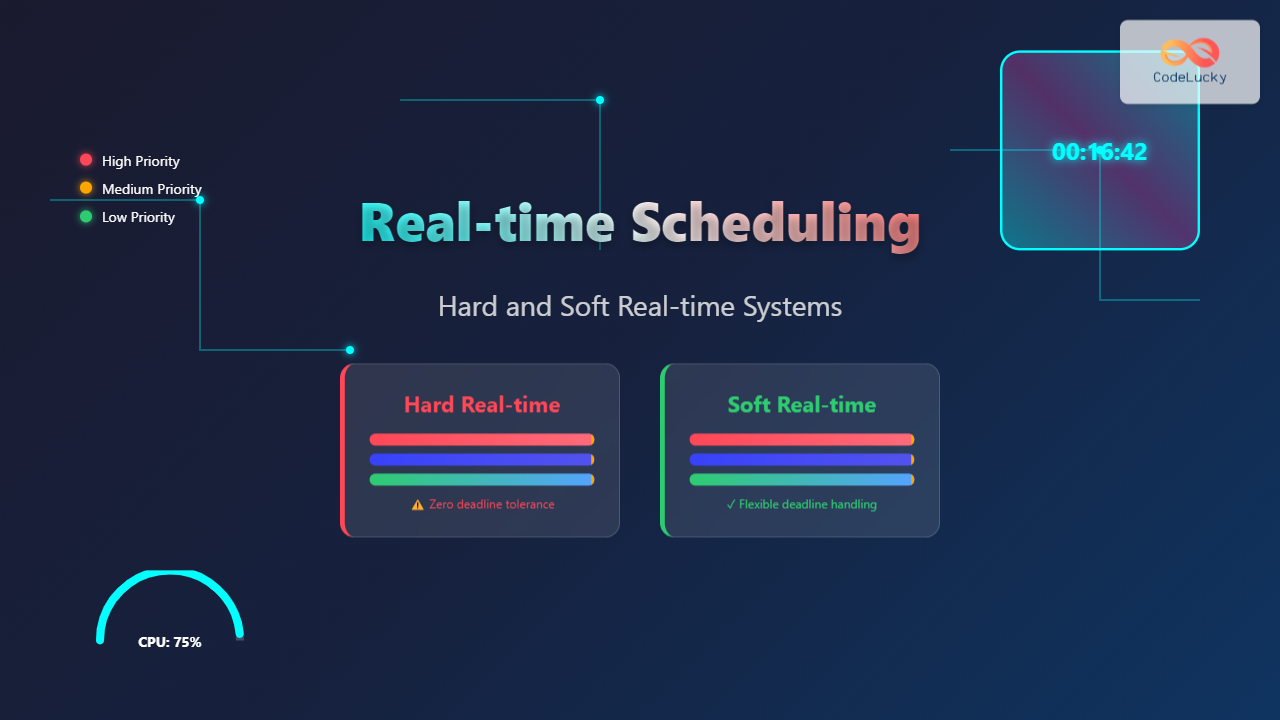
Real-time scheduling is a critical component of operating systems that manage tasks with strict timing requirements. Unlike traditional scheduling systems that prioritize throughput and fairness, real-time scheduling focuses on meeting deadlines and ensuring predictable system behavior. This comprehensive guide explores the fundamental concepts, types, and implementation strategies of real-time scheduling systems.
What is Real-time Scheduling?
Real-time scheduling is a CPU scheduling discipline designed for systems where tasks must complete within specified time constraints. The scheduler must guarantee that critical tasks meet their deadlines while maintaining system stability and predictability.
Key characteristics of real-time scheduling include:
- Deterministic behavior – System responses are predictable
- Deadline awareness – Scheduler considers task completion times
- Priority-based execution – Critical tasks receive higher precedence
- Bounded response times – Maximum execution times are known

Hard Real-time Systems
Hard real-time systems have absolute deadline requirements where missing a deadline can result in catastrophic system failure. These systems prioritize correctness over performance and require guaranteed response times.
Characteristics of Hard Real-time Systems
- Zero tolerance for deadline misses – Late completion is considered system failure
- Predictable worst-case execution times – All timing parameters must be known
- Static scheduling preferred – Pre-computed schedules ensure predictability
- Resource reservation – System resources are allocated in advance
Examples of Hard Real-time Systems
Aircraft Control Systems:
Flight Control Task Schedule:
- Navigation Update: Every 10ms (Critical)
- Altitude Control: Every 50ms (Critical)
- Engine Management: Every 100ms (Critical)
- Communication: Every 200ms (Important)

Deadline Miss Consequence: Aircraft crash
Medical Device Controllers:
Pacemaker Scheduling:
- Heart Rate Monitor: Every 1ms
- Pulse Generation: Every 800ms
- Battery Check: Every 1000ms
- Emergency Detection: Every 5ms

Deadline Miss Consequence: Patient death

Soft Real-time Systems
Soft real-time systems have flexible deadline requirements where occasional deadline misses are tolerable but degrade system performance. These systems balance timeliness with overall system efficiency.
Characteristics of Soft Real-time Systems
- Degraded performance acceptable – Late completion reduces quality but doesn’t cause failure
- Statistical guarantees – Most deadlines are met, not all
- Dynamic scheduling allowed – Runtime scheduling decisions are acceptable
- Best-effort delivery – System attempts to meet deadlines when possible
Examples of Soft Real-time Systems
Multimedia Applications:
Video Playback Schedule:
- Frame Decode: Every 33ms (60 FPS target)
- Audio Buffer: Every 10ms
- Display Refresh: Every 16ms
- User Interface: Every 100ms

Deadline Miss Consequence: Frame drops, audio stutters
Web Server Response:
HTTP Request Processing:
- Database Query: 500ms target
- Template Rendering: 200ms target
- Response Generation: 100ms target
- Cache Update: 1000ms target

Deadline Miss Consequence: Slower user experience
Real-time Scheduling Algorithms
Rate Monotonic Scheduling (RMS)
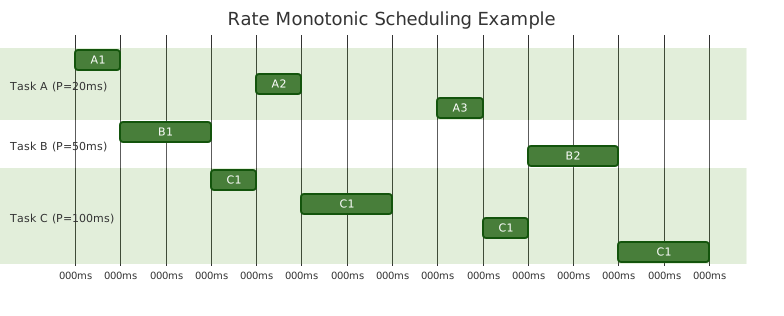
Rate Monotonic Scheduling is a static priority algorithm where tasks with shorter periods receive higher priorities. It’s optimal for periodic tasks in hard real-time systems.
RMS Algorithm Steps:
- Assign priorities based on task periods (shorter period = higher priority)
- Schedule highest priority ready task
- Preempt lower priority tasks when higher priority task becomes ready
- Continue until all tasks complete or deadlines are missed
Example Implementation:
Task Set:
- Task A: Period = 20ms, Execution = 5ms, Priority = 1 (highest)
- Task B: Period = 50ms, Execution = 10ms, Priority = 2
- Task C: Period = 100ms, Execution = 15ms, Priority = 3 (lowest)

Schedulability Test:
Utilization = (5/20) + (10/50) + (15/100) = 0.25 + 0.20 + 0.15 = 0.60

Since U ≤ n(2^(1/n) - 1) = 3(2^(1/3) - 1) ≈ 0.78, schedule is feasible.
Earliest Deadline First (EDF)
Earliest Deadline First is a dynamic priority algorithm that assigns highest priority to the task with the earliest absolute deadline. It’s optimal for both hard and soft real-time systems.
EDF Algorithm Steps:
- Calculate absolute deadlines for all ready tasks
- Select task with earliest deadline
- Preempt current task if new task has earlier deadline
- Execute selected task until completion or preemption
Example Schedule:
Current Time: 0ms
Ready Tasks:
- Task X: Deadline = 30ms, Remaining = 8ms
- Task Y: Deadline = 25ms, Remaining = 12ms
- Task Z: Deadline = 40ms, Remaining = 6ms

EDF Selection: Task Y (earliest deadline = 25ms)

Time 0-12ms: Execute Task Y
Time 12ms: Task Y completes
Next Selection: Task X (deadline = 30ms)
Deadline Miss Handling Strategies
Hard Real-time Deadline Miss
When hard real-time systems miss deadlines, immediate action is required:
- System shutdown – Graceful termination to prevent damage
- Failover activation – Switch to backup system
- Emergency protocols – Execute predefined safety procedures
- Error logging – Record failure for analysis
Implementation Example:
void handle_hard_deadline_miss(task_t *task) {
    // Log critical error
    log_critical("Hard deadline miss: Task %s at time %d",
                 task->name, current_time());

    // Activate emergency protocols
    activate_emergency_mode();

    // Initiate system shutdown
    if (task->criticality == SAFETY_CRITICAL) {
        emergency_shutdown();
    } else {
        initiate_failover();
    }
}
Soft Real-time Deadline Miss
Soft real-time systems handle deadline misses more gracefully:
- Quality degradation – Reduce output quality to catch up
- Task skipping – Skip less important tasks
- Load shedding – Temporarily reduce system load
- Priority adjustment – Modify task priorities dynamically

Real-time Operating System Features
Preemptive Kernels
Real-time systems require preemptive kernels that can interrupt running tasks to ensure high-priority tasks execute immediately:
// Kernel preemption example
void schedule_realtime_task(task_t *new_task) {
    task_t *current = get_running_task();

    if (new_task->priority > current->priority) {
        // Preempt current task
        context_save(current);
        context_switch(new_task);

        // Update scheduler state
        current->state = READY;
        new_task->state = RUNNING;

        // Record preemption event
        log_preemption(current, new_task);
    }
}
Priority Inheritance Protocol
Priority inheritance prevents priority inversion where high-priority tasks are blocked by low-priority tasks holding required resources:
void acquire_mutex_with_inheritance(mutex_t *mutex) {
    task_t *current = get_current_task();
    task_t *holder = mutex->holder;

    if (holder && holder->priority < current->priority) {
        // Inherit higher priority temporarily
        holder->inherited_priority = current->priority;
        reschedule_task(holder);

        log_priority_inheritance(holder, current);
    }

    // Block until mutex is available
    wait_for_mutex(mutex);
}
Performance Metrics and Analysis
Key Metrics for Real-time Systems
Schedulability Analysis:
- CPU Utilization – Percentage of CPU time used by tasks
- Response Time – Time from task activation to completion
- Deadline Miss Ratio – Percentage of missed deadlines
- Jitter – Variation in task execution times
Calculation Examples:
// CPU Utilization Calculation
Task Set Analysis:
- Task 1: C=10ms, T=50ms, U1 = 10/50 = 0.2
- Task 2: C=15ms, T=100ms, U2 = 15/100 = 0.15
- Task 3: C=20ms, T=200ms, U3 = 20/200 = 0.1

Total Utilization = 0.2 + 0.15 + 0.1 = 0.45 (45%)

// Response Time Analysis
Worst Case Response Time (WCRT):
R1 = C1 = 10ms (highest priority)
R2 = C2 + ceil(R2/T1) * C1 = 15 + ceil(25/50) * 10 = 25ms
R3 = C3 + ceil(R3/T1) * C1 + ceil(R3/T2) * C2
Implementation Considerations
Memory Management
Real-time systems require deterministic memory allocation to avoid unpredictable delays:
- Static allocation – Pre-allocate all required memory at startup
- Memory pools – Use fixed-size memory pools for dynamic allocation
- Garbage collection avoidance – Prevent non-deterministic cleanup
- Memory locking – Prevent swapping of critical memory pages
// Real-time memory pool implementation
typedef struct {
    void *pool_start;
    size_t block_size;
    size_t total_blocks;
    bitmap_t free_blocks;
    spinlock_t lock;
} rt_memory_pool_t;

void* rt_alloc(rt_memory_pool_t *pool) {
    spin_lock(&pool->lock);

    int free_block = find_first_free_bit(pool->free_blocks);
    if (free_block == -1) {
        spin_unlock(&pool->lock);
        return NULL; // Pool exhausted
    }

    set_bit(pool->free_blocks, free_block);
    void *ptr = pool->pool_start + (free_block * pool->block_size);

    spin_unlock(&pool->lock);
    return ptr;
}
Interrupt Handling
Efficient interrupt handling is crucial for maintaining real-time guarantees:
// Two-level interrupt handling
void hardware_interrupt_handler(void) {
    // Minimal work in interrupt context
    disable_interrupts();

    // Acknowledge interrupt
    ack_interrupt_controller();

    // Schedule bottom half processing
    schedule_bottom_half();

    enable_interrupts();
}

void bottom_half_processor(void) {
    // Process interrupt in task context
    // Can be preempted by higher priority tasks
    process_deferred_work();
}
Real-world Applications
Automotive Systems
Modern vehicles extensively use real-time scheduling for safety-critical systems:
Automotive ECU Task Schedule:
Engine Control Unit (Hard Real-time):
- Fuel Injection: Every 5ms
- Ignition Timing: Every 2ms
- Sensor Reading: Every 1ms

Anti-lock Braking System (Hard Real-time):
- Wheel Speed Monitor: Every 1ms
- Brake Pressure Control: Every 5ms
- Safety Check: Every 10ms

Infotainment System (Soft Real-time):
- Audio Processing: Every 20ms
- Display Update: Every 33ms
- User Input: Every 50ms
Industrial Automation
Manufacturing systems rely on precise timing for coordination and safety:
Robot Control System:
Motion Control (Hard Real-time):
- Joint Position Update: Every 1ms
- Safety Monitoring: Every 2ms
- Force Feedback: Every 5ms

Process Control (Soft Real-time):
- Temperature Regulation: Every 100ms
- Quality Monitoring: Every 500ms
- Production Logging: Every 1000ms
Conclusion
Real-time scheduling is essential for systems where timing constraints are critical for correct operation. Hard real-time systems demand absolute deadline guarantees for safety-critical applications, while soft real-time systems provide flexibility for performance-oriented applications.
Key takeaways include:
- Algorithm selection depends on system requirements and task characteristics
- Schedulability analysis is crucial for system design validation
- Implementation details significantly impact real-time performance
- Trade-offs exist between determinism and system efficiency
Understanding these concepts enables developers to design robust real-time systems that meet strict timing requirements while maintaining system reliability and performance. Whether building embedded control systems or multimedia applications, proper real-time scheduling ensures predictable and reliable system behavior.
Related Posts
Real-time Operating System: Complete Guide to RTOS Characteristics and Examples
A Real-time Operating System (RTOS) is a specialized operating system designed to handle tasks with strict timing constraints. Unlike traditional...
Process Scheduling in Operating System: Algorithms, Types & Implementation Guide
Process scheduling is one of the most critical components of an operating system that determines how the CPU time is...

Completely Fair Scheduler: Linux CFS Algorithm Deep Dive
The Linux Completely Fair Scheduler (CFS) revolutionized process scheduling in the Linux kernel when it was introduced in version 2.6.23....

Preemptive vs Non-Preemptive Scheduling: Complete Guide to CPU Scheduling in Operating Systems
Understanding CPU Scheduling in Operating Systems CPU scheduling is one of the most critical functions of an operating system, determining...
Virtual CPU Scheduling: Complete Guide to Time-sharing Physical Processors
Virtual CPU scheduling is the cornerstone of modern operating systems, enabling multiple processes to share limited physical processors efficiently. This...

Multilevel Queue Scheduling: Multiple Priority Levels in Operating Systems
Introduction to Multilevel Queue Scheduling Multilevel queue scheduling is a sophisticated CPU scheduling algorithm used in operating systems to manage...

Priority Scheduling Algorithm: Complete Implementation Guide with Examples
What is Priority Scheduling Algorithm? Priority scheduling is a CPU scheduling algorithm where each process is assigned a priority value,...

Operating System Types: Real-time, Distributed, Mobile and Desktop Systems Explained
Operating systems serve as the crucial bridge between computer hardware and software applications, but not all operating systems are created...
Embedded Operating System: Complete Guide to Resource-Constrained Environments
Embedded operating systems form the backbone of countless devices we interact with daily, from smart home appliances to automotive control...

Fair Share Scheduling: Resource Allocation by User Groups in Operating Systems
Introduction to Fair Share Scheduling Fair Share Scheduling (FSS) is a sophisticated CPU scheduling algorithm designed to allocate computing resources...

Lottery Scheduling: Fair CPU Allocation Through Proportional Sharing
Introduction to Lottery Scheduling Lottery scheduling is a probabilistic CPU scheduling algorithm that provides proportional share resource allocation by assigning...

CPU Scheduling Algorithms: FCFS, SJF, Round Robin Complete Guide
CPU scheduling is a fundamental concept in operating systems that determines how processes are allocated processor time. The CPU scheduler...