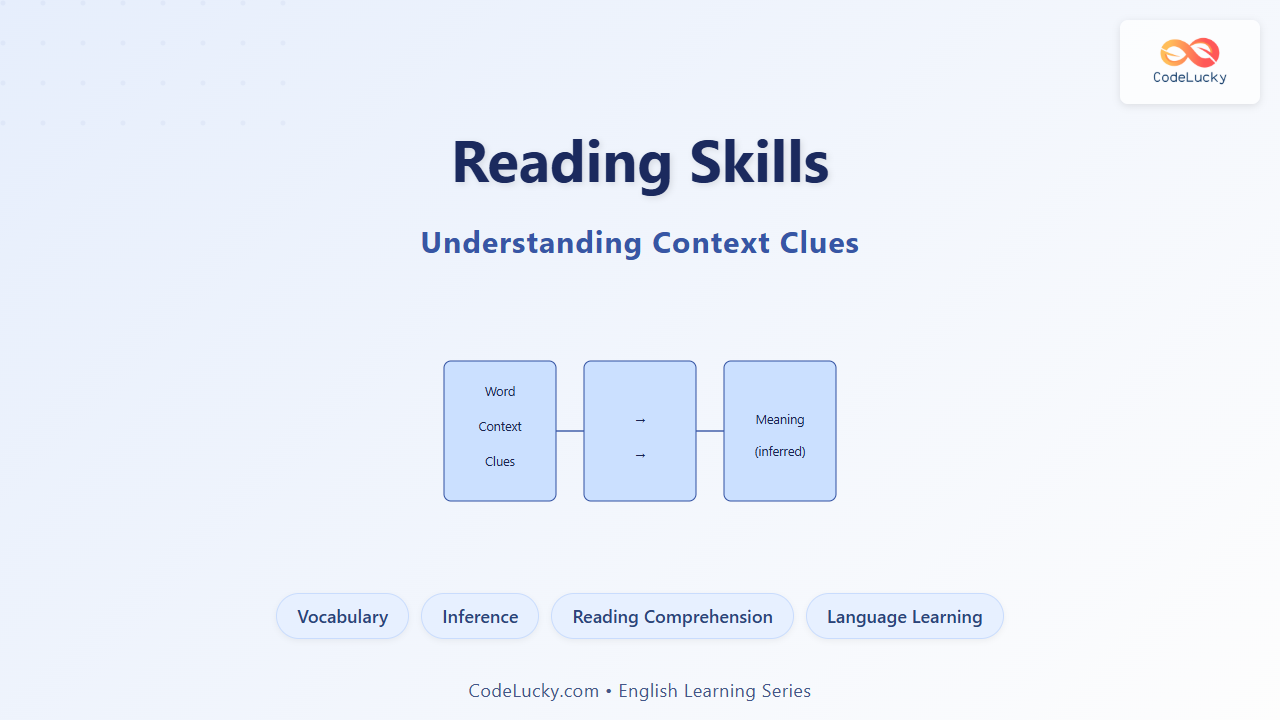
Reading Skills: Understanding Context Clues is one of the most essential abilities for anyone looking to improve their English comprehension. Whether you’re reading textbooks, novels, or online articles, understanding unfamiliar words without immediately reaching for a dictionary is a game-changer. This article explores what context clues are, their types, and how to use them effectively—complete with examples and interactive practices.
What Are Context Clues?
Context clues are hints or bits of information found within a sentence or paragraph that help a reader determine the meaning of an unfamiliar word. Writers often include these clues to make their writing more understandable and fluid.

In simpler terms, if you encounter a word you don’t know, look around it. The surrounding words often give you valuable signals about its meaning.
Why Are Context Clues Important?
- They make reading faster and smoother.
- They help you understand without constant dictionary use.
- They expand your vocabulary naturally.
- They improve critical thinking and interpretation skills.
Types of Context Clues
Let’s explore the main categories of context clues and see examples of each.
1. Definition or Explanation Clues
The unknown word is explained directly in the sentence.
Example: “Arthropods, which are animals with jointed legs and exoskeletons, include insects and spiders.”
Clue Type: Definition — The sentence explains what arthropods are.
2. Synonym or Restatement Clues
The sentence uses a familiar word or phrase that means the same thing.
Example: “The artist was meticulous, or extremely careful, about every brushstroke.”
Clue Type: Synonym — The phrase “extremely careful” gives the meaning.
3. Antonym or Contrast Clues
The sentence includes a word or phrase with an opposite meaning as a hint.
Example: “Unlike his gregarious sister, who loved parties, Sam preferred quiet evenings alone.”
Clue Type: Antonym — “Unlike” shows a contrast; being “gregarious” means sociable.
4. Example Clues
Words like “such as,” “for example,” or “including” introduce clues by listing examples.
Example: “Celestial bodies such as stars, planets, and comets fill the universe.”
Clue Type: Example — The examples explain what celestial bodies are.
5. Inference or General Sense Clues
Sometimes the surrounding text implies the meaning without defining it outright.
Example: “He felt an overwhelming sense of rapture as he listened to the symphony.”
Clue Type: Inference — The emotional tone suggests “rapture” means great joy or delight.

How to Identify Context Clues Step-by-Step
- Spot the unfamiliar word. Pause when a word feels unclear.
- Read the full sentence. Don’t isolate the word—context lives around it.
- Look for signal words such as “or,” “unlike,” “such as,” or “that is.”
- Evaluate logic and tone. Ask what feeling or action fits the context.
- Test your guess. Replace the word mentally with your hypothesized meaning.
Interactive Practice: Guess the Meaning!
Try to infer the meaning of the bolded words using the given clues.
- The desert is arid, making it hard for most plants to survive. (Clue: desert environment)
- After hours of work, the kitchen was finally immaculate. (Clue: result after cleaning)
- His melancholy mood made everyone in the room quiet. (Clue: emotional tone)
Show Possible Answers
- Arid → Dry
- Immaculate → Spotless
- Melancholy → Sad or gloomy
Common Signal Words for Context Clues
Identifying certain words can make clue detection faster. Here’s a quick reference:
| Type of Clue | Signal Words or Phrases |
|---|---|
| Definition | that is, which means, refers to, in other words |
| Synonym | or, also known as, similar to |
| Antonym | but, however, on the other hand, unlike |
| Example | such as, for example, like, including |
| Inference | no direct markers; infer from tone or theme |
Visual Flow: How Context Helps Meaning

Tips to Strengthen Context Clue Skills
- Read widely—different kinds of writing expose you to new word uses.
- Keep a journal of words you decode through context instead of a dictionary.
- Play vocabulary games that focus on inference.
- Discuss readings—talking helps strengthen memory and meaning recognition.
Example Passage and Walkthrough
Let’s apply the skill in a realistic paragraph.
The cacophony from the construction site made it impossible to concentrate. Drills buzzed, hammers pounded, and workers shouted instructions across the yard.
Even if “cacophony” is unfamiliar, the noisy setting clues us in—it must mean a harsh mix of sounds.

Conclusion
Understanding context clues transforms the way you read. Instead of memorizing vocabulary lists, you’ll grow your word power naturally by recognizing patterns, tone, and structure. Practice regularly, and you’ll find that meaning often hides right in plain sight—waiting for you to discover it through context.
At CodeLucky.com, we believe mastering context clues is more than a reading skill—it’s a thinking skill that empowers lifelong learners.