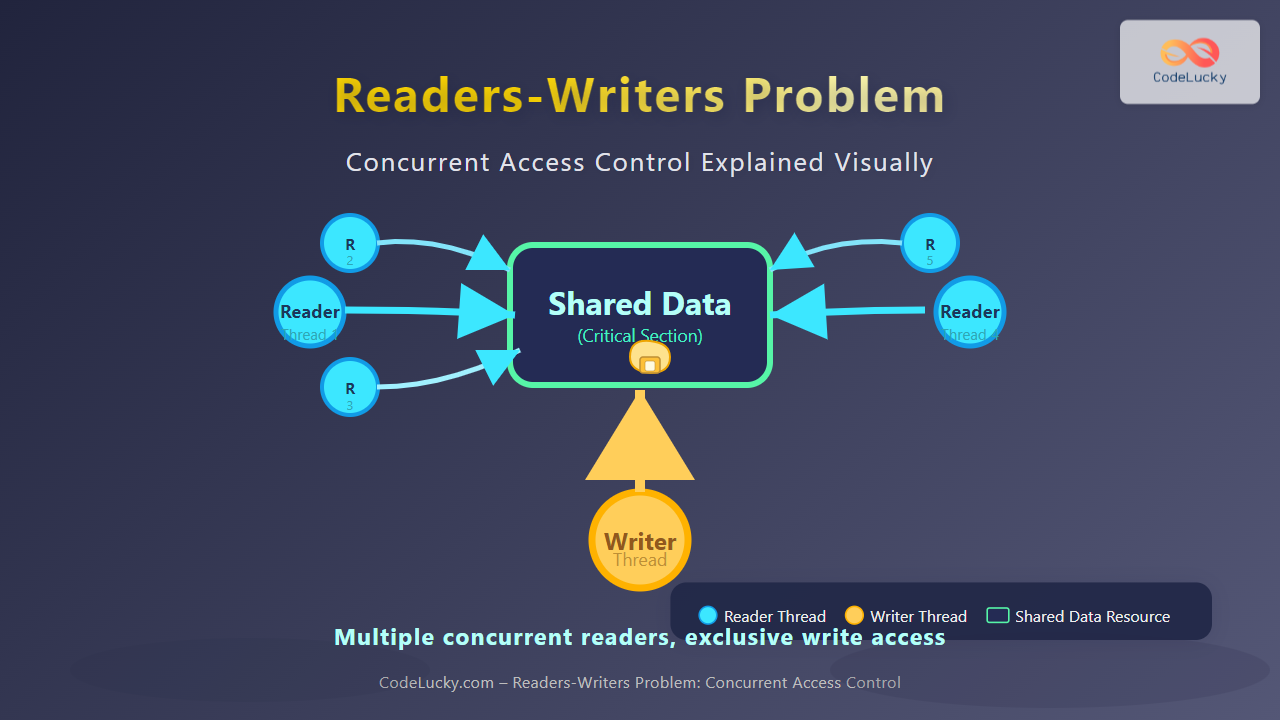
The Readers-Writers Problem is a classic synchronization challenge in concurrent programming, central to managing data consistency and maximizing parallelism in shared resources. This article provides an in-depth, SEO-friendly guide to the problem, its types, solutions, and real-world impact, packed with clear examples, visuals, and unique explanations for CodeLucky.com readers.
- Introduction to the Readers-Writers Problem
- Formal Problem Statement
- Real-World Applications
- Types and Variants
- Solution Strategies
- Illustrative Example (with Visual Output)
- Visualizations with Mermaid Diagrams
- Challenges and Limitations
- Conclusion
Introduction to the Readers-Writers Problem
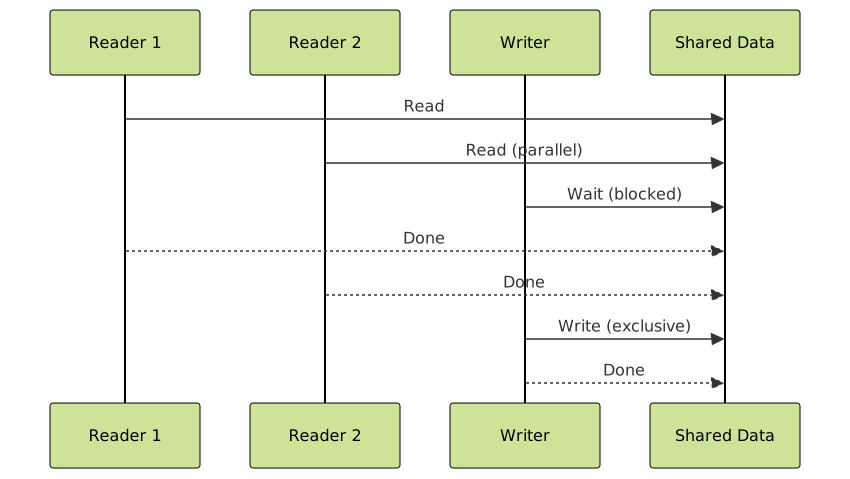
When multiple threads (or processes) need to access shared data, conflicts can arise. The Readers-Writers Problem models such conflicts where readers can safely access the resource concurrently, but writers require exclusive access. The goal is to allow maximum parallelism while preventing data inconsistency or race conditions.
Formal Problem Statement
The challenge is to design a concurrent protocol ensuring:
- Multiple readers can access a shared resource simultaneously.
- Only a single writer may access (write) at a time – no readers or other writers should be allowed concurrently.
- No thread (reader or writer) should suffer from starvation.
This can be formalized as:
- Any number of readers may read the data at the same time.
- Only one writer can modify the data, with no readers present.
Real-World Applications
- Databases: Concurrency control during read-write operations.
- File Systems: Managing access to files between editors and viewers.
- Caching: Serving multiple cache reads while handling cache invalidations by writers.
- Configuration Management: Allowing many clients to read prefs, only one to update at a time.
Types and Variants
There are three common variants of the Readers-Writers Problem, each prioritizing either readers, writers, or fairness.

- First Readers-Writers Problem (Readers Preference): Readers have priority, possible writer starvation.
- Second Readers-Writers Problem (Writers Preference): Writers have priority, possible reader starvation.
- Third/Fair Solution: Ensures neither is starved by queueing threads in order of arrival.
Solution Strategies
Efficient synchronization requires mechanisms like mutexes, semaphores, and sometimes custom lock objects. Let’s analyze the typical approaches:
Classic Readers Preference Solution (Pseudocode)
Semaphore mutex = 1      // for counter synchronization
Semaphore wrt = 1        // controls writer access
int readcount = 0

Reader Process:
    wait(mutex)
    readcount++
    if (readcount == 1) wait(wrt) // first reader locks write access
    signal(mutex)
    // Reading section
    wait(mutex)
    readcount--
    if (readcount == 0) signal(wrt) // last reader releases write lock
    signal(mutex)

Writer Process:
    wait(wrt)
    // Writing section
    signal(wrt)
This solution allows multiple readers when no writer is active, but may starve writers.
Writers Preference (Starvation-Free) Solution (Pseudocode)
Semaphore mutex = 1
Semaphore wrt = 1
Semaphore readTry = 1
int readcount = 0, writecount = 0

Reader Process:
    wait(readTry)
    wait(mutex)
    readcount++
    if (readcount == 1) wait(wrt)
    signal(mutex)
    signal(readTry)
    // Reading section
    wait(mutex)
    readcount--
    if (readcount == 0) signal(wrt)
    signal(mutex)

Writer Process:
    wait(mutex)
    writecount++
    if (writecount == 1) wait(readTry)
    signal(mutex)
    wait(wrt)
    // Writing section
    signal(wrt)
    wait(mutex)
    writecount--
    if (writecount == 0) signal(readTry)
    signal(mutex)
This approach prevents both reader and writer starvation by ensuring writers get a chance.
Illustrative Example (with Visual Output)
Here’s a simplified Python pseudocode demonstrating concurrent readers and writers using threading and locks.
import threading
import time
from random import randint

# Shared data and lock variables
data = 0
readcount = 0
mutex = threading.Lock()
wrt = threading.Lock()

def reader(id):
    global readcount
    while True:
        with mutex:
            readcount += 1
            if readcount == 1:
                wrt.acquire()
        print(f"Reader-{id} reading value: {data}")
        time.sleep(randint(1,3))
        with mutex:
            readcount -= 1
            if readcount == 0:
                wrt.release()
        time.sleep(randint(1,2))

def writer(id):
    global data
    while True:
        wrt.acquire()
        data += 1
        print(f"Writer-{id} updated value to: {data}")
        time.sleep(randint(2,4))
        wrt.release()
        time.sleep(randint(1,3))
This will produce output like:
Reader-1 reading value: 7

Writer-1 updated value to: 8

Reader-2 reading value: 8

Reader-3 reading value: 8

Writer-1 updated value to: 9
Visualizations with Mermaid Diagrams
1. Simple Sequence: One Writer, Multiple Readers
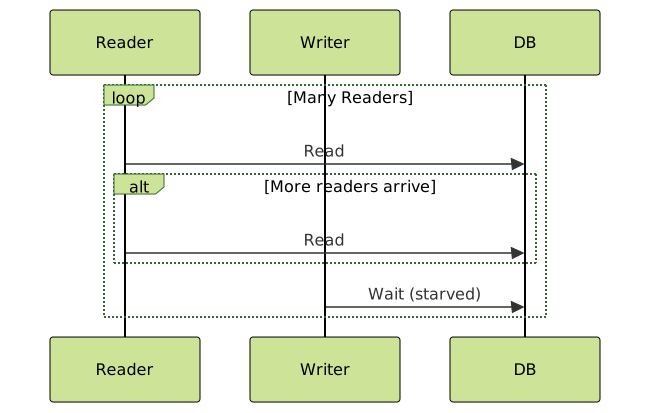
2. Starvation Scenario: Writer Waiting
3. Entry Condition Decision

4. Starvation-Free Fair Queue

Challenges and Limitations
- Starvation: Poor protocol design may starve writers (or readers) if a steady stream of the other group keeps arriving.
- Performance Overheads: Over-synchronization may decrease concurrency. Token/fair lock systems can help but may add complexity and context-switch overhead.
- Priority Inversion: Real-world systems must avoid priority inversion by factoring thread priorities alongside protocol rules.
Conclusion
The Readers-Writers Problem demonstrates foundational concurrency control concepts essential in modern multi-threaded systems. Understanding its nuances, patterns, and practical implementations equips developers to build robust, efficient, and fair data-access solutions. Explore further by experimenting with the example code and visualizing problem scenarios using the mermaid diagrams provided above.