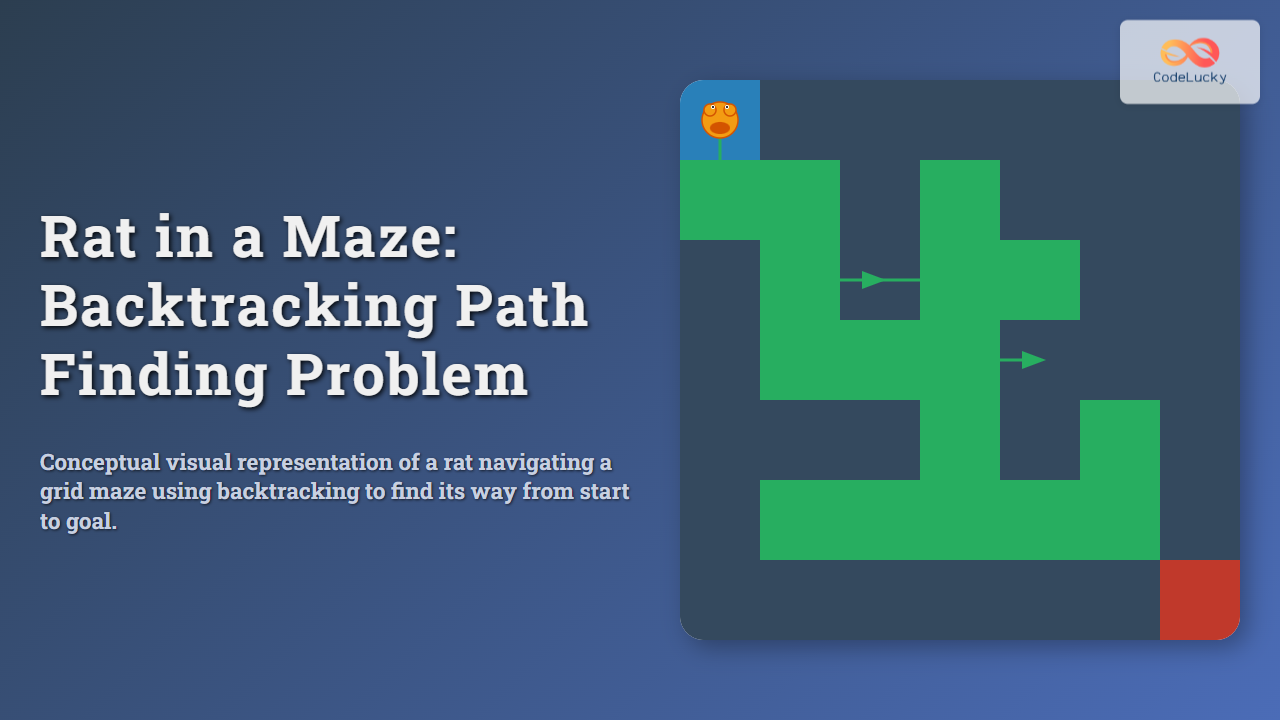
The Rat in a Maze problem is a classic computer science challenge that demonstrates the power of backtracking algorithms. It is often used to teach fundamental concepts of recursion, constraint satisfaction, and path-finding strategies. In this problem, you are tasked with finding a path for a rat starting from the top-left corner of a maze to reach the bottom-right corner while navigating through valid paths.
This article explores the Rat in a Maze backtracking approach, provides Python implementations, complexity analysis, and uses visual explanations for better understanding.
What is the Rat in a Maze Problem?
The maze is represented as a grid (a two-dimensional matrix) where:
1represents a valid path (open cell).0represents a blocked cell (wall).
The rat starts at (0,0) (top left) and must reach (n-1,n-1) (bottom right), moving only in allowed directions such as:
- Down (
D) - Right (
R) - Up (
U) – if moves are allowed - Left (
L) – if moves are allowed

How Backtracking is Used?
Backtracking works on the principle of explore, check, and undo. The rat moves step by step, tries all possible paths recursively, and when it hits a dead end, it backtracks to the previous step to try another route. This continues until the goal is found or all paths are exhausted.
Steps of the Algorithm:
- Start from cell (0,0).
- Check if the current cell is safe (within bounds and not blocked).
- Mark the cell as part of the solution path.
- Move to the next possible cell (Right, Down, Left, Up).
- If no valid path is found, unmark the cell (backtrack).
- Continue until destination is reached.
Python Implementation
def is_safe(maze, x, y, n):
    return 0 <= x < n and 0 <= y < n and maze[x][y] == 1

def solve_maze_util(maze, x, y, solution, n):
    if x == n - 1 and y == n - 1:  # goal reached
        solution[x][y] = 1
        return True

    if is_safe(maze, x, y, n):
        solution[x][y] = 1  # mark as part of solution

        # Move Right
        if solve_maze_util(maze, x, y + 1, solution, n):
            return True
        # Move Down
        if solve_maze_util(maze, x + 1, y, solution, n):
            return True

        # Backtrack
        solution[x][y] = 0
        return False

    return False

def solve_maze(maze):
    n = len(maze)
    solution = [[0] * n for _ in range(n)]

    if solve_maze_util(maze, 0, 0, solution, n):
        for row in solution:
            print(row)
    else:
        print("No solution exists")

# Example Maze
maze = [
    [1, 0, 0, 0],
    [1, 1, 0, 1],
    [0, 1, 0, 0],
    [1, 1, 1, 1]
]

solve_maze(maze)
Output:
[1, 0, 0, 0]
[1, 1, 0, 0]
[0, 1, 0, 0]
[0, 1, 1, 1]
The solution matrix marks 1 where the rat travels and 0 otherwise.

Exploring All Possible Paths
The above solution stops when it finds the first valid path. However, many interview and competitive programming problems require finding all possible paths. We can modify the function to explore all routes instead of returning immediately when reaching the destination.
def find_paths(maze, x, y, n, visited, path, paths):
    if x == n-1 and y == n-1:
        paths.append(path)
        return

    directions = [(1,0,'D'), (0,1,'R'), (-1,0,'U'), (0,-1,'L')]

    for dx, dy, move in directions:
        nx, ny = x + dx, y + dy
        if 0 <= nx < n and 0 <= ny < n and maze[nx][ny] == 1 and not visited[nx][ny]:
            visited[nx][ny] = True
            find_paths(maze, nx, ny, n, visited, path + move, paths)
            visited[nx][ny] = False  # backtrack

def rat_in_maze_all_paths(maze):
    n = len(maze)
    visited = [[False]*n for _ in range(n)]
    visited[0][0] = True
    paths = []
    find_paths(maze, 0, 0, n, visited, "", paths)
    return paths

maze = [
    [1, 0, 0],
    [1, 1, 0],
    [0, 1, 1]
]

print(rat_in_maze_all_paths(maze))
Output:
['DRR', 'RRDD']
This shows that there can be multiple possible solutions to the maze depending on the available paths.

Complexity Analysis
- Time Complexity: In the worst case, every cell is visited at most once in each possible path, leading to exponential time
O(4^(n*n))for all paths exploration. For a single path solution, it is approximatelyO(n^2). - Space Complexity:
O(n^2)for the recursion stack and visited matrix.
Applications of Rat in a Maze Problem
- Robotics path navigation.
- AI search problems in games.
- Solving puzzles like Sudoku (conceptually similar backtracking).
- Path planning in grid-based maps.
Interactive Variation (Try Yourself)
You can enhance the problem by creating an interactive Python program using tkinter or a simple grid visualization. For web developers, JavaScript + HTML Canvas can animate the rat’s movement through the maze step by step.
Conclusion
The Rat in a Maze problem is a fundamental example of backtracking algorithms. Understanding and implementing this problem not only improves recursion skills but also builds a strong foundation for solving complex pathfinding and constraint satisfaction problems. Whether finding a single path or exploring all possible solutions, this problem encapsulates the core concept of backtracking elegantly.