Randomized Quick Sort is a powerful variation of the classic Quick Sort algorithm. Unlike the traditional version, it introduces randomness when selecting the pivot element. This randomization ensures that, regardless of the input distribution, the algorithm has an average time complexity of O(n log n). This article deeply explores how Randomized Quick Sort works, why it avoids worst-case pitfalls, and provides examples with diagrams for clarity.
Introduction to Randomized Quick Sort
Sorting is a fundamental problem in computer science, and Quick Sort is one of the most efficient methods used. However, classic Quick Sort suffers from a worst-case time complexity of O(n²) if the pivot selection is poor (e.g., already sorted arrays with a bad pivot choice). Randomized Quick Sort addresses this by choosing pivots randomly, giving every element an equal probability of being the pivot. This prevents adversarial inputs from consistently causing poor performance.
Key Idea Behind Randomization
The core idea of randomization is to shuffle pivot selection. By randomizing, we reduce the probability of consistently unbalanced partitions, ensuring that the recursion tree remains balanced in expectation. This guarantees that the average complexity remains O(n log n), regardless of input distribution.
Algorithm Steps
- Select a pivot randomly from the array.
- Partition the array into two subarrays: elements less than the pivot and elements greater than the pivot.
- Recursively sort the two partitions using the same randomized approach.
- Combine results to get the sorted array.

Time Complexity Analysis
The runtime of Randomized Quick Sort depends on how balanced the partitions are.:
- In the best case, every pivot divides the array evenly, leading to O(n log n) runtime.
- In the worst case, partitions are highly unbalanced, and time becomes O(n²) (but randomization makes this rare).
- On average, the random pivot ensures balanced recursion depth, guaranteeing O(n log n).
The expected time can be derived by summing partition costs across recursive levels, showing that random pivoting avoids degeneracy to quadratic time in practice.
Illustrative Example
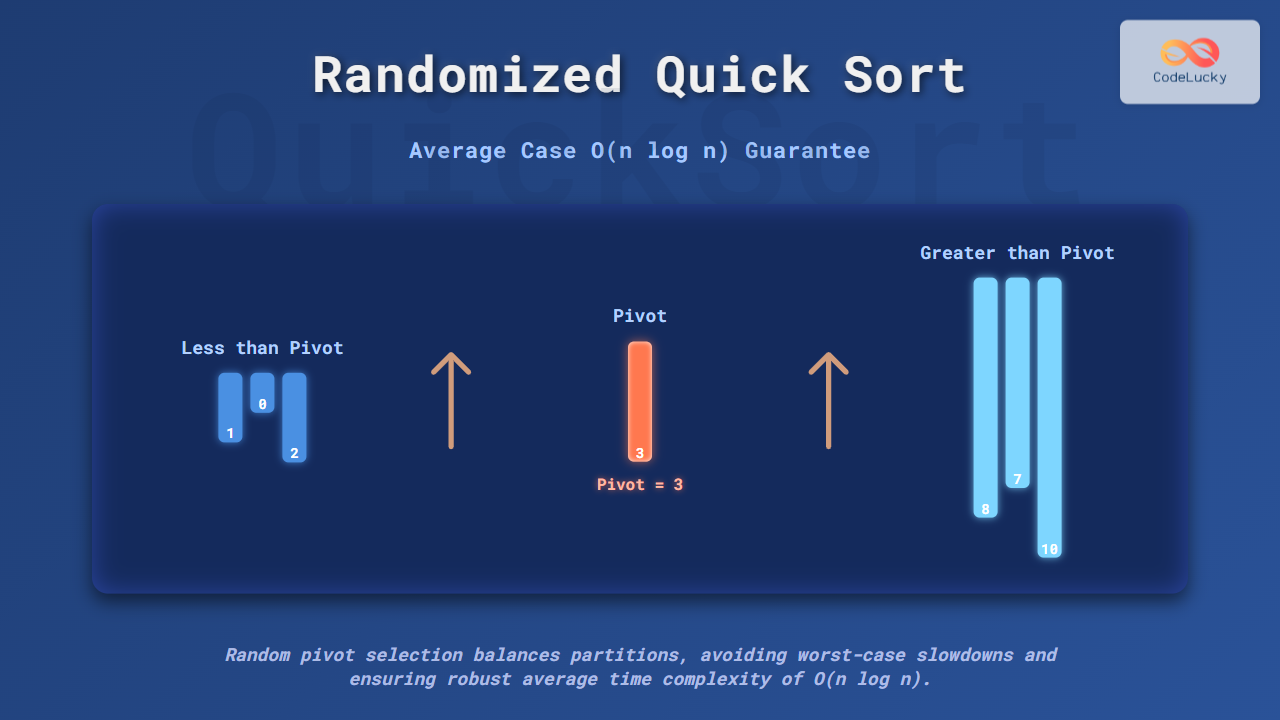
Suppose we want to sort the array: [8, 3, 1, 7, 0, 10, 2]
- Randomly pick a pivot, e.g., pivot =
3. - Partition around pivot →
[1, 0, 2]|[3]|[8, 7, 10]. - Recursively apply Randomized Quick Sort.

Python Implementation
import random

def randomized_partition(arr, low, high):
    pivot_index = random.randint(low, high)
    arr[pivot_index], arr[high] = arr[high], arr[pivot_index]
    pivot = arr[high]
    i = low - 1
    for j in range(low, high):
        if arr[j] <= pivot:
            i += 1
            arr[i], arr[j] = arr[j], arr[i]
    arr[i + 1], arr[high] = arr[high], arr[i + 1]
    return i + 1

def randomized_quick_sort(arr, low, high):
    if low < high:
        p = randomized_partition(arr, low, high)
        randomized_quick_sort(arr, low, p - 1)
        randomized_quick_sort(arr, p + 1, high)

arr = [8, 3, 1, 7, 0, 10, 2]
randomized_quick_sort(arr, 0, len(arr) - 1)
print(arr)  # Output: [0, 1, 2, 3, 7, 8, 10]
Interactive Example
Try running this code snippet interactively in your own Python environment. Each run may pick different pivots, leading to slightly different recursive paths, but the final result will always be a sorted array.
Advantages of Randomized Quick Sort
- Average-case performance of O(n log n) regardless of input distribution.
- Significantly reduces probability of worst-case scenarios compared to standard Quick Sort.
- In-place sorting, requiring only O(log n) extra space due to recursive calls.
When to Use Randomized Quick Sort
Randomized Quick Sort is highly effective in scenarios where the input distribution is unknown or adversarial inputs may be encountered. It is widely adopted in practice within libraries and frameworks because it offers performance comparable to deterministic Quick Sort but with added robustness against worst-case patterns.
Conclusion
Randomized Quick Sort combines the power of divide-and-conquer with randomness to ensure consistently fast performance. By choosing pivots randomly, it avoids being trapped in worst-case input scenarios, making it one of the most practical sorting algorithms in modern computing. With an expected time complexity of O(n log n), it stands as a reliable choice for real-world applications where efficiency and robustness matter.