Randomized algorithms are powerful tools in computer science that introduce randomness into their logic to achieve efficiency, simplicity, or better average-case performance. Unlike deterministic algorithms, which always produce the same output for the same input, randomized algorithms use probability to make decisions during execution. This randomness can lead to faster execution times, lower space complexity, or innovative problem-solving strategies.
In this article, we will dig deep into the concept of randomized algorithms, classifications, advantages, complexity measures, and explore a few examples with visual explanations and code outputs. This comprehensive guide aims to help you grasp how probabilistic techniques play a key role in modern computing.
What are Randomized Algorithms?
A randomized algorithm makes random choices during its execution. These random decisions may affect the control flow, the structure of the data being processed, or the results themselves. Randomized algorithms do not guarantee identical results for identical inputs, but they guarantee correctness or performance within probabilistic bounds. The randomness is usually generated using pseudo-random number generators (PRNGs).
Types of Randomized Algorithms
Monte Carlo Algorithms
Monte Carlo algorithms trade accuracy for speed. They always execute within bounded time, but their correctness is probabilistic. For instance, a Monte Carlo algorithm may decide if a number is prime with a small probability of error.
Las Vegas Algorithms
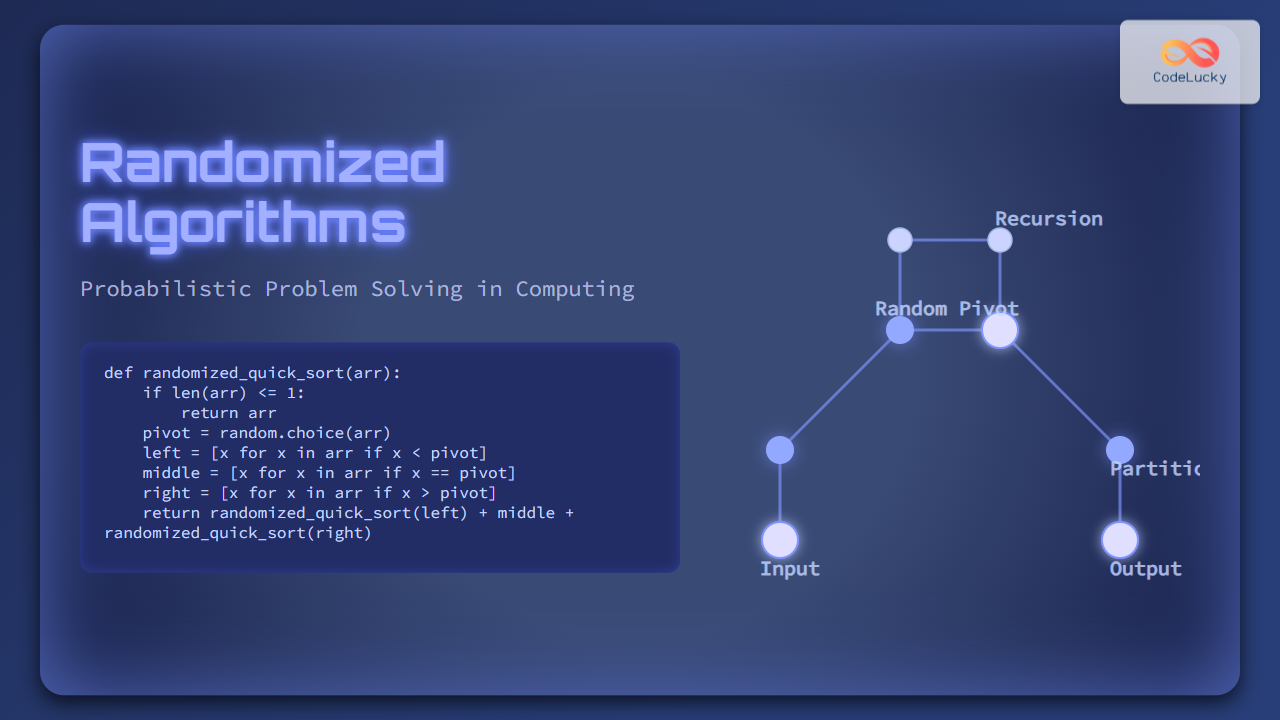
Las Vegas algorithms always produce correct results, but their runtime is a random variable. For example, randomized quicksort is a Las Vegas algorithm where pivot selection is randomized, leading to different runtimes for each input set.
Advantages of Randomization
- Breaks worst-case input structures, making average execution faster.
- Often simpler to implement compared to deterministic counterparts.
- Provides solutions when deterministic methods are too expensive.
- Enables probabilistic security in cryptography and randomized hashing.
Complexity Analysis of Randomized Algorithms
When analyzing randomized algorithms, we measure expected runtime or probability of correctness:
- Expected Runtime: The average running time over all possible runs considering random choices.
- High Probability Bounds: Measurement of the likelihood that the runtime remains within acceptable limits.
- Error Probability: Especially in Monte Carlo algorithms, the probability of failure is usually small and manageable.

Example 1: Randomized Quicksort
Randomized Quicksort randomly selects a pivot element to avoid worst-case scenarios present in normal QuickSort when input data is already sorted.
import random

def randomized_quick_sort(arr):
    if len(arr) <= 1:
        return arr
    pivot = random.choice(arr)
    left = [x for x in arr if x < pivot]
    middle = [x for x in arr if x == pivot]
    right = [x for x in arr if x > pivot]
    return randomized_quick_sort(left) + middle + randomized_quick_sort(right)

data = [8, 4, 6, 2, 9, 1, 5]
print("Original:", data)
print("Sorted:", randomized_quick_sort(data))
Sample Output:
Original: [8, 4, 6, 2, 9, 1, 5]
Sorted: [1, 2, 4, 5, 6, 8, 9]
Example 2: Monte Carlo Method – Estimating π
The Monte Carlo method can estimate π by randomly generating points inside a square and checking how many fall inside an inscribed circle.
import random

def estimate_pi(n):
    inside_circle = 0
    for _ in range(n):
        x, y = random.random(), random.random()
        if x*x + y*y <= 1:
            inside_circle += 1
    return (inside_circle / n) * 4

print("Estimated π with 100000 iterations:", estimate_pi(100000))
Sample Output:
Estimated π with 100000 iterations: 3.14192
Example 3: Randomized Min-Cut Algorithm
Karger’s algorithm is a classic randomized approach to finding the minimum cut in a graph. The algorithm randomly contracts edges until only two vertices remain, then counts the number of crossing edges.

Applications of Randomized Algorithms
- Cryptography: Randomness ensures unpredictability, crucial for security protocols.
- Machine Learning: Used in sampling methods, ensemble techniques, and stochastic optimization.
- Computational Geometry: For approximating problems that are otherwise hard.
- Network Optimization: Randomized routing and hashing balance network loads.
- Search and Optimization: Randomized local search methods improve solution discovery.
Key Takeaways
- Randomized algorithms bring probability into computing for efficiency and robustness.
- They are mostly classified as Monte Carlo (probabilistic correctness) or Las Vegas (random runtime).
- Randomization prevents adversarial worst-case input in sorting, searching, and graph algorithms.
- They play a significant role in modern areas like cryptography, AI, and optimization.
Randomized algorithms are indispensable in today’s computational landscape. By embracing probability, they provide elegant, efficient, and often surprisingly simple solutions to otherwise difficult problems.