The Random Walk Algorithm is a fundamental technique used for probabilistic graph traversal. Unlike deterministic algorithms such as Depth-First Search (DFS) or Breadth-First Search (BFS), a random walk explores the graph by making random choices at each step, allowing applications in areas like sampling, network analysis, and Markov Chain Monte Carlo (MCMC) methods.
This article delves deeply into the workings of the Random Walk Algorithm, illustrating its principles, use cases, and examples with clear visual and interactive outputs. Using mermaid diagrams, we will visually clarify key concepts and support understanding.
What is a Random Walk in Graphs?
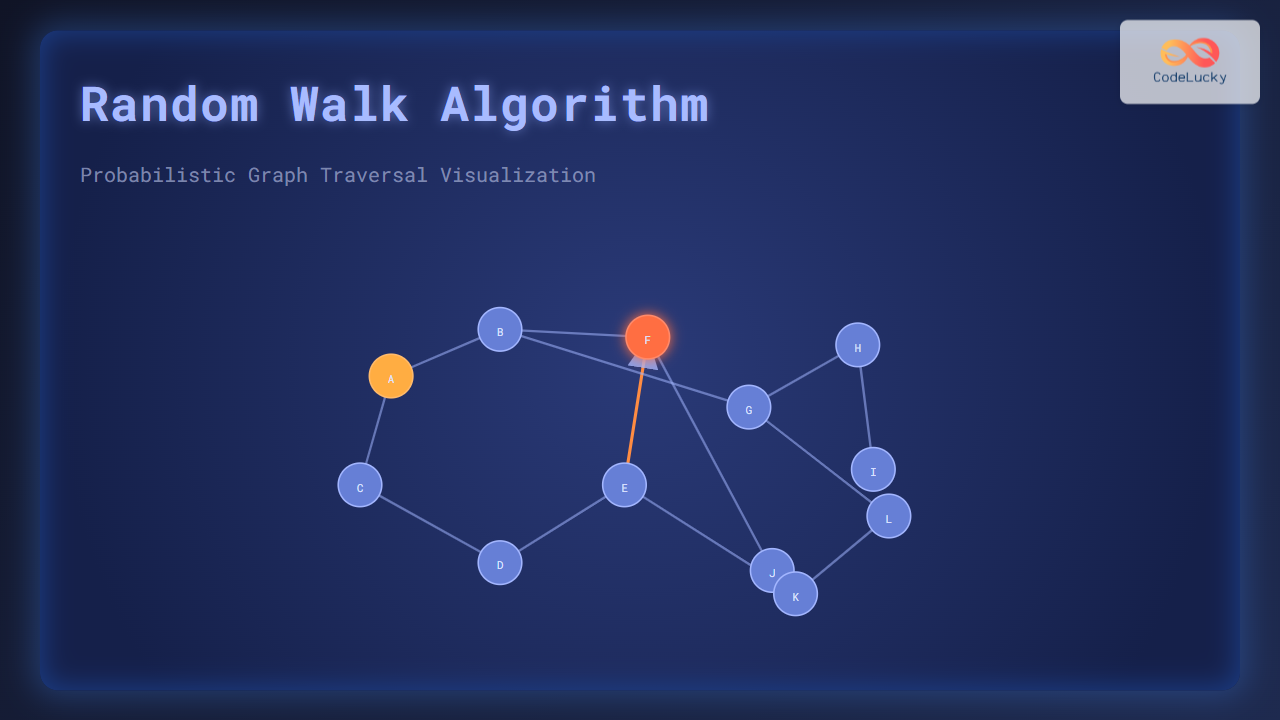
A random walk on a graph is a stochastic process that begins at a chosen vertex and moves to a neighboring vertex selected uniformly at random at each step. This traversal continues for a specified number of steps or until some stopping condition is met.
Formally, given a graph \(G = (V, E)\), starting at vertex \(v_0 \in V\), the next vertex \(v_{i+1}\) is chosen randomly from the neighbors of \(v_i\). This produces a path whose selection depends on probability rather than deterministic rules.

Why Use Random Walks?
Random walks are powerful when the structure of the graph is unknown or too large to explore exhaustively. They serve as foundational tools in:
- Sampling nodes or edges uniformly in large graphs
- Estimating properties of networks like PageRank
- Modeling phenomena in physics, biology, and social sciences
- Solving probabilistic problems and simulations
Random Walk Algorithm: Step-by-Step
- Initialize: Choose a starting vertex in the graph.
- Iterate: At each step, retrieve current node’s neighbors.
- Random selection: Uniformly select a neighbor to move next.
- Move: Advance to the selected neighbor node.
- Repeat: Continue until a stopping condition (steps, time, coverage) is met.
Example: Random Walk on an Undirected Graph
Consider the following simple undirected graph:
Starting at node A, a random walk might proceed as follows:
- Step 1: A’s neighbors are B and C. Pick one randomly (e.g., B).
- Step 2: B’s neighbors are A, D, and E. Choose one (e.g., E).
- Step 3: E’s only neighbor is B, so the walk moves back to B.
- Step 4: Repeat random choice from B’s neighbors, and so forth.
Interactive Random Walk Simulator (Pseudo-Interactive)
Below is a conceptual JavaScript example snippet to simulate a random walk and display steps:
// Simple Graph Adjacency List
const graph = {
  A: ["B", "C"],
  B: ["A", "D", "E"],
  C: ["A", "F"],
  D: ["B"],
  E: ["B"],
  F: ["C"]
};

function randomWalk(start, steps) {
  let current = start;
  let path = [current];
  for (let i = 0; i < steps; i++) {
    const neighbors = graph[current];
    if (!neighbors.length) break;
    // Pick random neighbor
    current = neighbors[Math.floor(Math.random() * neighbors.length)];
    path.push(current);
  }
  return path;
}

// Example usage
console.log(randomWalk("A", 10));
Mathematical Properties
Random walks on graphs have fascinating theoretical properties studied extensively in probability theory and graph theory.
- Markov Property: The next state depends only on the current state, not past history.
- Stationary Distribution: For connected, non-bipartite graphs, the random walk converges to a steady-state distribution over vertices.
- Expected Hitting Time: The expected number of steps for the walk to reach a given vertex.
Applications of Random Walk Algorithms
- PageRank Algorithm: Google’s ranking based on random surfing model.
- Network Sampling: Estimating properties of very large social or web graphs.
- Optimization: Random walks underpin algorithms like simulated annealing.
- Physics & Chemistry: Modeling molecular diffusion or random particle movements.
Example: Random Walk for PageRank Intuition

Imagine a “random surfer” clicking links at random on a small web graph. Over time, pages visited more frequently have higher rank scores. This process is a random walk used as the foundational model behind PageRank.
Summary
The Random Walk Algorithm is an elegant probabilistic tool for graph traversal with wide-ranging applications from web search to network analysis and scientific simulations. By randomly choosing next nodes to visit, it explores graphs in an unbiased, stochastic way, offering unique insights and solutions in large or complex networks.
The examples and diagrams provided illustrate how random walks operate and why they matter, equipping readers with a clear understanding of this important graph algorithm.