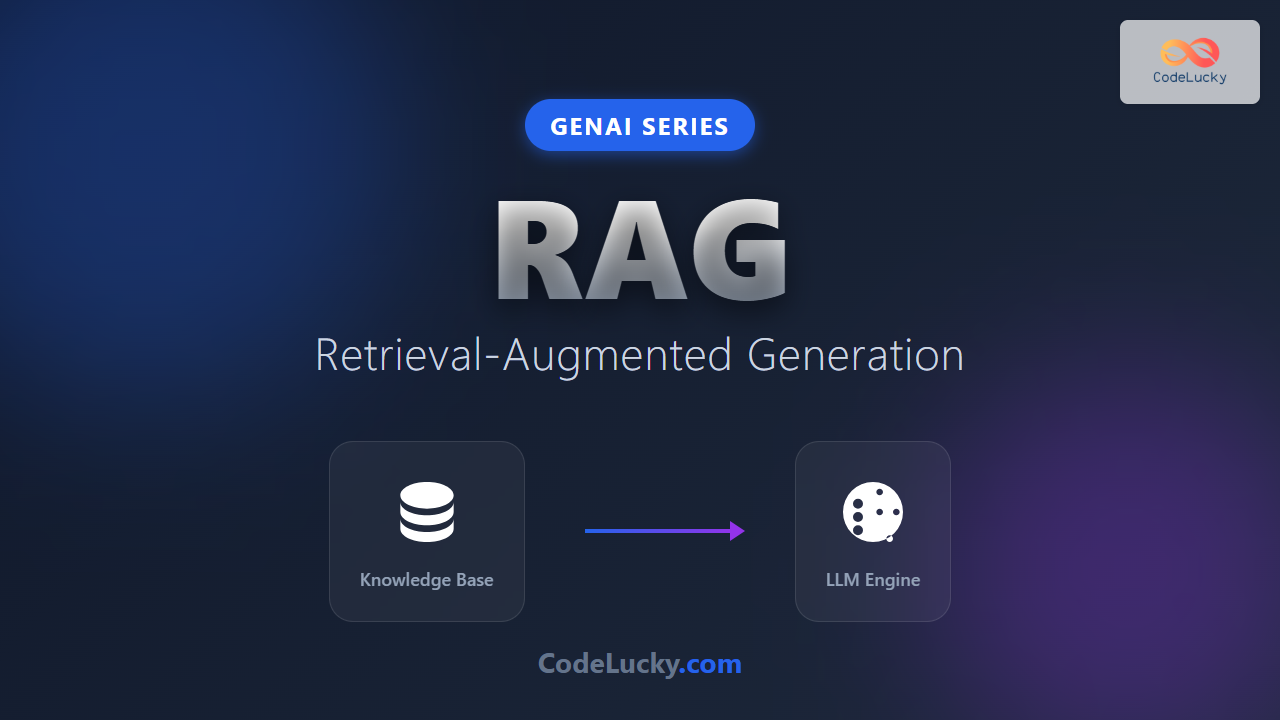
In the rapidly evolving world of Generative AI, Large Language Models (LLMs) like GPT-4 and Claude 3 are incredibly powerful, yet they suffer from two major “Achilles’ heels”: hallucinations and knowledge cutoff dates. This is where Retrieval-Augmented Generation (RAG) steps in as a game-changer.
For developers at CodeLucky.com and beyond, understanding RAG is no longer optional—it is the standard for building production-ready AI applications that are accurate, reliable, and grounded in private or real-time data.
What is Retrieval-Augmented Generation (RAG)?
RAG is an architectural framework that enhances the output of an LLM by fetching relevant information from an external, authoritative knowledge base before generating a response. Instead of relying solely on the patterns it learned during training, the model “looks up” specific facts to provide more precise answers.

Why RAG is Essential for Modern AI
Standard LLMs are like brilliant students who have read every book in the library up until last year but aren’t allowed to check the internet or their own notes during an exam. RAG gives that student an “Open Book” advantage.
- Eliminating Hallucinations: By forcing the model to cite its sources, you drastically reduce the chance of it making things up.
- Real-Time Updates: You don’t need to retrain a multi-billion parameter model to update its knowledge; you just update your database.
- Data Privacy: RAG allows you to use sensitive company data with a pre-trained model without ever sending that data for training.
The RAG Architecture: A Deep Dive
The RAG process is typically divided into two main phases: Indexing (preparing the data) and Retrieval/Generation (answering the query).
1. The Indexing Pipeline
Before a query is even made, your data must be prepared so the AI can find it quickly.
- Load: Document ingestion (PDFs, Markdown, Database entries).
- Split: Breaking documents into manageable “chunks.”
- Embed: Converting text chunks into numerical vectors using an Embedding Model.
- Store: Saving these vectors in a specialized Vector Database (like Pinecone, Milvus, or Chroma).

2. The Retrieval & Generation Pipeline
When a user asks a question, the following “magic” happens in milliseconds:
- Vector Search: The user’s query is converted into a vector, and the system finds the most similar chunks in the Vector Database.
- Augmentation: The retrieved chunks are stuffed into the prompt alongside the original question.
- Generation: The LLM reads the context and provides a grounded answer.
Interactive Example: Conceptual Logic
Imagine building a support bot for CodeLucky.com. Here is how the augmented prompt looks behind the scenes:
You are a helpful assistant. Use the provided context to answer the question.
CONTEXT FROM DATABASE:
1. “CodeLucky’s premium membership costs $19/month.”
2. “Members get access to exclusive GEN AI tutorials.”
USER QUESTION:
How much is the premium plan?
LLM OUTPUT:
The premium plan at CodeLucky.com is $19 per month, which includes exclusive access to GEN AI tutorials.
Key Components of a RAG System
| Component | Popular Choices | Role |
|---|---|---|
| Orchestration | LangChain, LlamaIndex | Glue that connects the LLM to the database. |
| Vector DB | Pinecone, Weaviate, Chroma | Stores and searches numerical representations of data. |
| Embedding Model | OpenAI text-embedding-3, Cohere | Turns words into mathematical coordinates. |
Advanced RAG Techniques
Simple RAG is often not enough for complex queries. Advanced pipelines use:
- Reranking: Using a secondary model to sort retrieved results by relevance more accurately.
- Query Transformation: Rewriting the user’s question to make it easier to search.
- Hybrid Search: Combining keyword search (BM25) with vector search for better accuracy on specific terms.

Conclusion: The Future is Augmented
Retrieval-Augmented Generation bridges the gap between static artificial intelligence and dynamic human knowledge. For developers at CodeLucky.com, mastering RAG means building apps that don’t just “chat,” but actually “know.”
As we move toward Agentic RAG, where AI agents can autonomously choose which tools and databases to query, the possibilities for automated research, coding assistants, and personalized tutors are endless.
Ready to build your first RAG app? Stay tuned to CodeLucky.com for our hands-on LangChain tutorial!