Imagine a computer so powerful that it can solve problems in seconds that would take today’s fastest supercomputers thousands of years. This isn’t science fiction; it is the promise of quantum computing. While classical computers have driven the digital revolution for decades, we are approaching the physical limits of how small and fast silicon chips can be. Quantum computing represents a paradigm shift, harnessing the strange and counterintuitive laws of quantum mechanics to process information in fundamentally new ways.
In this comprehensive guide, we will dismantle the complexity of quantum computing, exploring its core principles, how it differs from the devices we use today, and the revolutionary applications lying on the horizon.
The Fundamental Limit of Classical Computing
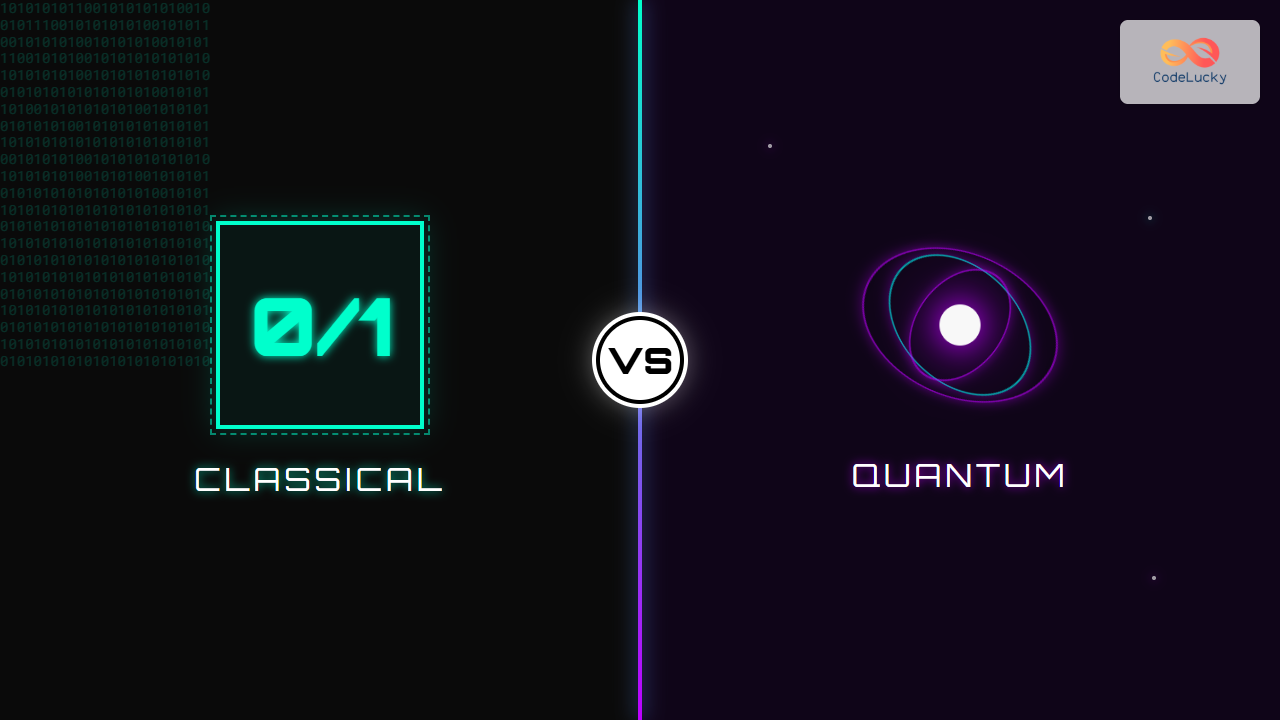
To understand quantum computing, we must first look at how classical computers work. Your laptop, smartphone, and the servers powering the internet all operate on the same basic principle: binary logic.
Information is stored in bits, which can exist in one of two states: 0 (off) or 1 (on). It is like a light switch—it is either on or off, never both at the same time. While we can process incredible amounts of data by stringing billions of these switches together, linear processing has limitations when dealing with complex, combinatorial problems.

Enter the Qubit: The Heart of Quantum Computing
Quantum computers use quantum bits, or qubits. Unlike a classical bit, a qubit can exist in a state of 0, 1, or a complex combination of both simultaneously. This phenomenon is known as superposition.
1. Superposition
Think of a coin spinning on a table. While it is spinning, is it heads or tails? It is essentially both until it stops (is measured). A classical bit is the coin resting flat (definite heads or tails). A qubit is the spinning coin.
This allows quantum computers to process a vast number of possibilities in parallel. If you have two classical bits, they can be in one of four configurations (00, 01, 10, 11) at any given time. Two qubits in superposition can represent all four of those states simultaneously.
2. Entanglement
The second pillar of quantum mechanics is entanglement. Albert Einstein famously called this “spooky action at a distance.” When two qubits become entangled, the state of one is directly correlated with the state of the other, no matter how far apart they are physically.
If you measure one entangled qubit and it collapses to “1,” its partner will instantly reflect a corresponding state. This allows quantum computers to move data around and perform logical operations much more efficiently than classical links.

How Quantum Computers Calculate
Quantum computers don’t just run faster; they run differently. They use Quantum Gates to manipulate qubits. Unlike logic gates (AND, OR, NOT) that process bits sequentially, quantum gates manipulate the probabilities of the qubits’ states.
A quantum algorithm sets up qubits in a superposition of all possible inputs. The algorithm then uses interference (similar to noise-canceling headphones) to amplify the probability of the correct answer and cancel out the wrong answers. When the measurement is finally taken, the system collapses into the correct solution.
Real-World Applications
Quantum computing isn’t just about faster gaming or browsing. It is designed for specific types of problems that are currently intractable.
Cryptography and Cybersecurity
Most modern encryption (like RSA) relies on the difficulty of factoring incredibly large numbers into primes. A classical supercomputer might take millions of years to crack a 2048-bit key. A quantum computer running Shor’s Algorithm could theoretically do it in hours. This has led to the race for “Post-Quantum Cryptography” to secure data against future quantum threats.
Drug Discovery and Material Science
Simulating molecular interactions is incredibly complex because every atom interacts with every other atom. Classical computers can only approximate simple molecules. Quantum computers operate on the same quantum principles as nature itself, allowing them to simulate complex chemical reactions accurately. This could lead to:
- New life-saving drugs.
- More efficient battery materials.
- Better fertilizers to reduce global emissions.
Optimization Problems
From routing thousands of delivery trucks to optimizing financial portfolios, quantum computers can handle variables that grow exponentially. They can find the absolute best solution among quintillions of possibilities (“global minima”) much faster than classical “brute force” methods.
Challenges Ahead
Despite the hype, we are currently in the NISQ (Noisy Intermediate-Scale Quantum) era. Building a stable quantum computer is an engineering nightmare.
- Decoherence: Qubits are incredibly sensitive to their environment. A tiny variation in temperature or a stray electromagnetic wave can cause the superposition to collapse, resulting in calculation errors.
- Cooling: Most quantum processors, like those from IBM and Google, require temperatures near absolute zero (-273°C) to function, making them massive and energy-intensive to maintain.
- Error Correction: Because qubits are “noisy,” we need thousands of physical qubits just to create a single logical (error-corrected) qubit.

The Future Landscape
We are witnessing a technological arms race. Giants like Google (Sycamore), IBM (Eagle), and startups like Rigetti and IonQ are pushing the boundaries of “Quantum Supremacy”—the point where a quantum computer performs a task impossible for a classical machine.
While you won’t have a quantum chip in your smartphone anytime soon, the hybrid model—where classical computers offload specific complex tasks to quantum processors in the cloud—is already beginning to take shape.
Conclusion
Quantum computing is more than just an upgrade; it is a fundamental reimagining of how we process information. By harnessing the strange laws of the quantum realm, we are opening doors to discoveries that remain invisible to classical logic. As we overcome the hurdles of stability and error correction, we stand on the precipice of a new era of innovation, one where the impossible becomes merely a calculation away.