When working with algorithms in Python, writing correct code is just the first step. The Pythonic coding style emphasizes readability, maintainability, and efficiency. In this article, we explore how to implement algorithms in Python the “right” way, following the Pythonic philosophy and idioms. By the end, you will not only write working Python code but also code that looks natural to Python developers and is easier to maintain.
What is Pythonic Style?
Being Pythonic means following conventions and using idioms that leverage Python’s features effectively. Instead of writing code in the style of another programming language, we harness Python’s strengths:
- Readable and concise code
- Use of built-in functions and data structures
- Clear and explicit implementation of ideas
- Leveraging Python’s syntax sugar such as list comprehensions and generator expressions
Example: Non-Pythonic vs Pythonic Implementation
Suppose we want to find the square of even numbers in a list. Compare the two implementations:
# Non-Pythonic
numbers = [1, 2, 3, 4, 5]
squares = []
for n in numbers:
    if n % 2 == 0:
        squares.append(n**2)

print(squares)  # Output: [4, 16]
# Pythonic using list comprehension
numbers = [1, 2, 3, 4, 5]
squares = [n**2 for n in numbers if n % 2 == 0]

print(squares)  # Output: [4, 16]
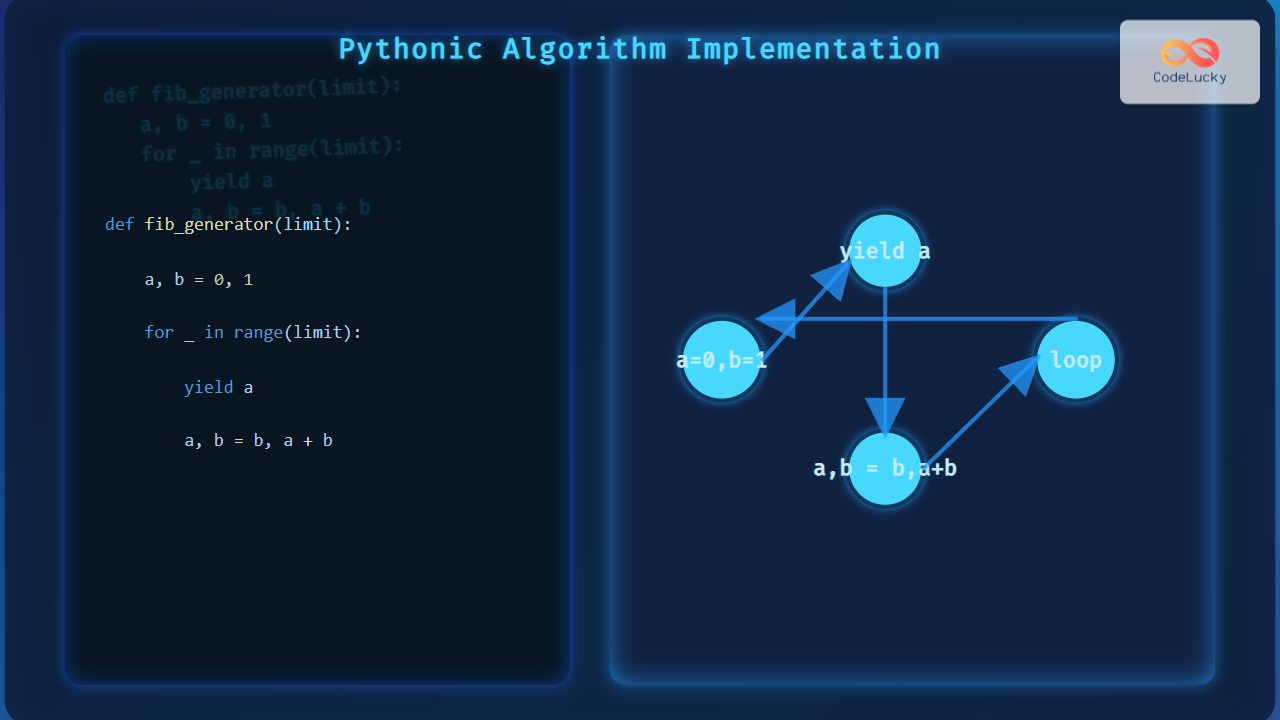
Pythonic Algorithm Implementation: Fibonacci Series
Let’s demonstrate with one of the most common examples: the Fibonacci sequence. A naive recursive solution works, but Pythonic style allows us to write it elegantly and efficiently.
# Non-Pythonic: Recursive Fibonacci
def fib_recursive(n):
    if n <= 1:
        return n
    return fib_recursive(n-1) + fib_recursive(n-2)

print([fib_recursive(i) for i in range(10)])
# Output: [0, 1, 1, 2, 3, 5, 8, 13, 21, 34]
# Pythonic: Using generator
def fib_generator(limit):
    a, b = 0, 1
    for _ in range(limit):
        yield a
        a, b = b, a+b

print(list(fib_generator(10)))
# Output: [0, 1, 1, 2, 3, 5, 8, 13, 21, 34]
The generator-based implementation is clearer and memory-efficient compared to the recursive one.

Pythonic Sorting Example
Sorting is a powerful area where Python’s idioms shine. Rather than writing custom sorting logic, Python provides a sorted function with key support.
# Non-Pythonic: Bubble sort
def bubble_sort(arr):
    n = len(arr)
    for i in range(n):
        for j in range(n-1):
            if arr[j] > arr[j+1]:
                arr[j], arr[j+1] = arr[j+1], arr[j]
    return arr

print(bubble_sort([3, 1, 4, 1, 5, 9]))
# Output: [1, 1, 3, 4, 5, 9]
# Pythonic: Using built-in sorted
arr = [3, 1, 4, 1, 5, 9]
print(sorted(arr))
# Output: [1, 1, 3, 4, 5, 9]

# Sorting with custom key
words = ['python', 'algorithm', 'pythonic', 'style']
print(sorted(words, key=len))
# Output: ['style', 'python', 'pythonic', 'algorithm']
Pythonic Search Algorithm: Binary Search
Binary search is a classic algorithm that benefits from Python’s readability and expressive power.
# Pythonic Binary Search using bisect
import bisect

arr = [1, 3, 4, 7, 10, 14]
x = 7
index = bisect.bisect_left(arr, x)

if index != len(arr) and arr[index] == x:
    print(f"Found {x} at index {index}")
else:
    print(f"{x} not found in the list")

# Output: Found 7 at index 3
This approach avoids manual implementation and utilizes Python’s powerful built-in bisect module.
Interactive Demonstration
Try running this interactive snippet to practice Pythonic approach:
def find_even_squares(nums):
    return [n**2 for n in nums if n % 2 == 0]

test_input = [int(x) for x in input("Enter numbers separated by space: ").split()]
print("Even squares:", find_even_squares(test_input))
This small interactive script demonstrates how Pythonic practices (like comprehensions) can simplify real tasks drastically.
When to Use Pythonic Style
Pythonic style is not just about shorter code; it’s about writing code that others can easily read, debug, and extend. Follow these guidelines:
- Avoid reinventing the wheel; leverage Python’s built-ins.
- Prefer comprehensions and generators where possible.
- Use clear naming and avoid unnecessary complexity.
- Adhere to the Zen of Python (
import thisin your interpreter).
Conclusion
Implementing algorithms in Python is best done when we follow the Pythonic style, making the code not only functional but elegant and efficient. From simple list comprehensions to memory-efficient generators and built-in utilities like sorted() and bisect, Python offers features that align with the principles of good software development. Writing Pythonic algorithms ensures that your code at CodeLucky.com or any other project is easy to read, maintain, and share with the community.