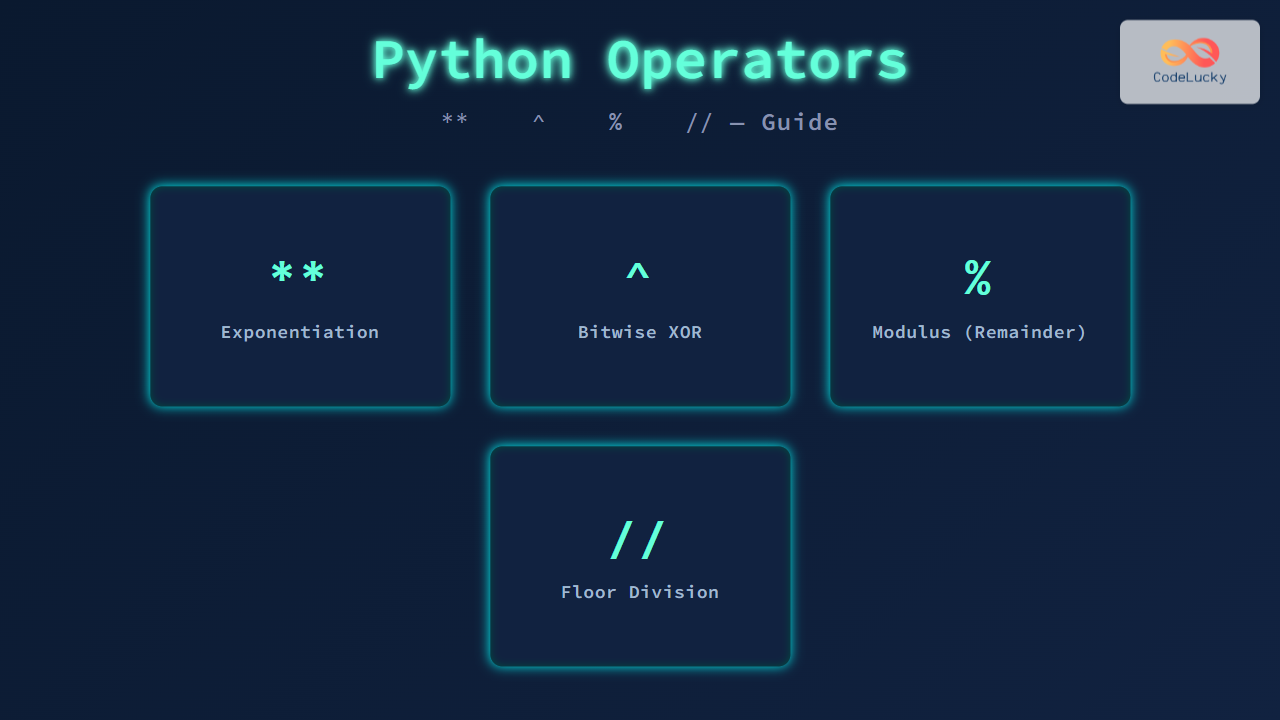
Python offers a rich variety of operators for mathematical computations and bitwise operations. Among these, **, ^, %, // are operators that often cause confusion for beginners. This detailed guide breaks down what each of these operators means in Python, their behavior, and practical examples with outputs. Visual aids and diagrams simplify your learning process, making these operators easy to understand and apply effectively in your code.
1. The Exponentiation Operator (**)
The double asterisk ** operator in Python is known as the exponentiation operator. It raises the number on its left to the power of the number on its right.
Syntax:
base ** exponentExample:
result = 2 ** 3
print(result)  # Output: 8
Here, 2 ** 3 means 2 raised to the power 3, which equals 8.

More examples with outputs:
5 ** 0 = 1(any number to the power of 0 is 1)4 ** 0.5 = 2.0(square root of 4)3 ** -1 = 0.3333...(reciprocal of 3)
2. The Bitwise XOR Operator (^)
The caret symbol ^ is used as the bitwise XOR (exclusive OR) operator in Python. It performs a bitwise comparison of two numbers and returns a number whose binary bits are set to 1 where the corresponding bits of the operands differ.
How XOR works at the bit level:
- Bit = 1 if bits differ
- Bit = 0 if bits are the same
Example:
5 ^ 3 # In binary: 0101 ^ 0011Step-by-step bitwise XOR:
  0101  (5)
^ 0011  (3)
= 0110  (6)
Result is 6 because bits differ in positions 2 and 3.
Additional bitwise XOR examples:
10 ^ 4 = 147 ^ 7 = 0(XOR with itself is always zero)
3. The Modulus Operator (%)
The percent symbol % is known as the modulus operator in Python. It calculates the remainder when the left operand is divided by the right operand.
Example:
10 % 3 # Output: 1Explanation: 10 divided by 3 equals 3 with a remainder of 1, so the result of 10 % 3 is 1.
Use cases of modulus operator:
- Checking if a number is even or odd (e.g.,
x % 2 == 0means even) - Wrapping around values in cyclic structures (e.g., clock arithmetic)
4. The Floor Division Operator (//)
The double slash // operator in Python performs floor division. It divides the left operand by the right operand and rounds the result down to the nearest whole integer.
Example:
10 // 3 # Output: 3Explanation: 10 divided by 3 is approximately 3.33, but floor division returns the integer 3 (the floor).

Additional points about floor division:
- Works with both integers and floats:
7.8 // 2 # Output: 3.0-7 // 2 == -4Summary Table of Operators
| Operator | Meaning | Example | Output |
|---|---|---|---|
** |
Exponentiation (power) | 2 ** 4 |
16 |
^ |
Bitwise XOR | 5 ^ 3 |
6 |
% |
Modulus (remainder) | 10 % 3 |
1 |
// |
Floor division (integer quotient) | 10 // 3 |
3 |
Interactive Python Examples
Try these examples in an interactive Python environment like Repl.it or your local Python shell to deepen understanding:
# Exponentiation
print("2 ** 5 =", 2 ** 5)  # 32

# Bitwise XOR
a = 12  # 1100 in binary
b = 10  # 1010 in binary
print("12 ^ 10 =", a ^ b)  # 6 (0110 binary)

# Modulus
print("29 % 4 =", 29 % 4)  # 1

# Floor division
print("15 // 4 =", 15 // 4)  # 3
print("-15 // 4 =", -15 // 4)  # -4 (floored)
Conclusion
This guide explained the four important Python operators: ** (exponentiation), ^ (bitwise XOR), % (modulus), and // (floor division). By understanding their underlying behavior, visualizing their action with diagrams, and experimenting with examples, programmers can leverage these operators confidently in various coding scenarios. Whether performing mathematical calculations, controlling binary data, or manipulating integers, these operators form an essential part of Python programming skills.