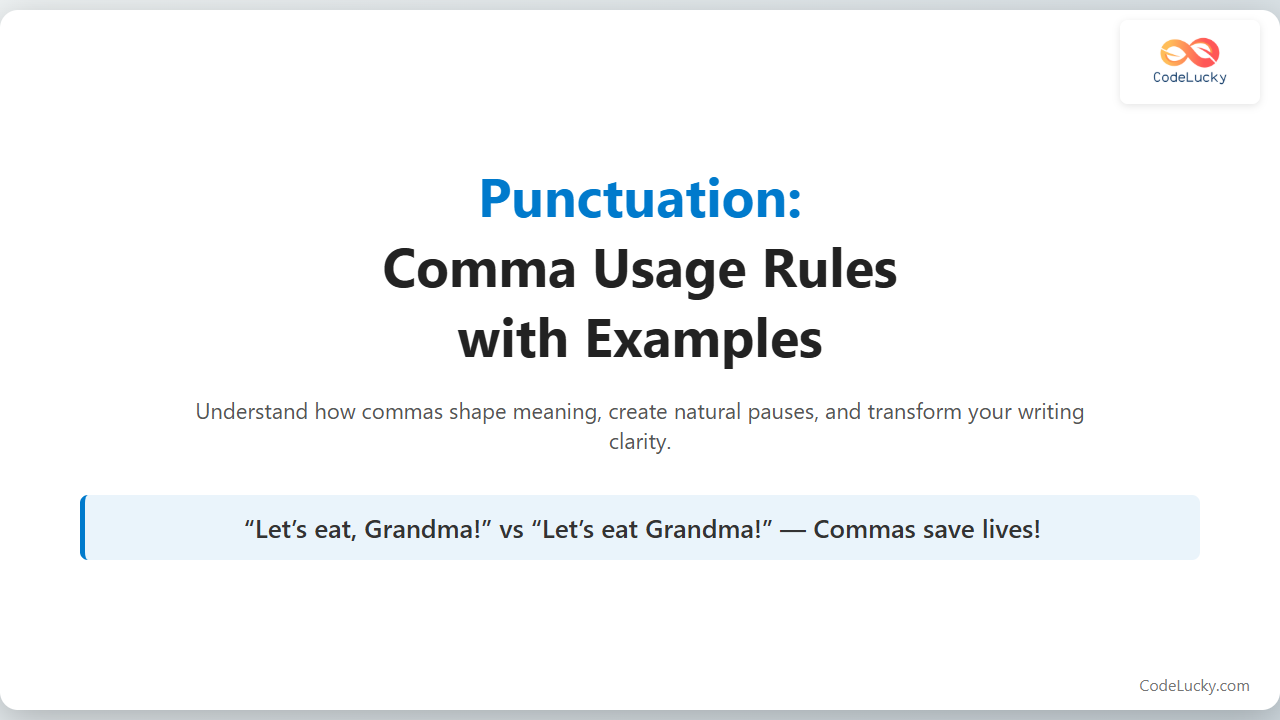
Mastering comma usage is one of the most essential writing skills for clear, professional English. Commas create natural pauses, separate ideas, and help readers understand meaning effortlessly. Misplacing or forgetting commas can lead to confusion or even change a sentence’s meaning. This detailed guide from CodeLucky.com covers all major comma usage rules with examples, visuals, and interactive explanations.
Why Comma Usage Matters
A comma may seem small, but its impact is significant. Think of a comma as a road sign for your reader — it tells them when to pause, separate thoughts, or proceed smoothly. Without commas, sentences can feel cramped and unclear.

1. Use Commas to Separate Items in a List
When listing three or more items, place commas between them. The final comma before “and” (called the Oxford comma) is optional but can prevent ambiguity.
- With Oxford comma: I bought apples, bananas, and pears.
- Without Oxford comma: I bought apples, bananas and pears.
Tip: Use the Oxford comma in formal or complex writing for clarity.

2. Use a Comma after Introductory Words or Phrases
When a sentence starts with an introductory phrase, a comma helps separate it from the main clause.
Examples:
After dinner, we went for a walk.
However, she decided to stay home.
In the morning, you’ll feel better.
If the introductory phrase is short (like “In 2022”), the comma can be optional — but using it improves readability.
3. Use Commas before Conjunctions in Compound Sentences
A compound sentence joins two independent clauses with a conjunction (like and, but, or, so, yet). Place a comma before the conjunction.
Example:
I wanted to go out, but it started raining.
She loves coffee, and he prefers tea.
Pro tip: Don’t use a comma when the clauses are not independent, e.g., I wanted to go out but couldn’t.
4. Use Commas to Set Off Nonessential (Parenthetical) Clauses
When additional information appears in the middle of a sentence, commas help mark it as nonessential.
Example:
My brother, who lives in Canada, is coming to visit.
The laptop, however, was already sold.
If the phrase is essential to the meaning, skip the commas:
Students who study regularly perform better.5. Use Commas with Coordinate Adjectives
When two or more adjectives equally describe a noun, separate them with commas. If they are not equal, skip the comma.
Examples:
- Coordinate adjectives: It was a long, exhausting day.
- Not coordinate: She wore a bright yellow dress. (No comma)
Test it: If you can swap the adjectives or add “and” between them without changing the meaning, use a comma.
6. Use Commas after Direct Address
When directly speaking to someone, put a comma after (or before) their name.
Examples:
Lisa, can you help me?
Can you help me, Lisa?
Thank you, my friend.

7. Use Commas for Dates, Places, and Numbers
Commas organize elements in dates, places, and large numbers for clear reading.
- Dates: I was born on April 7, 1998, in Delhi.
- Places: He moved to Paris, France, last year.
- Numbers: The population is 1,234,567.
8. Use Commas in Quotations
When introducing or interrupting a quotation, use a comma appropriately.
Examples:
She said, "I’ll be there soon."
"I’m not sure," he replied, "if it will work."
Note: In American English, commas usually go inside quotation marks; in British English, placement can vary.
9. Avoid Common Comma Mistakes
- Comma splice: Don’t join independent clauses with a comma alone.
Example of incorrect use: I went home, I was tired. ✅ Correct: I went home because I was tired. - Unnecessary commas: Avoid inserting commas between subject and verb.
❌ The dog, barked loudly. ✅ The dog barked loudly. - Overuse: Too many commas can break sentence flow and distract readers.
Interactive Check: Do You Need a Comma?
Try this quick mental checklist when writing:
- Is it a list of three or more items?
- Is there an introductory phrase?
- Are two independent clauses joined by a conjunction?
- Can the phrase be removed without changing the main meaning?
- Would adding “and” between adjectives sound natural?
If any answer is yes — you likely need a comma!

Final Thoughts
Using commas correctly transforms messy writing into polished communication. It helps your readers breathe, understand your ideas, and focus on your message. Keep these rules in mind, read your sentences aloud, and your rhythm will naturally guide your commas.
For more writing and grammar guides, explore our CodeLucky English Learning Series.