Pronunciation is more than just speaking clearly—it’s about using stress, rhythm, and intonation to communicate meaning naturally. Whether you’re a beginner learning English or an intermediate speaker refining your accent, understanding these three pillars can dramatically improve your fluency and confidence.
1. What Is Word and Sentence Stress?
Stress in English refers to emphasizing certain syllables or words more than others. A stressed syllable sounds louder, longer, and often has a higher pitch. Native speakers unconsciously rely on stress patterns to understand meaning and emotion.
Word Stress Example
Notice how the stress changes the meaning:
| Word | Stressed Syllable | Pronunciation Hint |
|---|---|---|
| PREsent | First | (noun) A gift 🎁 |
| preSENT | Second | (verb) To show or offer 💬 |
| REcord | First | (noun) A document or album 🎶 |
| reCORD | Second | (verb) To capture sound 🔴 |
👉 When you change the stress, you often change the meaning entirely!
Sentence Stress
In sentences, not all words receive equal attention. Content words (nouns, main verbs, adjectives, adverbs) are usually stressed. Function words (articles, prepositions, pronouns) are often unstressed.
Example:
- “I love learning English.” → Content words: love, English
- “She’s going to the market.” → Stressed: going, market

2. English Rhythm: The Beat of Speech
English is a stress-timed language. This means that the time between stressed syllables tends to remain equal, no matter how many unstressed syllables fall between them. The rhythm creates a musical flow that defines natural-sounding speech.
Example of Rhythm
Compare these two sentences. Both take about the same time to say though one is longer:
- “Cats sleep.”
- “The cats are sleeping.”
Even with more syllables, English keeps the rhythm steady by compressing or reducing unstressed words like “are”.
Interactive Practice Tip
Try clap rhythm drills 🎶 — Clap on each stressed word as you speak:
✨ I     LOVE     my     DOG.
✨ She’s  GOing   to     SCHOOL.
This helps you feel the “beat” of English.

3. Intonation: The Melody of English
Intonation is how your voice rises and falls while speaking. It expresses emotions, attitudes, and functions such as asking questions or emphasizing ideas.
Common Intonation Patterns
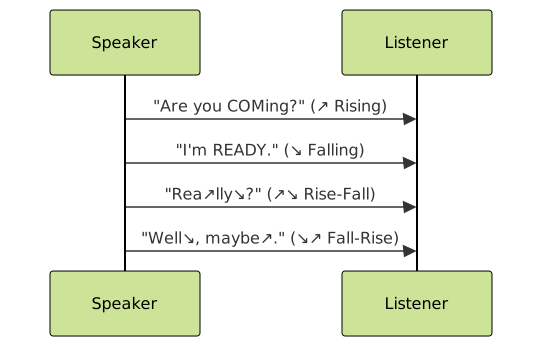
| Type | Pattern | Example | Meaning |
|---|---|---|---|
| Rising ↗ | End goes up | “Are you coming?” | Yes/No question |
| Falling ↘ | End goes down | “I’m tired.” | Statement or final idea |
| Rise–Fall ↗↘ | Up then down | “Really?” | Surprise or interest |
| Fall–Rise ↘↗ | Down then up | “Well, maybe.” | Uncertainty or hesitation |
Practice Tip
Record yourself asking and answering the same question in different tones. Listen and note how your emotions change with pitch movement.
4. Combining Stress, Rhythm, and Intonation
The three elements work together to make speech sound natural.
Example:
- Stress: Highlights important words — “I LOVE this SONG.”
- Rhythm: Keeps timing regular — “I LOVE this SONG” feels balanced.
- Intonation: Expresses feeling — Rising for excitement: “I LOVE this SONG↗!”

5. Common Mistakes & How to Fix Them
- Flat speaking: No pitch variation. → Practice mimicking movie dialogues.
- Equal stress on every word: Sounds robotic. → Highlight content words instead.
- Ignoring rhythm: → Record yourself and tap while speaking to stay in sync.
- Native language influence: → Listen to English songs or podcasts to internalize its musical pattern.
6. Practice Exercises
a. Stress Shift Game
Say the same sentence but stress different words to change meaning:
- “I didn’t say he stole the money.” → Someone else did.
- “I didn’t say he stole the money.” → Denial.
- “I didn’t say he stole the money.” → Implied differently.
b. Intonation Ladder
Imagine pitch levels as steps on a ladder. Start low for calm speech and rise gradually for questions or excitement.

7. Conclusion
Mastering English pronunciation isn’t just about articulation—it’s about mastering the music of language. By understanding stress, rhythm, and intonation, you’ll not only sound clearer but also more expressive and confident. Practice daily with minimal pairs, rhythmic reading, and pitch drills to gradually refine your spoken English.
Remember, native-like fluency comes not from speed but from control of stress patterns and tone. Speak with intention—and let your English sing!