
Professional emails are the cornerstone of modern business communication. In today’s digital workplace, your ability to write clear, concise, and courteous emails directly impacts your professional reputation. This comprehensive guide breaks down every element of professional email writing for beginners, providing actionable templates, real-world examples, and visual aids to help you communicate with confidence.
Why Professional Email Writing Matters
Unlike casual messaging, professional emails represent you and your organization. A single poorly written email can create confusion, damage relationships, or even cost business opportunities. Studies show that professionals receive an average of 120 emails daily, spending 28% of their workday managing inbox—making clarity essential. Mastering email etiquette demonstrates competence, respect for recipients’ time, and attention to detail.
- First impressions count: Your email is often the first interaction with colleagues, clients, or superiors
- Documentation trail: Emails serve as legal records of agreements and decisions
- Global communication: Clear writing bridges cultural and language gaps
1. Perfecting the Subject Line
The subject line determines whether your email gets opened immediately, later, or deleted unread. Keep it under 50 characters, specific, and action-oriented. Avoid vague phrases like “Hello” or “Question”—instead, state purpose clearly.
| ❌ Poor Subject Lines | ✅ Professional Subject Lines |
|---|---|
| “Meeting?” | “Request: 15-min meeting Tuesday 2PM” |
| “Update” | “Q4 Sales Report – Final Numbers” |
| “URGENT!!!” | “Action Needed: Contract Review by EOD” |
| “Hi John” | “Follow-up: Project Timeline Discussion” |

2. Professional Greetings and Salutations
Choose greetings based on relationship and formality level. When in doubt, err on the formal side—you can always adjust later based on response style.
| Relationship | Formal | Semi-formal | Casual |
|---|---|---|---|
| New contact/Superior | Dear Mr. Smith, | Dear John, | – |
| Existing colleague | Dear Sarah, | Hi Sarah, | Hello Sarah, |
| Team/Group | Dear Team, | Hi everyone, | Hey team, |
| Multiple recipients | Dear Ms. Johnson and Mr. Lee, | Hi Sarah and team, | – |
3. The Perfect Email Structure
Subject: [Clear Action + Context + Timeline]

Dear [Recipient Name],

I hope this email finds you well.

**Purpose:** [State main reason in 1 sentence]

**Background:** [1-2 sentences providing necessary context]

**Action requested:**
• [Specific request 1]
• [Specific request 2]
• [Deadline if applicable]

Please let me know if you need any additional information.

Best regards,
[Your Name]
[Your Position]
[Contact Info]
4. Real-World Email Examples
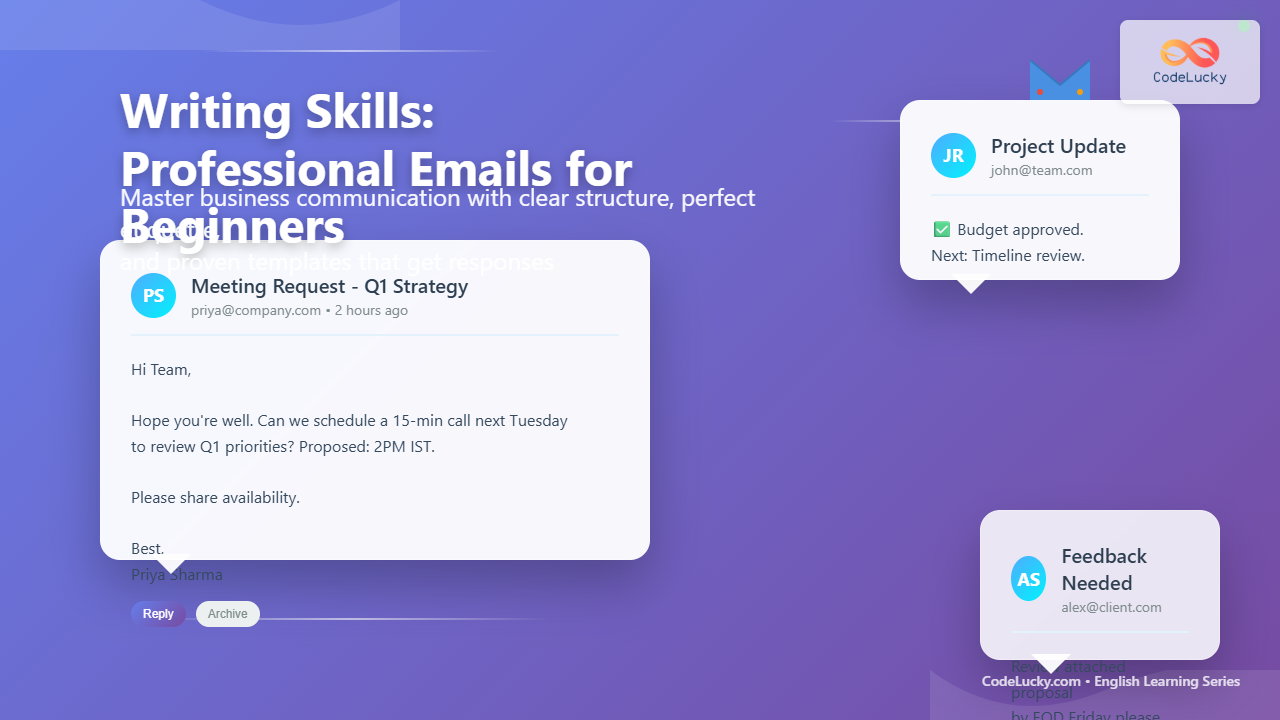
📧 Example 1: Meeting Request
Subject: 15-min call to discuss Q1 marketing strategy

Dear Ms. Patel,

I hope you're doing well.

I'm reaching out to schedule a brief call to align on our Q1 marketing priorities. Our team has prepared initial proposals and would value your feedback before finalizing.

**Proposed times (next week):**
• Tuesday, Jan 14 @ 2PM IST (30 min)
• Thursday, Jan 16 @ 11AM IST (15 min)

Please let me know your availability, or suggest alternatives.

Thank you for your time.

Warm regards,
Priya Sharma
Marketing Coordinator
CodeLucky.com
[email protected] | +91 98765 43210
📧 Example 2: Follow-up After Meeting
Subject: Follow-up: Action items from yesterday's strategy meeting

Hi Team,

Thank you for the productive strategy session yesterday. Here are the agreed action items with owners and deadlines:

**Immediate actions (by EOD Friday):**
• Rahul: Finalize budget allocation [Friday]
• Priya: Prepare vendor comparison [Friday]
• Vikram: Update project timeline [Friday]

**Next week deliverables:**
• Complete creative brief review [Monday]

Please reply-all to confirm receipt and raise any questions.

Best,
Alex
Project Manager
5. Common Email Mistakes to Avoid

- Missing action items: Always specify WHAT you want and WHEN
- Information overload: Use bullet points, not paragraphs
- Wrong recipients: Double-check CC/BCC usage
- Timing issues: Avoid Friday evenings or Monday mornings
- No proofreading: Read aloud before sending
6. Email Tone Guide
| Situation | ✅ Use This Tone | ❌ Avoid This |
|---|---|---|
| Requesting help | Grateful, specific, offers alternatives | Demanding, vague, entitled |
| Providing feedback | Constructive, specific examples, solutions | Vague criticism, emotional language |
| Sharing good news | Enthusiastic but professional, inclusive | Overly casual emojis, boasting |
| Delivering bad news | Direct, empathetic, clear next steps | Vague, overly apologetic, sugarcoating |
7. Quick-Reference Email Checklist
Pro Tips for Email Mastery
- Default to brevity: If it takes 2 sentences instead of 5, use 2
- Mobile-first: 46% of emails opened on phones—keep it scannable
- Signature standards: Name, title, company, phone, LinkedIn (max 4 lines)
- Response timing: Same day for internal, 24-48 hours for external
- Template library: Save your best emails as reusable templates
Practice these principles consistently, and professional email writing will become second nature. Start applying one technique at a time—begin with subject lines—and watch your response rates and relationships improve dramatically.