Prime factorization is a fundamental concept in number theory and computer algorithms. It involves representing a positive integer as a product of prime numbers. Understanding prime factorization is crucial for fields such as cryptography, algorithm design, and computational mathematics. In this article, we will explore the trial division method, more advanced prime factorization methods, and practical examples using Python.
What is Prime Factorization?
Prime factorization is the process of breaking a composite number into a product of primes. For example:
- 12 = 2 × 2 × 3
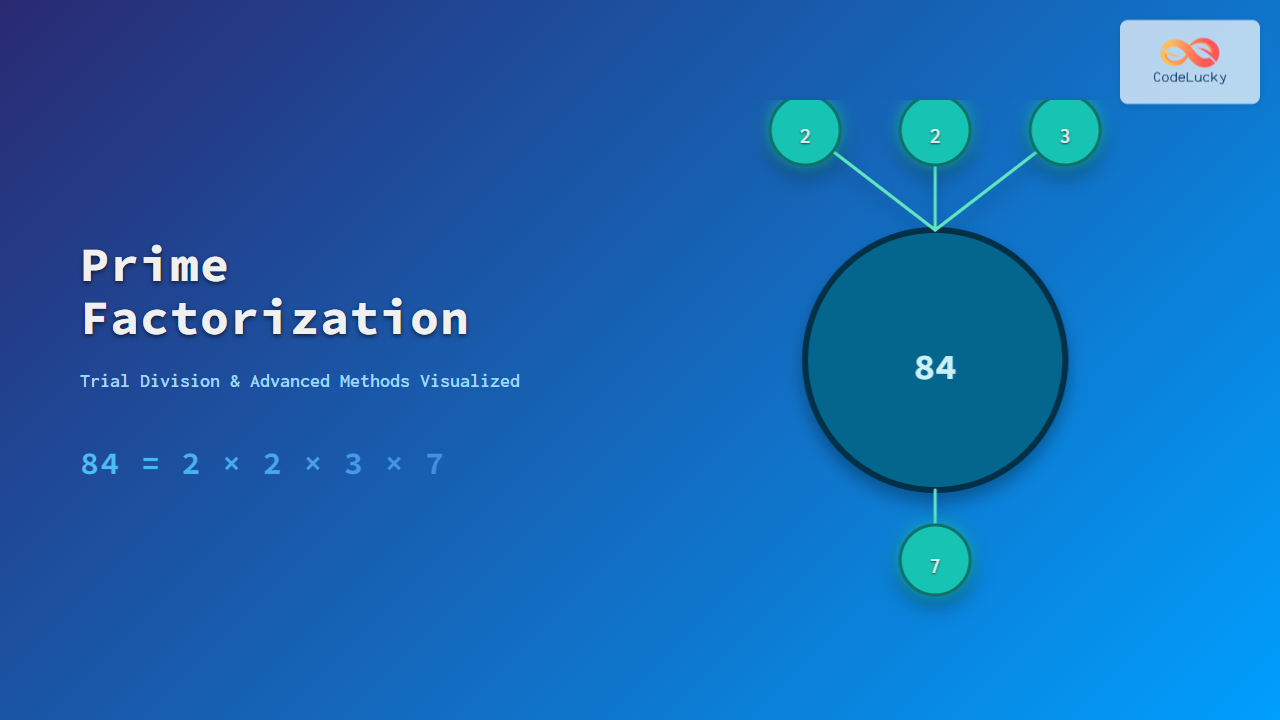
- 84 = 2 × 2 × 3 × 7
- 97 = 97 (since 97 is a prime number)
This representation is unique up to the order of factors, known as the Fundamental Theorem of Arithmetic.
Trial Division Method
The most straightforward algorithm for prime factorization is trial division. It checks divisibility of the number by successive primes (or small integers) up to its square root.
Algorithm (Trial Division)
Step-by-step Example:
Factorize 84:
- 84 ÷ 2 = 42 → record factor 2
- 42 ÷ 2 = 21 → record factor 2
- 21 ÷ 3 = 7 → record factor 3
- Remaining 7 is prime → record factor 7
Result: 84 = 2 × 2 × 3 × 7
Python Implementation
def trial_division(n):
    factors = []
    # Divide by 2 until odd
    while n % 2 == 0:
        factors.append(2)
        n //= 2
    # Divide by odd numbers up to sqrt(n)
    i = 3
    while i * i <= n:
        while n % i == 0:
            factors.append(i)
            n //= i
        i += 2
    if n > 1:
        factors.append(n)
    return factors

print(trial_division(84))  # Output: [2, 2, 3, 7]
Advanced Methods for Prime Factorization
While trial division works for small numbers, it becomes inefficient for large values. Advanced factorization methods are often used for cryptographic applications and computational efficiency.
1. Pollard’s Rho Algorithm
Pollard’s Rho is a probabilistic method efficient for finding non-trivial factors of large numbers.
import math, random

def pollards_rho(n):
    if n % 2 == 0:
        return 2
    x = random.randint(2, n-1)
    y = x
    c = random.randint(1, n-1)
    d = 1
    while d == 1:
        x = (x*x + c) % n
        y = (y*y + c) % n
        y = (y*y + c) % n
        d = math.gcd(abs(x-y), n)
    if d == n:
        return pollards_rho(n)
    return d

print(pollards_rho(8051))  # Example output: 97 or 83
2. Fermat’s Factorization Method
Fermat’s method works efficiently for numbers that can be expressed as a difference of two squares:
n = a² – b² = (a – b)(a + b)
Example: Factorize 5959
- Find a such that a² ≥ n. Here a = 78
- Compute b² = a² – n → 78² – 5959 = 125
- Check if b² is a perfect square. If not, increment a until perfect square is found.
3. Quadratic Sieve and General Number Field Sieve (GNFS)
For very large integers (hundreds of digits), advanced algorithms like Quadratic Sieve and GNFS are used. GNFS is currently the fastest known factorization algorithm for huge semiprimes, crucial in breaking RSA encryption.
Comparison of Methods
| Method | Best Use Case | Complexity |
|---|---|---|
| Trial Division | Small numbers, learning purposes | O(√n) |
| Pollard’s Rho | Medium sized numbers | O(n^0.25) |
| Fermat’s Method | Numbers with factors close to each other | Varies, faster when factors are close |
| Quadratic Sieve | Large integers up to 100 digits | Sub-exponential |
| GNFS | Very large cryptographic numbers | Sub-exponential (fastest known) |
Interactive Example
Try this small Python script in your environment: Enter a number, and the program prints its prime factors using trial division.
n = int(input("Enter a number: "))
print("Prime factors:", trial_division(n))
Applications of Prime Factorization
- Cryptography: RSA algorithm security relies on difficulty of factoring large semiprimes.
- Mathematical research: Studying divisor functions, greatest common divisor (GCD), and least common multiple (LCM).
- Error detection: Algorithms in coding theory and data integrity checks.
- Optimization problems: Factorization helps in modular arithmetic and discrete mathematics.
Conclusion
Prime factorization is not only a mathematical curiosity but also the backbone of modern cryptography and algorithmic applications. While trial division is simple and effective for small inputs, advanced algorithms like Pollard’s Rho, Fermat’s method, Quadratic Sieve, and GNFS are indispensable for handling large numbers. A deep understanding of prime factorization helps in both theoretical and applied computer science.