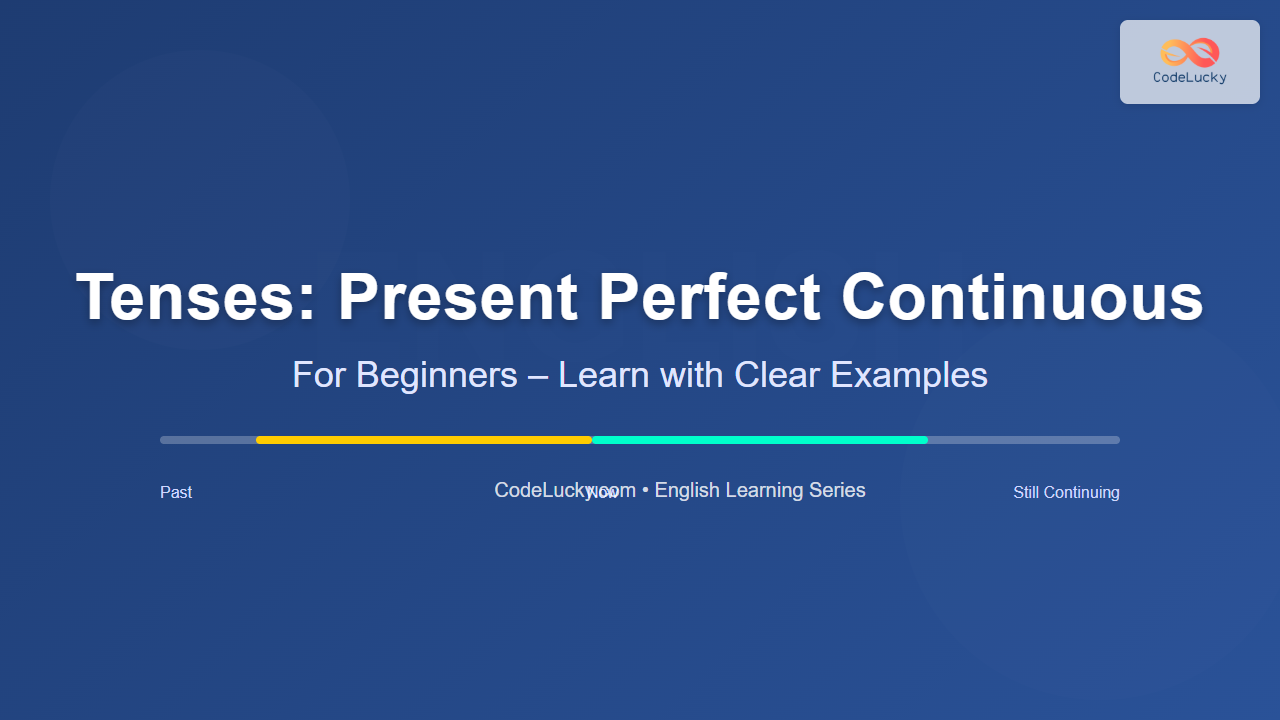
Present Perfect Continuous Tense is one of the most interesting yet confusing tenses for English learners. It connects the past with the present and shows that an action started in the past and is still happening or has just stopped recently. In this beginner-friendly guide, you’ll learn its meaning, structure, usage, and easy-to-understand examples. We’ll also visualize timelines using Mermaid diagrams so that you can clearly see how time works with this tense.
What Is the Present Perfect Continuous Tense?
The Present Perfect Continuous Tense (sometimes called the Present Perfect Progressive Tense) describes an action that began in the past and is still continuing in the present or has recently finished. It emphasizes duration — how long an activity has been in progress.
Example: She has been studying English for two hours.
- The action “studying” started in the past (two hours ago).
- The action is still happening now or finished just a short time ago.

Structure of Present Perfect Continuous Tense
The formula for the tense is very simple. You just need:
Subject + has/have + been + V1 + ing + (object) + (time expression)
| Type | Structure | Example |
|---|---|---|
| Affirmative | Subject + has/have + been + verb-ing | He has been playing the guitar. |
| Negative | Subject + has/have + not + been + verb-ing | They have not been watching TV. |
| Interrogative | Has/Have + subject + been + verb-ing? | Have you been studying English? |
When to Use Present Perfect Continuous
This tense is typically used in the following situations:
- To show an action that began in the past and is continuing now:
Example: I have been writing emails since morning. - To show an action that has recently stopped but has a present result:
Example: She has been crying. (You can still see tears.) - To express temporary situations:
Example: They have been living in Dubai for six months. - To emphasize duration or how long something has been happening:
Example: We have been waiting for you all day!
Time Expressions Commonly Used
Here are some common time expressions that often appear in sentences using the present perfect continuous tense:
- for → a specific duration (e.g., for two years, for a long time)
- since → a specific point in time (e.g., since 2010, since morning)
- lately, recently, all day, all week
Example: He has been working here since 2020.
Example: They have been practicing cricket all day.

Interactive Exercise – Test Your Knowledge
Try to fill in the blanks using the correct form of the verbs in parentheses. (Scroll down for answers!)
- I __________ (read) this book for two hours.
- They __________ (wait) for the train since morning.
- She __________ (not/sleep) well lately.
- __________ you __________ (work) on your project?
- He __________ (exercise) regularly these days.
Suggested Answers:
- have been reading
- have been waiting
- has not been sleeping
- Have you been working
- has been exercising
Common Mistakes to Avoid
- Don’t confuse it with Present Perfect Simple.
Wrong: I have done this since morning.
Correct: I have been doing this since morning. - Always use “has” for singular subjects and “have” for plural subjects.
- Remember to use “been” between “has/have” and the “-ing” verb.
- Use “for” with durations and “since” with specific times.

Real-Life Examples You Can Relate To
- Students have been preparing for their final exams all week.
- It has been raining since morning.
- I have been learning coding for six months.
- We have been watching this series together.
- He has been fixing his bike since yesterday.
Quick Recap
- Form: Subject + has/have + been + verb-ing.
- Use: To show action that started in the past and continues to the present.
- Keywords: for, since, lately, recently, all day.
- Focus: Duration or continuity of the action.

Conclusion
The Present Perfect Continuous Tense helps describe actions with ongoing or just-finished effects. Once you understand its structure and timeline, using it becomes easy and natural. Practice daily using personal examples: talk about what you’ve been doing, watching, reading, or learning. Over time, you’ll gain fluency and confidence.
Now that you’ve learned the Present Perfect Continuous, try noticing it in everyday conversations, TV shows, or news headlines to see how naturally it’s used!