Prepositions of Place are words that tell us where something is located. Among them, on, in, and under are the most basic and most commonly used. Understanding these prepositions helps English learners describe positions and spatial relationships clearly. This article explores each with step-by-step explanations, diagrams, and examples designed for visual learners.
What Are Prepositions of Place?
A preposition of place shows the relationship between a noun (or pronoun) and its location. These words describe where a person, object, or thing is positioned in the physical world. Common examples include on, in, under, behind, next to, and between.
In this lesson, we will focus on the three foundational prepositions of place: on, in, and under.
1. Using “On”
“On” is used when something is in contact with a surface. It describes position where an object rests above another object and touches it directly.
Structure Example:
Subject + be verb + on + place
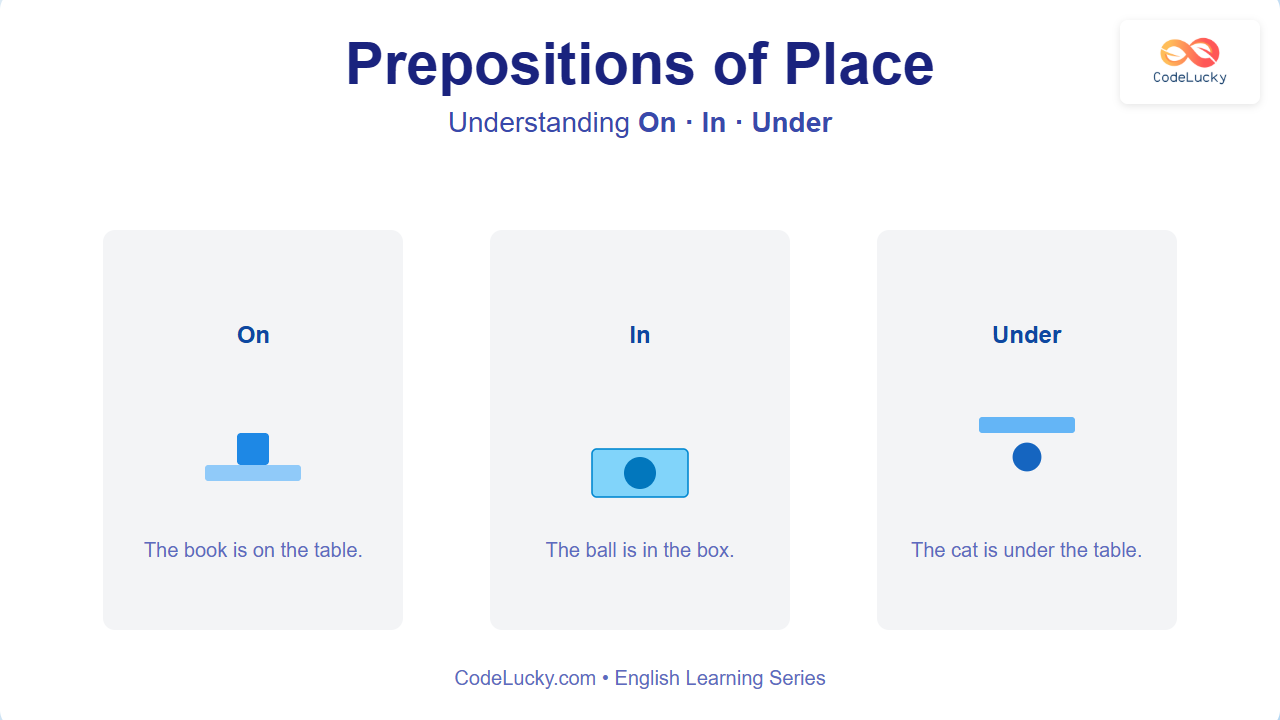
Example: The book is on the table.

More examples:
- The picture is on the wall.
- There is a cup on the desk.
- The cat is sitting on the sofa.
Visual Understanding
Imagine a flat surface such as a table. If an object rests on top of that surface and touches it, we use “on”.

2. Using “In”
“In” means something is enclosed or surrounded by something else. It refers to the inside space of a container, area, or boundary.
Structure Example:
Subject + be verb + in + container/place
Example: The apples are in the basket.

More examples:
- The clothes are in the wardrobe.
- There is a fish in the tank.
- The shoes are in the box.
Visual Understanding
Whenever an object is surrounded or contained by something else, the correct preposition is “in”.
3. Using “Under”
“Under” describes a position below or beneath something else. It indicates that one object is vertically lower than another, with no contact needed.
Structure Example:
Subject + be verb + under + object
Example: The cat is under the table.

More examples:
- The shoes are under the bed.
- The dog is under the chair.
- The bag is under the desk.
Comparing “On”, “In” and “Under”
Here’s how to distinguish these easily with a simple table:
| Preposition | Meaning | Example |
|---|---|---|
| On | Touching a surface above | The book is on the table. |
| In | Inside or surrounded by boundaries | The cat is in the box. |
| Under | Below or beneath something | The shoes are under the bed. |
Interactive Exercise
Try filling in the blanks with on, in, or under:
- The pen is ___ the desk.
- The cookies are ___ the jar.
- The carpet is ___ the sofa.
Answers: 1. on, 2. in, 3. under
Quick Visual Recap
The following diagram summarizes how each preposition of place works visually:

Common Mistakes to Avoid
- ❌ Saying “The cat is in the table” – ✅ Correct: “The cat is under the table.”
- ❌ Saying “The book is in the table” – ✅ Correct: “The book is on the table.”
- ❌ Saying “The keys are on the bag” when they are inside – ✅ Correct: “The keys are in the bag.”
Conclusion
Mastering prepositions of place like on, in, and under helps English learners describe their surroundings more confidently. The best way to learn them is through observation and consistent practice. Next time you describe where something is, pause and visualize: Is it touching on something, inside in something, or below under something?
Practice daily with simple sentences around your home or workspace to make these words part of your natural English vocabulary.