Prepositions of Movement are words that describe how or in what direction something moves. They tell us where something or someone is going or coming from. Among the most common are to, into, and from. Mastering them helps learners talk about actions involving travel, direction, and change of position naturally.
1. Understanding Prepositions of Movement
Prepositions of movement always show action – something is changing its position. Compare this with prepositions of place (like in or on) that describe static situations. When you say “She walks to school,” it’s not about where she is but where she is heading.
Key Prepositions of Movement
- To – shows the direction towards a place or person.
- Into – shows movement from outside to inside a space.
- From – shows the starting point of that movement.
2. Preposition “To” – Moving Toward a Destination
Use to when the subject moves with a purpose toward something or someone.
Structure: Subject + verb of movement + to + destination
Examples:
- He is walking to the park.
- They drove to the airport.
- The train goes to Delhi.

Visual: The arrow shows movement from one place to another directionally toward the destination.
3. Preposition “Into” – Movement from Outside to Inside
Into expresses entering an enclosed or defined space. It shows a change of position — from the outside area to the inside.
Examples:
- The cat jumped into the box.
- She walked into the room quietly.
- He poured water into the glass.

Visual: Movement crosses a boundary or threshold, showing entry to an enclosed area.
4. Preposition “From” – Indicating the Point of Origin
From shows where the movement began. It identifies the source or starting point of an action or object.
Examples:
- They are returning from the market.
- I received a letter from my cousin.
- The bird flew from the tree to the roof.

Visual: The origin of movement is clearly marked; the subject starts from a certain point before heading elsewhere.
5. Combining “From” and “To” Together
Often, prepositions of movement are paired to describe both the starting point and the destination of travel.
Examples:
- He traveled from Delhi to Mumbai.
- The package came from France to India.

Visual: The arrow shows a complete journey with a beginning and an end point.
6. Real-Life Visualization of Prepositions
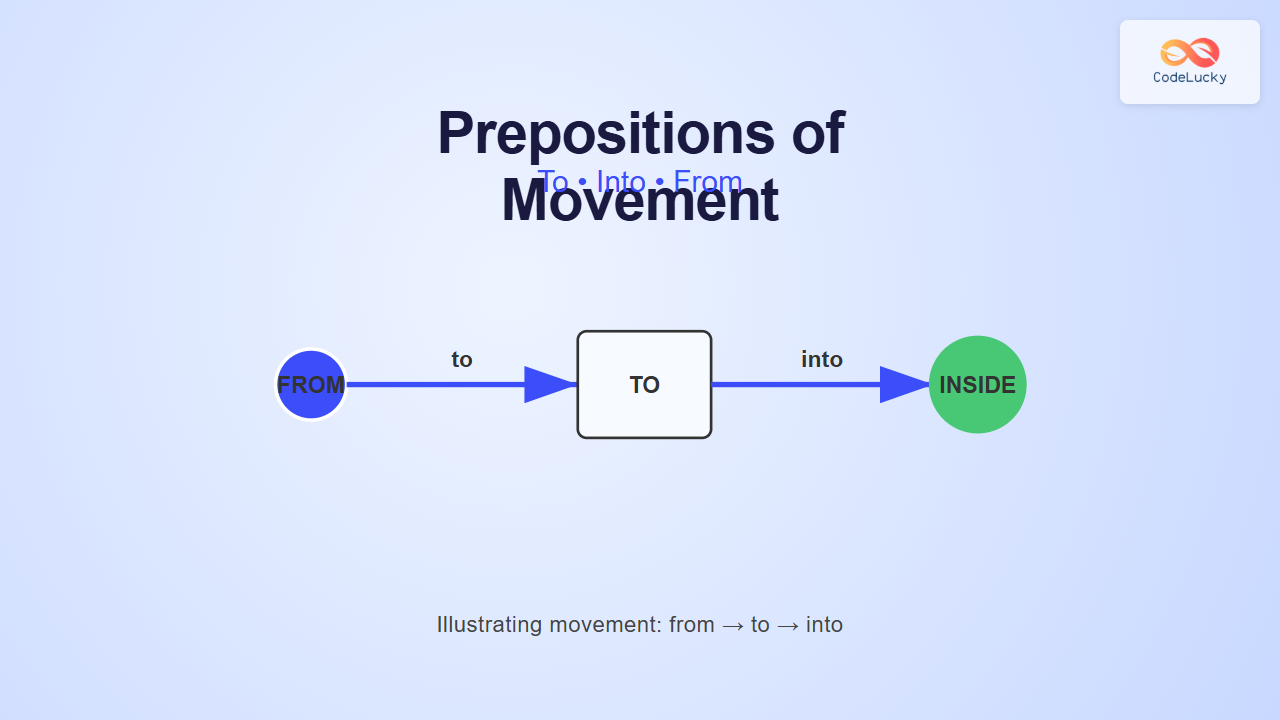
Let’s imagine a scene to make these prepositions even clearer. Picture a child walking from the gate to the classroom, then running into the room. Each preposition tells how the movement unfolds step by step.
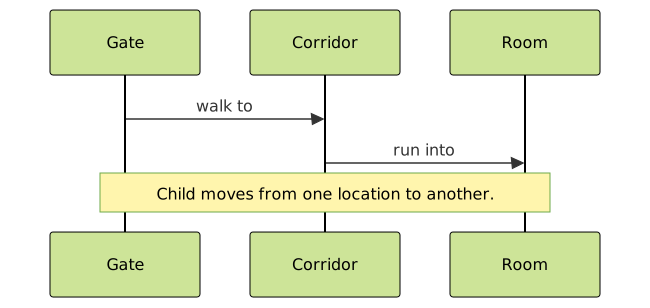
This diagram demonstrates continuous movement using all three prepositions in context — from (starting point), to (direction), and into (entry point).
7. Common Mistakes and Tips
- Don’t use to after verbs that already include direction, like “enter” or “go inside.” Say “He entered the room,” not “He entered to the room.”
- Use into when movement involves crossing a boundary; use in only for static position.
- From always pairs naturally with to when describing both ends of travel.
8. Quick Interactive Practice
Try filling in the blanks mentally (or with friends):
- She is going __ the cinema.
- The frog jumped __ the pond.
- We’re coming __ the station.
Answer key: 1. to 2. into 3. from
9. Summary Table
| Preposition | Indicates | Example |
|---|---|---|
| To | Direction toward a destination | He drove to work. |
| Into | Movement from outside to inside | The cat jumped into the basket. |
| From | Starting point of movement | She came from France. |
10. Conclusion
Prepositions of movement form the bridge between actions and destinations. Words like to, into, and from make your English dynamic and natural. Practice using them in everyday sentences — whether you move from home to the office, or step into a new opportunity — and soon you’ll sound more fluent and confident.