Prepositions are small words that create big confusion in English. They connect nouns, pronouns, and phrases to other words, showing relationships like time, place, or direction. Yet, many English learners struggle with choosing the right one. This guide explains the most common preposition mistakes and how to avoid them with clear examples, visuals, and interactive exercises.
What Are Prepositions?
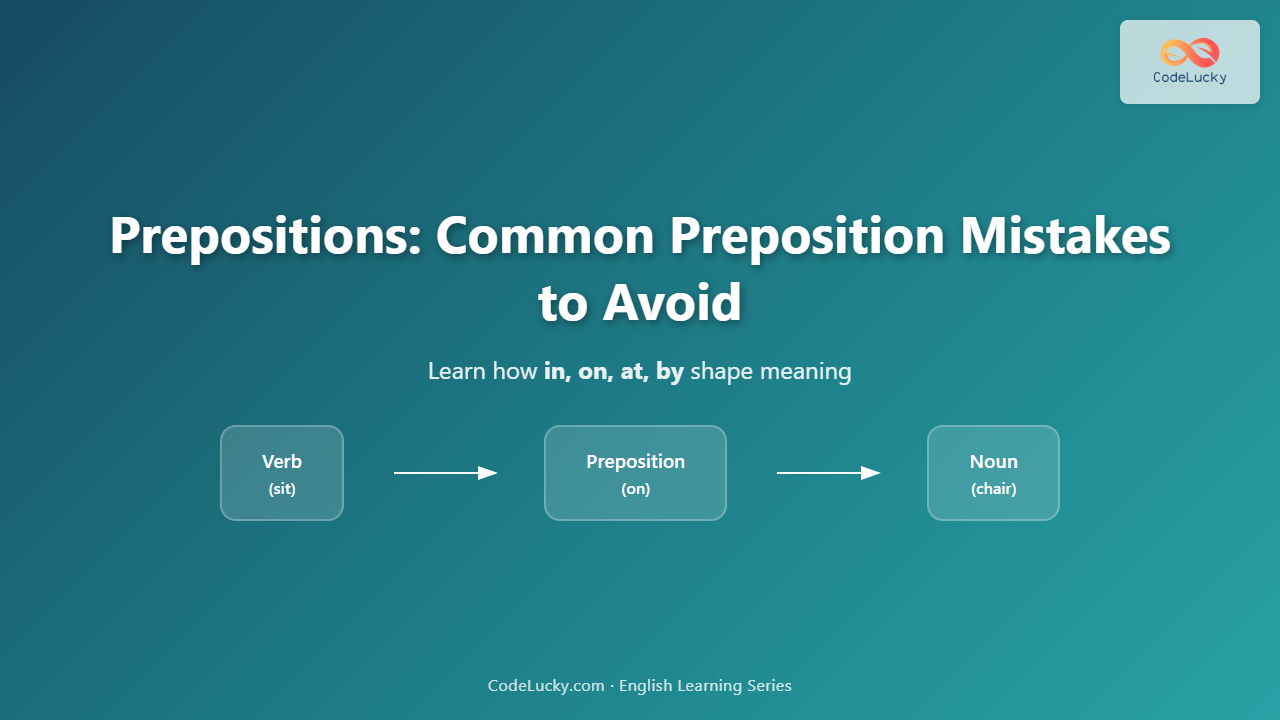
A preposition is a word placed before a noun or pronoun to show its relationship with another word in the sentence. Common ones include in, on, at, for, from, by, with, to.
Example: She sat on the chair. → (“on” shows the relationship between sat and chair.)

This simple link builds meaning, but small misuse can lead to big errors. Let’s look at these common traps!
1. Confusing “In” and “On”
“In” is used for enclosed spaces or areas, while “On” refers to surfaces.
- ✅ She lives in Delhi. (Within the city)
- ✅ The book is on the table. (On the surface)
- ❌ The book is in the table. (Incorrect!)
Tip: Think of in as something inside a boundary, and on as something touching a flat surface.

2. Misusing “At” for Time and Place
“At” is precise, while “in” and “on” are broader.
Time examples:
- ✅ I’ll meet you at 5 PM.
- ✅ We go on vacation in June.
- ✅ The meeting is on Monday.
Place examples:
- ✅ She is at the bus stop. (Specific point)
- ✅ He is in the station. (Inside the building)
- ✅ There’s a poster on the wall. (Surface)
Quick visual to remember:

3. Using “For” vs. “Since” Incorrectly
These two prepositions both talk about duration but from different angles.
- For shows the total period. ✅ She has lived here for two years.
- Since shows the starting point. ✅ She has lived here since 2020.
❌ Incorrect: She has lived here for 2020.
✅ Correct: She has lived here since 2020.

4. Overusing “By” and “With”
These prepositions confuse many learners because both can indicate how something is done.
- By = the person or method that performs an action.
✅ The book was written by Shakespeare. - With = the tool or instrument used.
✅ He cut the paper with scissors.
Helpful check: If there’s a doer, use by; if there’s a tool, use with.
5. Dropping or Adding Unnecessary Prepositions
Some verbs don’t require prepositions, but learners often add them due to influence from other languages.
- ❌ Discuss about the topic → ✅ Discuss the topic.
- ❌ Enter into the room → ✅ Enter the room.
- ❌ Request for your help → ✅ Request your help.
Similarly, don’t drop a preposition when it’s necessary:
- ❌ I am waiting you → ✅ I am waiting for you.
6. “Between” vs. “Among”
Use between for two items and among for more than two.
- ✅ The money was divided between John and Mary.
- ✅ The teacher walked among the students.
Interactive Practice
Try filling in the blanks. Choose the correct preposition:
- He has been waiting ___ morning. (for/since)
- She is sitting ___ the sofa. (in/on)
- The concert starts ___ 7 PM. (at/on)
- I cut the cake ___ a knife. (with/by)
Show Answers
- since
- on
- at
- with
Quick Recap Table
| Preposition | Use | Example |
|---|---|---|
| In | Inside an area or period | In a room, in 2021 |
| On | Surface or specific day | On the table, on Monday |
| At | Exact point of time or place | At 5 PM, at the door |
| For | Duration or total time | For two hours |
| Since | Starting point in time | Since 2020 |
| By | Agent or deadline | Written by author, by Monday |
Final Thoughts
Mastering prepositions is about understanding patterns and logic, not memorizing lists. Visualize relationships — time, place, direction — rather than isolated words. Regular reading, writing, and quizzes like the one above can make correct preposition usage feel natural.
Keep practicing, and soon you’ll speak and write English with confidence and accuracy.