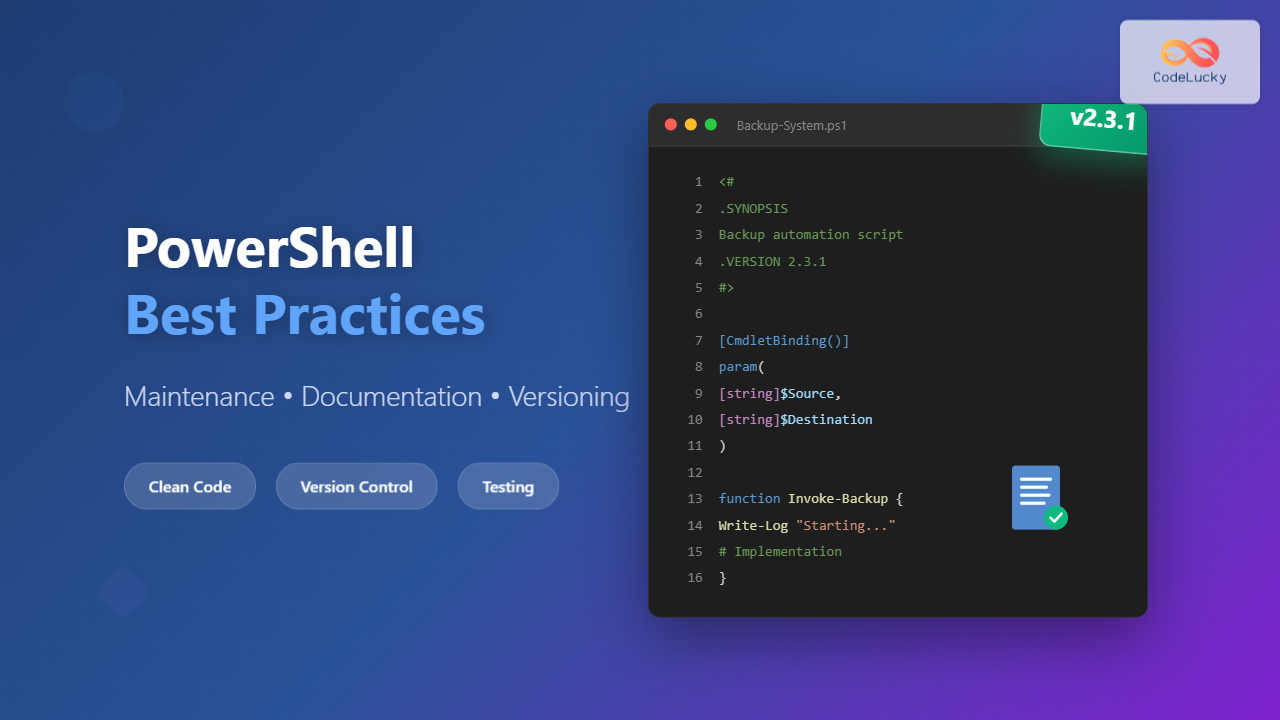
Maintaining PowerShell scripts over time requires disciplined practices in documentation, versioning, and code organization. This comprehensive guide explores battle-tested strategies that transform one-off scripts into maintainable, professional automation solutions.
Why Script Maintenance Matters
PowerShell scripts rarely remain static. Business requirements evolve, systems change, and team members transition. Without proper maintenance practices, scripts become technical debt—difficult to understand, risky to modify, and eventually abandoned. Well-maintained scripts save time, reduce errors, and enable teams to build on previous work rather than starting from scratch.
Documentation Best Practices
Comment-Based Help
PowerShell’s comment-based help system transforms your scripts into self-documenting tools. This structured format provides users with familiar Get-Help output.
<#
.SYNOPSIS
    Backs up user profile directories to a network share.

.DESCRIPTION
    This script creates compressed backups of user profile folders and transfers
    them to a designated network location. It includes error handling, logging,
    and email notifications for backup status.

.PARAMETER UserPath
    The local path to the user profile directory to backup.

.PARAMETER BackupDestination
    The UNC path where backups will be stored.

.PARAMETER RetentionDays
    Number of days to retain old backups. Default is 30 days.

.PARAMETER EmailNotification
    Switch to enable email notifications upon completion.

.EXAMPLE
    .\Backup-UserProfile.ps1 -UserPath "C:\Users\JDoe" -BackupDestination "\\server\backups"

    Creates a backup of John Doe's profile to the network share.

.EXAMPLE
    .\Backup-UserProfile.ps1 -UserPath "C:\Users\JDoe" -BackupDestination "\\server\backups" -RetentionDays 60 -EmailNotification

    Creates a backup with 60-day retention and sends an email notification.

.NOTES
    Author: IT Operations Team
    Version: 2.1.0
    Last Modified: 2025-10-15
    Requires: PowerShell 5.1 or higher
    Dependencies: None

.LINK
    https://codelucky.com/powershell-backup-strategies
#>

[CmdletBinding()]
param(
    [Parameter(Mandatory=$true)]
    [ValidateScript({Test-Path $_ -PathType Container})]
    [string]$UserPath,

    [Parameter(Mandatory=$true)]
    [string]$BackupDestination,

    [Parameter()]
    [ValidateRange(1,365)]
    [int]$RetentionDays = 30,

    [Parameter()]
    [switch]$EmailNotification
)

# Script implementation follows...
Output when running Get-Help:
PS C:\Scripts> Get-Help .\Backup-UserProfile.ps1 -Full

NAME
    Backup-UserProfile.ps1

SYNOPSIS
    Backs up user profile directories to a network share.

DESCRIPTION
    This script creates compressed backups of user profile folders...

PARAMETERS
    -UserPath <String>
        The local path to the user profile directory to backup.
        Required?                    true
        Position?                    named
        Default value
        Accept pipeline input?       false
        Accept wildcard characters?  false
Inline Comments for Complex Logic
Strategic inline comments explain the “why” behind non-obvious code decisions:
function Remove-StaleBackups {
    param([string]$Path, [int]$RetentionDays)

    $cutoffDate = (Get-Date).AddDays(-$RetentionDays)

    # Using -File instead of -Directory to avoid removing the parent folder structure
    # which may contain metadata or index files needed for restore operations
    Get-ChildItem -Path $Path -File -Recurse |
        Where-Object { $_.LastWriteTime -lt $cutoffDate } |
        ForEach-Object {
            # Suppress errors for files locked by other processes
            # rather than halting execution - these will be caught
            # in the next cleanup cycle
            Remove-Item $_.FullName -Force -ErrorAction SilentlyContinue
        }
}
Header Documentation Block
Every script should include a header block with essential metadata:
# ==============================================================================
# Script Name:     Deploy-Application.ps1
# Description:     Automated application deployment with rollback capabilities
# Author:          DevOps Team
# Created:         2024-03-15
# Last Modified:   2025-10-20
# Version:         3.2.1
#
# Change Log:
#   3.2.1 (2025-10-20) - Fixed rollback issue with configuration files
#   3.2.0 (2025-09-12) - Added support for containerized deployments
#   3.1.0 (2025-07-05) - Implemented parallel deployment for web farms
#
# Requirements:
#   - PowerShell 7.2+
#   - Azure PowerShell Module 10.0+
#   - Elevated privileges on target servers
#
# Dependencies:
#   - .\Modules\DeploymentHelpers.psm1
#   - .\Config\deployment-config.json
# ==============================================================================

Versioning Strategies
Semantic Versioning
Adopt semantic versioning (SemVer) for clear version communication: MAJOR.MINOR.PATCH
- MAJOR: Breaking changes or incompatible API modifications
- MINOR: New functionality added in a backward-compatible manner
- PATCH: Backward-compatible bug fixes
# Version tracking within the script
[version]$ScriptVersion = "2.3.1"

function Get-ScriptVersion {
    <#
    .SYNOPSIS
        Returns the current script version.
    #>
    return $ScriptVersion
}

# Version compatibility check
function Test-CompatibilityVersion {
    param([version]$RequiredVersion)

    if ($ScriptVersion -lt $RequiredVersion) {
        throw "This script requires version $RequiredVersion or higher. Current version: $ScriptVersion"
    }

    Write-Verbose "Version check passed: Running v$ScriptVersion"
}
Git Integration for Scripts
Version control is essential for script maintenance. Initialize a repository structure:
# Initialize a scripts repository
New-Item -Path "C:\PowerShellScripts" -ItemType Directory
Set-Location "C:\PowerShellScripts"

git init
git config user.name "DevOps Team"
git config user.email "[email protected]"

# Create .gitignore for PowerShell
@"
# Sensitive files
*.credential
*-secrets.ps1
*.key

# Log files
*.log
logs/

# Temporary files
*.tmp
temp/

# User-specific files
*.user
"@ | Out-File -FilePath ".gitignore" -Encoding utf8

# Create initial commit
git add .gitignore
git commit -m "Initial commit: Repository structure"
Commit message conventions:
# Good commit messages follow a pattern:
git commit -m "feat: Add parallel processing for large datasets"
git commit -m "fix: Resolve null reference in error handling"
git commit -m "docs: Update parameter descriptions for clarity"
git commit -m "refactor: Simplify loop logic in backup function"
git commit -m "perf: Optimize database query execution"

# Create version tags
git tag -a v2.3.1 -m "Release version 2.3.1 - Bug fixes for backup retention"
git push origin v2.3.1

Change Log Management
Maintain a CHANGELOG.md file in your scripts directory:
# Changelog

All notable changes to the PowerShell Backup Suite will be documented in this file.

## [2.3.1] - 2025-10-20

### Fixed
- Resolved issue where backup retention cleanup would fail on locked files
- Corrected error message formatting in email notifications

### Changed
- Improved logging detail for debugging purposes

## [2.3.0] - 2025-10-05

### Added
- Support for incremental backups to reduce storage requirements
- New parameter `-IncrementalMode` for backup type selection
- Progress bar for long-running backup operations

### Deprecated
- Legacy backup format (will be removed in v3.0.0)

## [2.2.0] - 2025-09-15

### Added
- Email notification system with customizable templates
- Backup verification step after compression
- Multi-threaded compression for improved performance

### Security
- Encrypted credentials storage using Windows Data Protection API
Code Organization and Structure
Modular Design
Break complex scripts into reusable modules:
# File: BackupModule.psm1

function Invoke-Backup {
    [CmdletBinding()]
    param(
        [string]$Source,
        [string]$Destination
    )

    # Implementation
}

function Test-BackupIntegrity {
    [CmdletBinding()]
    param(
        [string]$BackupPath
    )

    # Implementation
}

function Send-BackupNotification {
    [CmdletBinding()]
    param(
        [string]$Status,
        [string]$Details
    )

    # Implementation
}

# Export only public functions
Export-ModuleMember -Function Invoke-Backup, Test-BackupIntegrity, Send-BackupNotification
Use the module in scripts:
# Main script: Backup-System.ps1
Import-Module .\BackupModule.psm1

# Clean, focused script logic
Invoke-Backup -Source "C:\Data" -Destination "\\server\backups"
Test-BackupIntegrity -BackupPath "\\server\backups\latest.zip"
Send-BackupNotification -Status "Success" -Details "Backup completed at $(Get-Date)"
Configuration Management
Separate configuration from logic using JSON or PSD1 files:
{
    "BackupSettings": {
        "SourcePaths": [
            "C:\\Users\\*\\Documents",
            "C:\\Users\\*\\Desktop"
        ],
        "DestinationRoot": "\\\\server\\backups",
        "RetentionDays": 30,
        "CompressionLevel": "Optimal",
        "EnableEncryption": true
    },
    "NotificationSettings": {
        "SmtpServer": "smtp.company.com",
        "From": "[email protected]",
        "To": ["[email protected]"],
        "OnSuccess": true,
        "OnFailure": true
    },
    "LogSettings": {
        "LogPath": "C:\\Logs\\Backups",
        "LogLevel": "Information",
        "MaxLogSizeMB": 50
    }
}
Load configuration in your script:
function Get-BackupConfiguration {
    param([string]$ConfigPath = ".\config.json")

    if (-not (Test-Path $ConfigPath)) {
        throw "Configuration file not found: $ConfigPath"
    }

    try {
        $config = Get-Content $ConfigPath -Raw | ConvertFrom-Json
        return $config
    }
    catch {
        throw "Failed to parse configuration: $_"
    }
}

# Usage
$config = Get-BackupConfiguration
$config.BackupSettings.SourcePaths | ForEach-Object {
    Write-Host "Will backup: $_"
}

Error Handling and Logging
Comprehensive Error Handling
function Invoke-BackupWithErrorHandling {
    [CmdletBinding()]
    param(
        [string]$Source,
        [string]$Destination
    )

    try {
        # Set strict error handling
        $ErrorActionPreference = 'Stop'

        Write-Log -Message "Starting backup from $Source to $Destination" -Level Information

        # Validation
        if (-not (Test-Path $Source)) {
            throw "Source path does not exist: $Source"
        }

        # Create destination if needed
        if (-not (Test-Path $Destination)) {
            New-Item -Path $Destination -ItemType Directory -Force | Out-Null
            Write-Log -Message "Created destination directory: $Destination" -Level Information
        }

        # Perform backup
        $timestamp = Get-Date -Format "yyyyMMdd_HHmmss"
        $backupFile = Join-Path $Destination "backup_$timestamp.zip"

        Compress-Archive -Path $Source -DestinationPath $backupFile -CompressionLevel Optimal

        # Verify backup
        if (Test-Path $backupFile) {
            $fileSize = (Get-Item $backupFile).Length / 1MB
            Write-Log -Message "Backup completed successfully. Size: $([math]::Round($fileSize, 2)) MB" -Level Information
            return $backupFile
        }
        else {
            throw "Backup file was not created"
        }
    }
    catch [System.UnauthorizedAccessException] {
        Write-Log -Message "Access denied: $($_.Exception.Message)" -Level Error
        Send-AlertEmail -Subject "Backup Failed - Access Denied" -Body $_.Exception.Message
        throw
    }
    catch [System.IO.IOException] {
        Write-Log -Message "I/O error during backup: $($_.Exception.Message)" -Level Error
        Send-AlertEmail -Subject "Backup Failed - I/O Error" -Body $_.Exception.Message
        throw
    }
    catch {
        Write-Log -Message "Unexpected error during backup: $($_.Exception.Message)" -Level Error
        Write-Log -Message "Stack trace: $($_.ScriptStackTrace)" -Level Debug
        Send-AlertEmail -Subject "Backup Failed - Unknown Error" -Body $_.Exception.Message
        throw
    }
    finally {
        # Cleanup temporary resources
        $ErrorActionPreference = 'Continue'
        Write-Log -Message "Backup operation completed" -Level Information
    }
}
Structured Logging System
function Write-Log {
    [CmdletBinding()]
    param(
        [Parameter(Mandatory=$true)]
        [string]$Message,

        [Parameter()]
        [ValidateSet('Debug', 'Information', 'Warning', 'Error', 'Critical')]
        [string]$Level = 'Information',

        [Parameter()]
        [string]$LogPath = "C:\Logs\BackupScript.log"
    )

    $timestamp = Get-Date -Format "yyyy-MM-dd HH:mm:ss"
    $logEntry = "[$timestamp] [$Level] $Message"

    # Ensure log directory exists
    $logDir = Split-Path $LogPath
    if (-not (Test-Path $logDir)) {
        New-Item -Path $logDir -ItemType Directory -Force | Out-Null
    }

    # Write to log file
    Add-Content -Path $LogPath -Value $logEntry

    # Console output with color coding
    switch ($Level) {
        'Debug'       { Write-Verbose $logEntry }
        'Information' { Write-Host $logEntry -ForegroundColor Cyan }
        'Warning'     { Write-Warning $logEntry }
        'Error'       { Write-Error $logEntry }
        'Critical'    { Write-Host $logEntry -ForegroundColor Red -BackgroundColor Yellow }
    }
}

# Usage example
Write-Log -Message "Backup process initiated" -Level Information
Write-Log -Message "Low disk space detected on backup destination" -Level Warning
Write-Log -Message "Failed to connect to backup server" -Level Error
Sample log output:
[2025-10-22 17:15:32] [Information] Backup process initiated
[2025-10-22 17:15:33] [Information] Created destination directory: \\server\backups
[2025-10-22 17:15:45] [Information] Backup completed successfully. Size: 847.23 MB
[2025-10-22 17:15:46] [Warning] Low disk space detected on backup destination
[2025-10-22 17:15:47] [Information] Backup operation completed
Testing and Validation
Pester Testing Framework
Implement unit tests for your scripts using Pester:
# File: BackupModule.Tests.ps1

BeforeAll {
    Import-Module .\BackupModule.psm1 -Force
}

Describe "Invoke-Backup" {
    Context "When source path is valid" {
        BeforeEach {
            $testSource = "TestDrive:\Source"
            $testDest = "TestDrive:\Destination"
            New-Item -Path $testSource -ItemType Directory -Force
            New-Item -Path "$testSource\test.txt" -ItemType File -Force
        }

        It "Creates a backup file" {
            $result = Invoke-Backup -Source $testSource -Destination $testDest
            Test-Path $result | Should -Be $true
        }

        It "Backup file is not empty" {
            $result = Invoke-Backup -Source $testSource -Destination $testDest
            (Get-Item $result).Length | Should -BeGreaterThan 0
        }
    }

    Context "When source path is invalid" {
        It "Throws an error" {
            { Invoke-Backup -Source "C:\NonExistent" -Destination "TestDrive:\Dest" } |
                Should -Throw
        }
    }
}

Describe "Test-BackupIntegrity" {
    It "Returns true for valid backup file" {
        $testBackup = "TestDrive:\valid.zip"
        # Create a valid zip file
        Compress-Archive -Path $PSScriptRoot -DestinationPath $testBackup

        Test-BackupIntegrity -BackupPath $testBackup | Should -Be $true
    }

    It "Returns false for corrupted backup file" {
        $testBackup = "TestDrive:\corrupt.zip"
        "Invalid content" | Out-File $testBackup

        Test-BackupIntegrity -BackupPath $testBackup | Should -Be $false
    }
}
Running tests:
PS C:\Scripts> Invoke-Pester .\BackupModule.Tests.ps1

Starting discovery in 1 files.
Discovery finished in 142ms.

Running tests.
[+] Invoke-Backup.When source path is valid.Creates a backup file 89ms (85ms|4ms)
[+] Invoke-Backup.When source path is valid.Backup file is not empty 78ms (76ms|2ms)
[+] Invoke-Backup.When source path is invalid.Throws an error 45ms (43ms|2ms)
[+] Test-BackupIntegrity.Returns true for valid backup file 156ms (154ms|2ms)
[+] Test-BackupIntegrity.Returns false for corrupted backup file 34ms (32ms|2ms)

Tests completed in 634ms
Tests Passed: 5, Failed: 0, Skipped: 0 NotRun: 0
Input Validation
Implement thorough parameter validation:
function Start-BackupProcess {
    [CmdletBinding()]
    param(
        [Parameter(Mandatory=$true)]
        [ValidateScript({
            if (-not (Test-Path $_)) {
                throw "Path does not exist: $_"
            }
            if (-not (Test-Path $_ -PathType Container)) {
                throw "Path is not a directory: $_"
            }
            return $true
        })]
        [string]$SourcePath,

        [Parameter(Mandatory=$true)]
        [ValidatePattern('^\\\\[\w\-]+\\[\w\-\$]+')]
        [string]$NetworkDestination,

        [Parameter()]
        [ValidateRange(1, 365)]
        [int]$RetentionDays = 30,

        [Parameter()]
        [ValidateSet('Fastest', 'Fast', 'Optimal', 'Maximum')]
        [string]$CompressionLevel = 'Optimal',

        [Parameter()]
        [ValidateScript({
            if ($_ -match '^\w+@[\w\-]+\.[\w\-]+$') {
                return $true
            }
            throw "Invalid email format: $_"
        })]
        [string[]]$EmailRecipients
    )

    # Validation passed, proceed with backup
    Write-Verbose "All parameters validated successfully"
}

Performance Optimization
Efficient Pipeline Usage
# Inefficient: Loading all items into memory
$allFiles = Get-ChildItem -Path "C:\Large\Directory" -Recurse
$allFiles | Where-Object { $_.Length -gt 10MB } | Remove-Item

# Efficient: Using pipeline streaming
Get-ChildItem -Path "C:\Large\Directory" -Recurse |
    Where-Object { $_.Length -gt 10MB } |
    Remove-Item -WhatIf
Parallel Processing
function Backup-MultipleServers {
    param([string[]]$ServerList)

    # PowerShell 7+ ForEach-Object -Parallel
    $ServerList | ForEach-Object -Parallel {
        $server = $_
        $destination = "\\backupserver\backups\$server"

        try {
            Invoke-Command -ComputerName $server -ScriptBlock {
                Get-ChildItem "C:\Data" -Recurse |
                    Where-Object { -not $_.PSIsContainer } |
                    Select-Object FullName, Length, LastWriteTime
            } | Export-Csv -Path "$destination\inventory.csv" -NoTypeInformation

            Write-Host "Completed backup for $server" -ForegroundColor Green
        }
        catch {
            Write-Host "Failed backup for $server : $_" -ForegroundColor Red
        }
    } -ThrottleLimit 5
}

# Usage
$servers = @('WEB01', 'WEB02', 'WEB03', 'DB01', 'DB02')
Backup-MultipleServers -ServerList $servers
Progress Tracking
function Backup-WithProgress {
    param(
        [string[]]$SourcePaths,
        [string]$Destination
    )

    $totalItems = $SourcePaths.Count
    $currentItem = 0

    foreach ($path in $SourcePaths) {
        $currentItem++
        $percentComplete = ($currentItem / $totalItems) * 100

        Write-Progress -Activity "Backing up directories" `
                       -Status "Processing: $path" `
                       -PercentComplete $percentComplete `
                       -CurrentOperation "Item $currentItem of $totalItems"

        Compress-Archive -Path $path -DestinationPath "$Destination\$(Split-Path $path -Leaf).zip"
        Start-Sleep -Milliseconds 500  # Simulated processing time
    }

    Write-Progress -Activity "Backing up directories" -Completed
}
Security Best Practices
Credential Management
function Get-SecureCredential {
    [CmdletBinding()]
    param(
        [string]$CredentialPath = ".\credentials.xml"
    )

    if (Test-Path $CredentialPath) {
        # Load existing credential
        $credential = Import-Clixml -Path $CredentialPath
    }
    else {
        # Prompt and save for future use
        $credential = Get-Credential -Message "Enter backup service credentials"
        $credential | Export-Clixml -Path $CredentialPath
        Write-Warning "Credentials saved to: $CredentialPath"
    }

    return $credential
}

# Usage in script
$cred = Get-SecureCredential
New-PSDrive -Name "BackupShare" -PSProvider FileSystem `
            -Root "\\server\backups" -Credential $cred
Script Signing
# Create self-signed certificate for development
$cert = New-SelfSignedCertificate -Subject "CN=PowerShell Code Signing" `
                                   -Type CodeSigning `
                                   -CertStoreLocation Cert:\CurrentUser\My

# Sign the script
Set-AuthenticodeSignature -FilePath ".\Backup-System.ps1" -Certificate $cert

# Verify signature
$signature = Get-AuthenticodeSignature -FilePath ".\Backup-System.ps1"
$signature.Status  # Should return "Valid"
Deployment and Distribution
Script Packaging
Create a structured package for distribution:
# Directory structure
BackupSolution/
├── Backup-System.ps1          # Main script
├── config.json                # Configuration file
├── README.md                  # Documentation
├── CHANGELOG.md               # Version history
├── Modules/
│   ├── BackupModule.psm1
│   ├── NotificationModule.psm1
│   └── LoggingModule.psm1
├── Tests/
│   ├── BackupModule.Tests.ps1
│   └── Integration.Tests.ps1
└── Templates/
    ├── config.template.json
    └── email-notification.html
Installation Script
# Install-BackupSolution.ps1

[CmdletBinding()]
param(
    [string]$InstallPath = "C:\Scripts\BackupSolution",
    [switch]$CreateScheduledTask
)

Write-Host "Installing Backup Solution..." -ForegroundColor Cyan

# Create installation directory
New-Item -Path $InstallPath -ItemType Directory -Force | Out-Null

# Copy files
Copy-Item -Path ".\*" -Destination $InstallPath -Recurse -Force

# Create config from template
$configTemplate = Get-Content ".\Templates\config.template.json" -Raw
$config = $configTemplate -replace '{{INSTALL_PATH}}', $InstallPath
$config | Out-File "$InstallPath\config.json" -Encoding utf8

Write-Host "Files installed to: $InstallPath" -ForegroundColor Green

if ($CreateScheduledTask) {
    $action = New-ScheduledTaskAction -Execute "powershell.exe" `
                                      -Argument "-File `"$InstallPath\Backup-System.ps1`""

    $trigger = New-ScheduledTaskTrigger -Daily -At "2:00 AM"

    Register-ScheduledTask -TaskName "DailyBackup" `
                          -Action $action `
                          -Trigger $trigger `
                          -Description "Automated backup process"

    Write-Host "Scheduled task created: DailyBackup" -ForegroundColor Green
}

Write-Host "Installation complete!" -ForegroundColor Green

Maintenance Workflows
Regular Review Checklist
Establish a maintenance schedule for your scripts:
- Monthly Review: Check logs for errors, verify backup integrity, update dependencies
- Quarterly Review: Review and update documentation, optimize performance bottlenecks
- Annual Review: Major version updates, deprecate unused features, security audit
Deprecation Strategy
function Invoke-LegacyBackup {
    [CmdletBinding()]
    param([string]$Path)

    # Deprecation warning
    Write-Warning @"
DEPRECATION NOTICE: This function is deprecated and will be removed in version 3.0.0
Please use 'Invoke-Backup' instead.
Migration guide: https://codelucky.com/backup-migration
"@

    # Log deprecation usage for tracking
    Write-Log -Message "Legacy function called: Invoke-LegacyBackup" -Level Warning

    # Call new function internally
    Invoke-Backup -Source $Path -Destination (Get-DefaultBackupPath)
}
Conclusion
Maintaining PowerShell scripts requires discipline and systematic approaches to documentation, versioning, and code quality. By implementing comment-based help, semantic versioning, comprehensive error handling, and structured testing, you create scripts that remain valuable assets over time. Regular reviews, clear deprecation strategies, and proper version control ensure your automation solutions evolve with your organization’s needs while maintaining reliability and clarity for current and future team members.