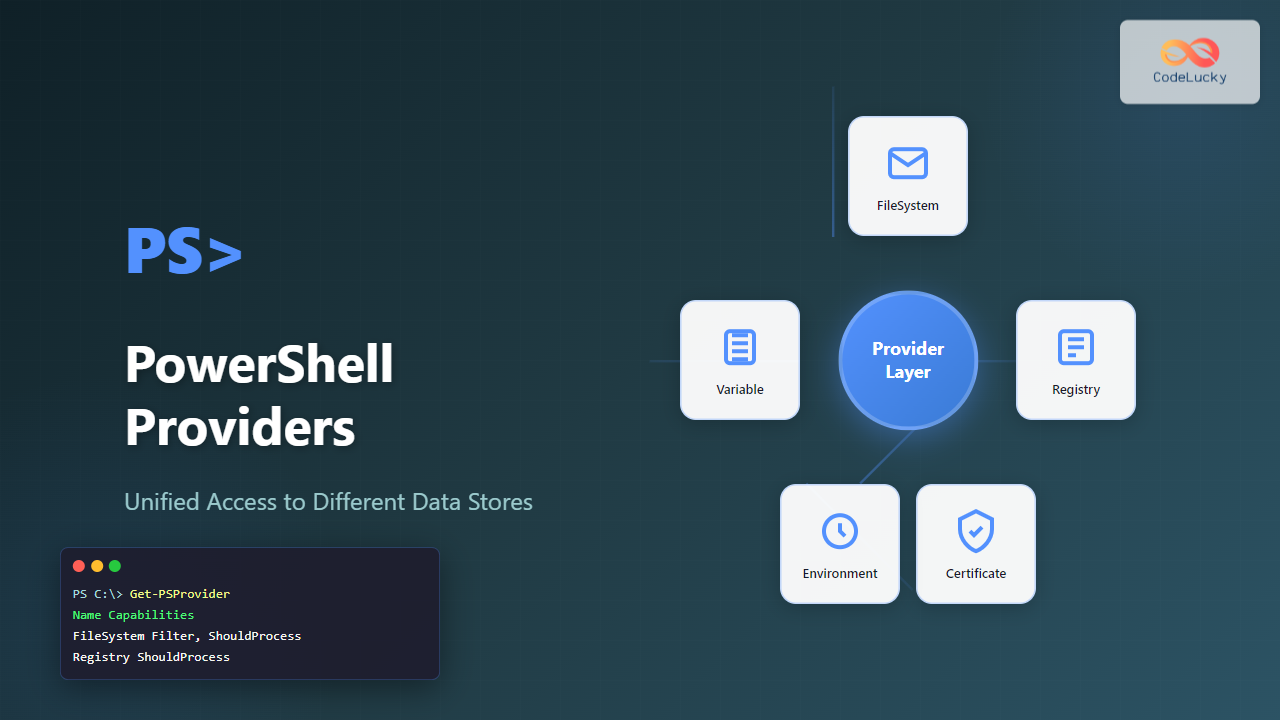
PowerShell Providers are one of the most powerful yet underappreciated features in PowerShell. They create a unified interface that allows you to interact with different data stores using the same set of cmdlets. Whether you’re navigating the file system, modifying registry keys, or managing environment variables, providers make it feel like you’re working with a familiar file structure.
This comprehensive guide explores PowerShell Providers in depth, covering the FileSystem, Registry, Environment, and other built-in providers with practical examples you can use immediately.
What Are PowerShell Providers?
PowerShell Providers are .NET programs that provide access to specialized data stores in a way that resembles a file system. They expose data stores as drives (similar to C:, D:, etc.) that you can navigate using familiar cmdlets like Get-ChildItem, Set-Location, and New-Item.

Viewing Available Providers
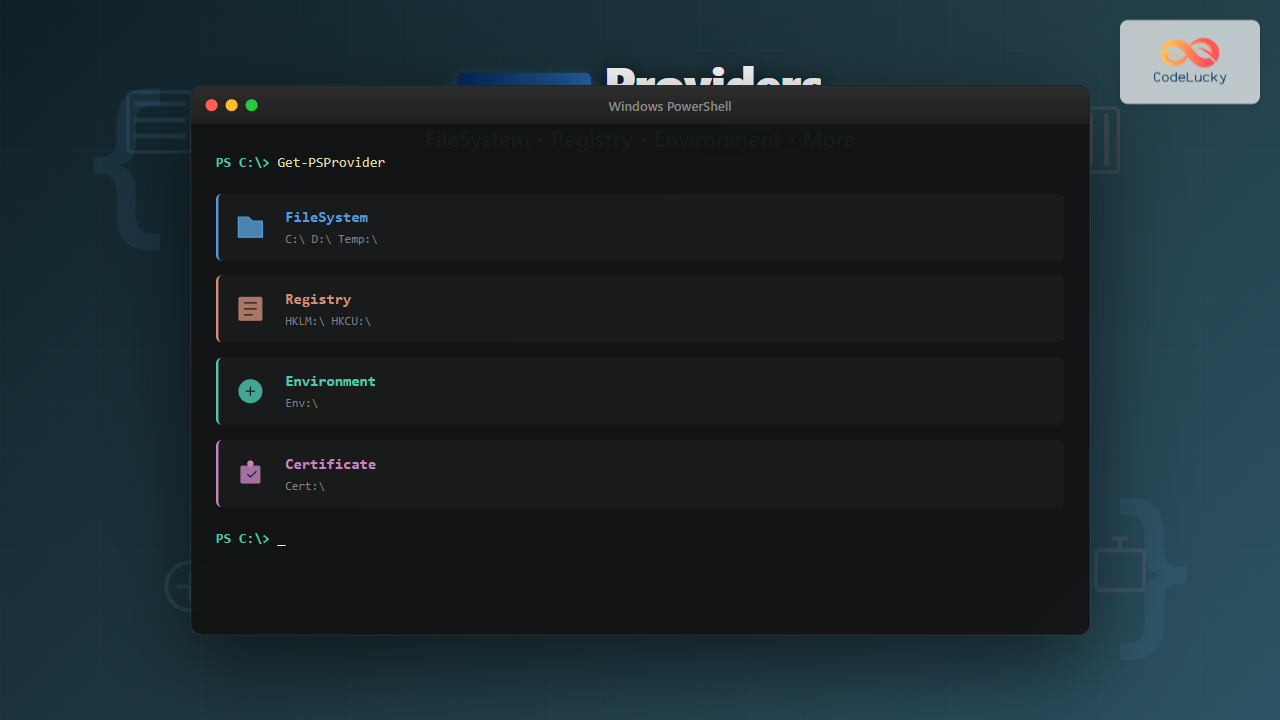
To see all providers available in your PowerShell session:
Get-PSProviderOutput:
Name                 Capabilities                       Drives
----                 ------------                       ------
Registry             ShouldProcess                      HKLM, HKCU
Alias                ShouldProcess                      Alias
Environment          ShouldProcess                      Env
FileSystem           Filter, ShouldProcess, Credentials C, D, Temp
Function             ShouldProcess                      Function
Variable             ShouldProcess                      Variable
Certificate          ShouldProcess                      Cert
Understanding Provider Drives
Each provider exposes one or more drives. View all available drives:
Get-PSDriveSample Output:
Name           Used (GB)     Free (GB) Provider      Root
----           ---------     --------- --------      ----
Alias                                  Alias
C                 234.56        189.23 FileSystem    C:\
Cert                                   Certificate   \
Env                                    Environment
Function                               Function
HKCU                                   Registry      HKEY_CURRENT_USER
HKLM                                   Registry      HKEY_LOCAL_MACHINE
Variable                               Variable
WSMan                                  WSMan
FileSystem Provider
The FileSystem provider is the most commonly used provider, giving you access to files and directories on your computer.
Navigating the File System
# Change to a different directory
Set-Location -Path "C:\Windows\System32"

# Get current location
Get-Location

# Navigate using aliases
cd C:\Users
pwd  # Print working directory
Working with Files and Directories
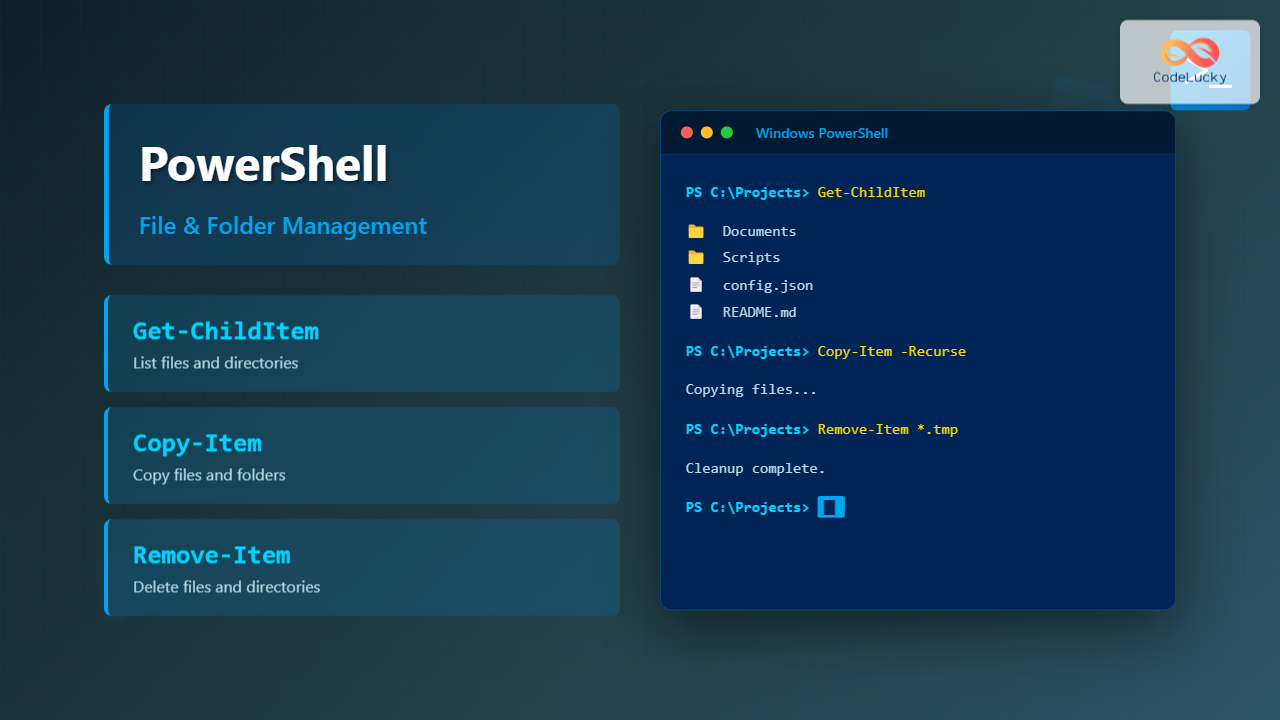
Create, read, and manage files using standard cmdlets:
# Create a new directory
New-Item -Path "C:\Temp\TestFolder" -ItemType Directory

# Create a new file
New-Item -Path "C:\Temp\TestFolder\sample.txt" -ItemType File -Value "Hello, PowerShell!"

# Read file content
Get-Content -Path "C:\Temp\TestFolder\sample.txt"

# List items in a directory
Get-ChildItem -Path "C:\Temp\TestFolder"

# Copy a file
Copy-Item -Path "C:\Temp\TestFolder\sample.txt" -Destination "C:\Temp\sample_backup.txt"

# Remove a file
Remove-Item -Path "C:\Temp\sample_backup.txt"
Advanced FileSystem Operations
Filter and search for specific files:
# Find all .log files in Windows directory (non-recursive)
Get-ChildItem -Path "C:\Windows\*.log"

# Recursive search for PowerShell scripts
Get-ChildItem -Path "C:\Scripts" -Filter "*.ps1" -Recurse

# Get files modified in the last 7 days
Get-ChildItem -Path "C:\Temp" -Recurse |
    Where-Object { $_.LastWriteTime -gt (Get-Date).AddDays(-7) }

# Get file properties
Get-ItemProperty -Path "C:\Windows\notepad.exe" |
    Select-Object Name, Length, CreationTime, LastWriteTime
Example Output:
Name         : notepad.exe
Length       : 214528
CreationTime : 9/15/2024 10:23:45 AM
LastWriteTime: 9/15/2024 10:23:45 AM
Working with File Content
# Add content to a file
Add-Content -Path "C:\Temp\log.txt" -Value "New log entry: $(Get-Date)"

# Replace content in a file
Set-Content -Path "C:\Temp\config.txt" -Value "Setting=Value"

# Read specific lines
Get-Content -Path "C:\Temp\log.txt" -TotalCount 5  # First 5 lines
Get-Content -Path "C:\Temp\log.txt" -Tail 5        # Last 5 lines

# Stream large files
Get-Content -Path "C:\Temp\large.log" -ReadCount 100 |
    ForEach-Object {
        # Process 100 lines at a time
    }
Registry Provider
The Registry provider allows you to navigate and modify Windows Registry as if it were a file system. PowerShell exposes two registry drives by default: HKLM (HKEY_LOCAL_MACHINE) and HKCU (HKEY_CURRENT_USER).

Navigating the Registry
# Change to HKLM drive
Set-Location -Path "HKLM:\"

# Navigate to a specific key
Set-Location -Path "HKLM:\SOFTWARE\Microsoft\Windows\CurrentVersion"

# List subkeys
Get-ChildItem

# Get current location in registry
Get-Location
Reading Registry Values
# Get all properties of a registry key
Get-ItemProperty -Path "HKCU:\Control Panel\Desktop"

# Get a specific property
Get-ItemProperty -Path "HKCU:\Control Panel\Desktop" -Name "Wallpaper"

# Using Get-Item to view key information
Get-Item -Path "HKLM:\SOFTWARE\Microsoft\Windows NT\CurrentVersion"
Example Output:
ProductName       : Windows 11 Pro
CurrentBuild      : 22631
InstallationType  : Client
RegisteredOwner   : User
RegisteredOrganization :
Modifying Registry Values
# Create a new registry key
New-Item -Path "HKCU:\Software\MyApplication" -Force

# Create a new value
New-ItemProperty -Path "HKCU:\Software\MyApplication" `
    -Name "Version" -Value "1.0.0" -PropertyType String

# Modify an existing value
Set-ItemProperty -Path "HKCU:\Software\MyApplication" `
    -Name "Version" -Value "1.0.1"

# Create a DWORD value
New-ItemProperty -Path "HKCU:\Software\MyApplication" `
    -Name "Enabled" -Value 1 -PropertyType DWord

# Remove a value
Remove-ItemProperty -Path "HKCU:\Software\MyApplication" -Name "Enabled"

# Remove a key
Remove-Item -Path "HKCU:\Software\MyApplication" -Recurse
Practical Registry Example
Check if a specific software is installed:
function Get-InstalledSoftware {
    param([string]$Name)

    $paths = @(
        "HKLM:\SOFTWARE\Microsoft\Windows\CurrentVersion\Uninstall\*",
        "HKLM:\SOFTWARE\WOW6432Node\Microsoft\Windows\CurrentVersion\Uninstall\*"
    )

    Get-ItemProperty -Path $paths -ErrorAction SilentlyContinue |
        Where-Object { $_.DisplayName -like "*$Name*" } |
        Select-Object DisplayName, DisplayVersion, Publisher, InstallDate
}

# Usage
Get-InstalledSoftware -Name "Chrome"
Environment Provider
The Environment provider gives you access to Windows environment variables through the Env: drive.
Viewing Environment Variables
# List all environment variables
Get-ChildItem Env:

# Get a specific environment variable
Get-ChildItem Env:Path
# or
$env:Path

# Get multiple variables
Get-ChildItem Env: | Where-Object { $_.Name -like "PROCESSOR*" }
Example Output:
Name                           Value
----                           -----
PROCESSOR_ARCHITECTURE         AMD64
PROCESSOR_IDENTIFIER           Intel64 Family 6 Model 142...
PROCESSOR_LEVEL                6
PROCESSOR_REVISION             8e09
Modifying Environment Variables
# Create a new environment variable (session-only)
New-Item -Path Env:MyVariable -Value "TestValue"
# or
$env:MyVariable = "TestValue"

# Modify an existing variable
Set-Item -Path Env:MyVariable -Value "NewValue"
# or
$env:MyVariable = "NewValue"

# Remove an environment variable
Remove-Item -Path Env:MyVariable
# or
$env:MyVariable = $null
Working with PATH Variable
# View current PATH
$env:Path -split ";"

# Add a directory to PATH (current session only)
$env:Path += ";C:\MyTools"

# Add permanently (user level)
[Environment]::SetEnvironmentVariable(
    "Path",
    "$([Environment]::GetEnvironmentVariable('Path', 'User'));C:\MyTools",
    "User"
)

# Add permanently (system level - requires admin)
[Environment]::SetEnvironmentVariable(
    "Path",
    "$([Environment]::GetEnvironmentVariable('Path', 'Machine'));C:\MyTools",
    "Machine"
)
Practical Environment Example
# Create a script that checks common environment variables
function Get-SystemEnvironmentInfo {
    [PSCustomObject]@{
        ComputerName = $env:COMPUTERNAME
        Username = $env:USERNAME
        UserDomain = $env:USERDOMAIN
        HomeDirectory = $env:USERPROFILE
        TempDirectory = $env:TEMP
        OSVersion = $env:OS
        ProcessorCount = $env:NUMBER_OF_PROCESSORS
        SystemRoot = $env:SystemRoot
    }
}

# Usage
Get-SystemEnvironmentInfo
Certificate Provider
The Certificate provider (Cert:) provides access to X.509 certificate stores on your computer.
Navigating Certificate Stores
# Navigate to certificate drive
Set-Location Cert:

# View certificate stores
Get-ChildItem

# Navigate to CurrentUser store
Set-Location Cert:\CurrentUser\My

# List all certificates in Personal store
Get-ChildItem -Path Cert:\CurrentUser\My
Working with Certificates
# Get certificates expiring soon
Get-ChildItem -Path Cert:\CurrentUser\My |
    Where-Object { $_.NotAfter -lt (Get-Date).AddDays(30) } |
    Select-Object Subject, NotAfter, Thumbprint

# Find certificates by subject
Get-ChildItem -Path Cert:\CurrentUser\My |
    Where-Object { $_.Subject -like "*example.com*" }

# Get certificate details
Get-Item -Path "Cert:\CurrentUser\My\THUMBPRINT_HERE" |
    Select-Object Subject, Issuer, NotBefore, NotAfter, Thumbprint
Exporting and Importing Certificates
# Export a certificate
$cert = Get-Item -Path "Cert:\CurrentUser\My\THUMBPRINT"
Export-Certificate -Cert $cert -FilePath "C:\Temp\certificate.cer"

# Import a certificate
Import-Certificate -FilePath "C:\Temp\certificate.cer" -CertStoreLocation Cert:\CurrentUser\My
Variable Provider
The Variable provider gives you access to PowerShell variables as a drive.
# List all variables
Get-ChildItem Variable:

# Get a specific variable
Get-Item Variable:PSVersionTable

# Create a variable using provider
New-Item -Path Variable:MyVar -Value "Hello"

# Remove a variable
Remove-Item -Path Variable:MyVar

# Get variables matching a pattern
Get-ChildItem Variable: | Where-Object { $_.Name -like "PS*" }
Alias and Function Providers
Alias Provider
# List all aliases
Get-ChildItem Alias:

# Get specific alias
Get-Item Alias:ls

# Create a new alias
New-Item -Path Alias:np -Value "notepad.exe"
# or
Set-Alias -Name np -Value notepad.exe

# Remove an alias
Remove-Item Alias:np
Function Provider
# List all functions
Get-ChildItem Function:

# Get a specific function definition
Get-Item Function:prompt

# Create a function using provider
New-Item -Path Function:Test-MyFunction -Value {
    param($Name)
    Write-Output "Hello, $Name!"
}
Creating Custom Provider Drives
You can create custom drives that map to any provider location for easier access:
# Create a drive for a frequently accessed directory
New-PSDrive -Name "Scripts" -PSProvider FileSystem -Root "C:\Users\Username\Documents\Scripts"

# Now you can use it like any drive
Set-Location Scripts:
Get-ChildItem

# Create a registry drive for easier access
New-PSDrive -Name "HKCR" -PSProvider Registry -Root "HKEY_CLASSES_ROOT"

# Access it
Get-ChildItem HKCR:\

# Remove a custom drive
Remove-PSDrive -Name "Scripts"
Persistent Custom Drives
# Create a persistent drive (survives PowerShell restart)
New-PSDrive -Name "Work" -PSProvider FileSystem `
    -Root "C:\WorkProjects" -Persist -Scope Global

# Add to your PowerShell profile for automatic creation
# Edit profile: notepad $PROFILE
# Add line: New-PSDrive -Name "Work" -PSProvider FileSystem -Root "C:\WorkProjects"
Provider Cmdlets Reference

Here are the essential cmdlets that work across all providers:
Navigation Cmdlets
Get-Location(alias:pwd) – Get current locationSet-Location(alias:cd) – Change locationPush-Location(alias:pushd) – Save current location and changePop-Location(alias:popd) – Return to saved location
Item Cmdlets
Get-Item– Get item at specified locationGet-ChildItem(alias:ls,dir) – Get child itemsNew-Item– Create new itemCopy-Item(alias:cp) – Copy itemMove-Item(alias:mv) – Move itemRemove-Item(alias:rm) – Delete itemRename-Item– Rename item
Property Cmdlets
Get-ItemProperty– Get item propertiesSet-ItemProperty– Set item propertiesNew-ItemProperty– Create new propertyRemove-ItemProperty– Remove property
Content Cmdlets
Get-Content(alias:cat) – Read contentSet-Content– Write content (overwrites)Add-Content– Append contentClear-Content– Clear content without deleting item
Real-World Practical Examples
Example 1: Backup System Configuration
function Backup-SystemConfig {
    param(
        [string]$BackupPath = "C:\Backup\SystemConfig_$(Get-Date -Format 'yyyyMMdd')"
    )

    # Create backup directory
    New-Item -Path $BackupPath -ItemType Directory -Force

    # Export environment variables
    Get-ChildItem Env: | Export-Csv "$BackupPath\Environment.csv" -NoTypeInformation

    # Export registry keys
    $regKeys = @(
        "HKCU:\Software\Microsoft\Windows\CurrentVersion\Explorer",
        "HKLM:\SOFTWARE\Microsoft\Windows\CurrentVersion\Run"
    )

    foreach ($key in $regKeys) {
        $fileName = $key -replace ":", "" -replace "\\", "_"
        Get-ItemProperty -Path $key -ErrorAction SilentlyContinue |
            Export-Csv "$BackupPath\$fileName.csv" -NoTypeInformation
    }

    Write-Output "Backup completed at $BackupPath"
}

# Usage
Backup-SystemConfig
Example 2: Audit File System Changes
function Get-RecentFileChanges {
    param(
        [string]$Path = "C:\Important",
        [int]$Days = 7
    )

    $since = (Get-Date).AddDays(-$Days)

    Get-ChildItem -Path $Path -Recurse -File |
        Where-Object { $_.LastWriteTime -gt $since } |
        Select-Object FullName, LastWriteTime, Length |
        Sort-Object LastWriteTime -Descending |
        Format-Table -AutoSize
}

# Usage
Get-RecentFileChanges -Path "C:\Projects" -Days 3
Example 3: Environment Setup Script
function Initialize-DevelopmentEnvironment {
    # Create project structure
    $projectRoot = "C:\Dev\MyProject"
    $folders = @("src", "tests", "docs", "bin")

    foreach ($folder in $folders) {
        New-Item -Path "$projectRoot\$folder" -ItemType Directory -Force
    }

    # Set environment variables
    $env:PROJECT_ROOT = $projectRoot
    $env:PROJECT_NAME = "MyProject"

    # Create custom drive
    New-PSDrive -Name "Project" -PSProvider FileSystem -Root $projectRoot

    # Set registry key for application settings
    $regPath = "HKCU:\Software\MyProject"
    New-Item -Path $regPath -Force
    New-ItemProperty -Path $regPath -Name "ProjectPath" -Value $projectRoot -Force
    New-ItemProperty -Path $regPath -Name "Version" -Value "1.0.0" -PropertyType String -Force

    Write-Output "Development environment initialized at $projectRoot"
    Write-Output "Use 'Project:' drive to access project files"
}

# Usage
Initialize-DevelopmentEnvironment
Example 4: Certificate Monitoring
function Get-ExpiringCertificates {
    param(
        [int]$DaysThreshold = 30
    )

    $expiryDate = (Get-Date).AddDays($DaysThreshold)

    $stores = @("Cert:\CurrentUser\My", "Cert:\LocalMachine\My")

    foreach ($store in $stores) {
        Get-ChildItem -Path $store -ErrorAction SilentlyContinue |
            Where-Object { $_.NotAfter -lt $expiryDate } |
            Select-Object @{Name="Store";Expression={$store}},
                         Subject,
                         NotAfter,
                         @{Name="DaysUntilExpiry";Expression={($_.NotAfter - (Get-Date)).Days}},
                         Thumbprint |
            Format-Table -AutoSize
    }
}

# Usage
Get-ExpiringCertificates -DaysThreshold 60
Provider Capabilities and Limitations
Not all providers support all operations. To check what a provider supports:
Get-PSProvider | Format-Table Name, CapabilitiesCommon Capabilities:
- ShouldProcess – Supports
-WhatIfand-Confirmparameters - Filter – Supports
-Filterparameter for efficient filtering - Credentials – Supports
-Credentialparameter for authentication - Transactions – Supports transacted operations
Testing Provider Support
# Check if provider supports content cmdlets
$provider = Get-PSProvider FileSystem
$provider.Capabilities -band [System.Management.Automation.Provider.ProviderCapabilities]::Filter

# Test if a cmdlet works with a specific provider
Get-Command Get-Content -Syntax
Best Practices
Performance Optimization
- Use
-Filterparameter with FileSystem provider instead ofWhere-Objectfor better performance - Avoid recursive searches on large directory structures unless necessary
- Use
-ErrorAction SilentlyContinuewhen scanning registry or file systems with restricted areas
# Faster
Get-ChildItem -Path "C:\Windows" -Filter "*.log"

# Slower
Get-ChildItem -Path "C:\Windows" | Where-Object { $_.Extension -eq ".log" }
Error Handling
try {
    $content = Get-Content -Path "C:\Config\app.config" -ErrorAction Stop
} catch [System.IO.FileNotFoundException] {
    Write-Warning "Configuration file not found. Using defaults."
    # Create default configuration
} catch {
    Write-Error "Unexpected error: $_"
}
Security Considerations
- Always validate user input when working with registry or file paths
- Use
-WhatIfparameter to test destructive operations - Be cautious when modifying system registry keys
- Use appropriate permissions when accessing certificate stores
# Safe registry modification with validation
function Set-RegistryValue {
    param(
        [ValidateNotNullOrEmpty()]
        [string]$Path,

        [ValidateNotNullOrEmpty()]
        [string]$Name,

        [string]$Value
    )

    if (-not (Test-Path $Path)) {
        throw "Registry path does not exist: $Path"
    }

    Set-ItemProperty -Path $Path -Name $Name -Value $Value -WhatIf

    $confirm = Read-Host "Proceed with modification? (Y/N)"
    if ($confirm -eq 'Y') {
        Set-ItemProperty -Path $Path -Name $Name -Value $Value
    }
}
Troubleshooting Common Issues
Access Denied Errors
# Check if running with admin privileges
$isAdmin = ([Security.Principal.WindowsPrincipal][Security.Principal.WindowsIdentity]::GetCurrent()).IsInRole([Security.Principal.WindowsBuiltInRole]::Administrator)

if (-not $isAdmin) {
    Write-Warning "This operation requires administrator privileges"
}
Provider Not Found
# Verify provider is available
if (Get-PSProvider -PSProvider FileSystem -ErrorAction SilentlyContinue) {
    Write-Output "FileSystem provider is available"
} else {
    Write-Error "FileSystem provider is not available"
}
Path Not Found
# Always test path existence
if (Test-Path -Path "HKLM:\SOFTWARE\MyApp") {
    Get-ItemProperty -Path "HKLM:\SOFTWARE\MyApp"
} else {
    Write-Warning "Registry key not found"
}
Conclusion
PowerShell Providers offer a unified and intuitive way to work with various data stores in Windows. By treating different systems like the FileSystem, Registry, Environment variables, and Certificates as navigable drives, you can use the same familiar cmdlets across all of them.
The key advantages of using providers include consistency in command syntax, discoverability through tab completion, and the ability to leverage pipeline operations across different data stores. Whether you’re managing files, configuring system settings, or auditing certificates, mastering PowerShell Providers will significantly enhance your scripting capabilities and system administration efficiency.
Start incorporating these provider-based techniques into your daily workflows, and you’ll quickly appreciate the power and flexibility they bring to automation and system management tasks.