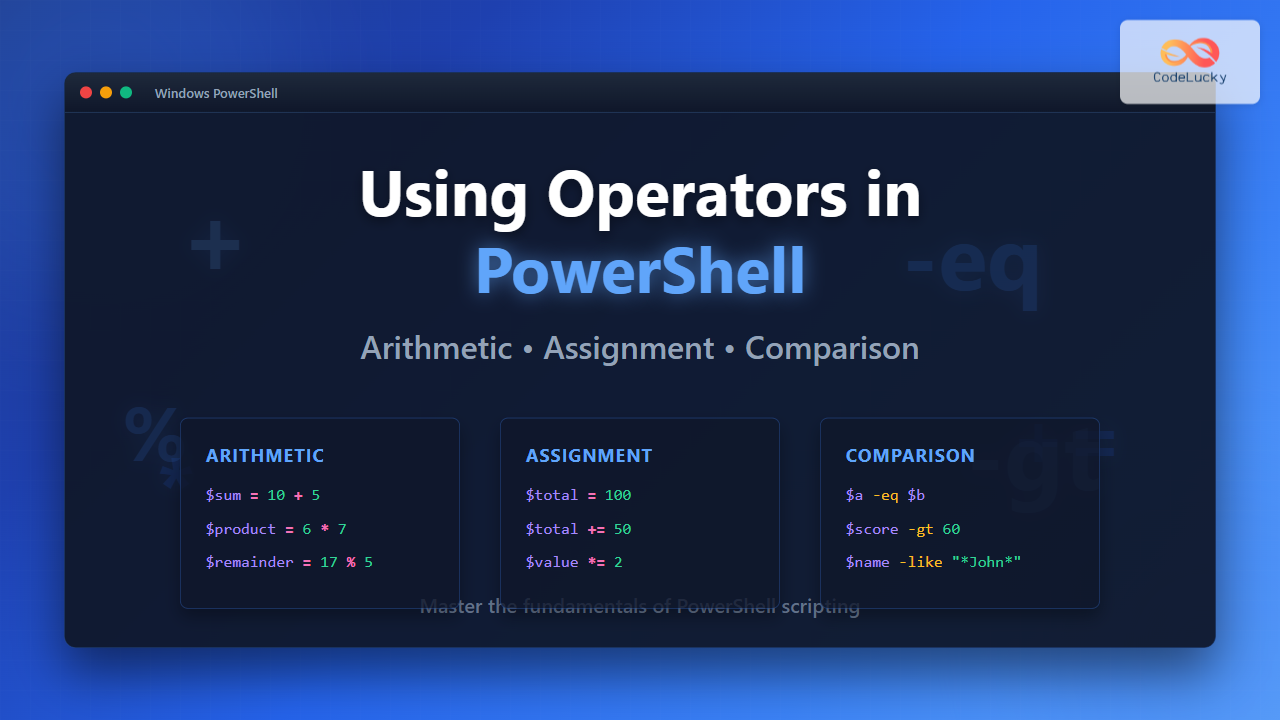
PowerShell operators are fundamental building blocks that allow you to perform calculations, assign values, compare data, and manipulate variables in your scripts. Understanding these operators is essential for writing efficient and powerful PowerShell code. This comprehensive guide explores arithmetic, assignment, and comparison operators with detailed examples and practical applications.
What Are PowerShell Operators?
Operators in PowerShell are special symbols or keywords that tell the PowerShell engine to perform specific operations on values or variables. They enable you to perform mathematical calculations, assign values to variables, compare data, and make logical decisions in your scripts.

Arithmetic Operators in PowerShell
Arithmetic operators perform mathematical operations on numeric values. PowerShell supports all standard arithmetic operations you’d expect in any programming language.
Basic Arithmetic Operators
Here are the primary arithmetic operators available in PowerShell:
- + (Addition) – Adds two values
- – (Subtraction) – Subtracts one value from another
- * (Multiplication) – Multiplies two values
- / (Division) – Divides one value by another
- % (Modulus) – Returns the remainder of a division operation
Addition Operator (+)
The addition operator adds numeric values together. It can also concatenate strings and combine arrays.
# Adding numbers
$result = 10 + 5
Write-Host "10 + 5 = $result"

# Adding multiple numbers
$sum = 25 + 15 + 10
Write-Host "25 + 15 + 10 = $sum"

# String concatenation
$firstName = "John"
$lastName = "Doe"
$fullName = $firstName + " " + $lastName
Write-Host "Full Name: $fullName"

# Array combination
$array1 = 1, 2, 3
$array2 = 4, 5, 6
$combined = $array1 + $array2
Write-Host "Combined Array: $combined"
Output:
10 + 5 = 15
25 + 15 + 10 = 50
Full Name: John Doe
Combined Array: 1 2 3 4 5 6
Subtraction Operator (-)
The subtraction operator subtracts one numeric value from another. It can also be used as a unary operator to negate a value.
# Basic subtraction
$result = 50 - 20
Write-Host "50 - 20 = $result"

# Negative numbers
$negative = -15
Write-Host "Negative value: $negative"

# Multiple operations
$calculation = 100 - 25 - 10
Write-Host "100 - 25 - 10 = $calculation"
Output:
50 - 20 = 30
Negative value: -15
100 - 25 - 10 = 65
Multiplication Operator (*)
The multiplication operator multiplies numeric values. It can also repeat strings and arrays.
# Basic multiplication
$result = 6 * 7
Write-Host "6 * 7 = $result"

# String repetition
$repeated = "PowerShell " * 3
Write-Host $repeated

# Array repetition
$numbers = 1, 2, 3
$repeatedArray = $numbers * 2
Write-Host "Repeated array: $repeatedArray"
Output:
6 * 7 = 42
PowerShell PowerShell PowerShell
Repeated array: 1 2 3 1 2 3
Division Operator (/)
The division operator divides one numeric value by another and returns a floating-point result.
# Basic division
$result = 20 / 4
Write-Host "20 / 4 = $result"

# Division with decimal result
$decimal = 15 / 4
Write-Host "15 / 4 = $decimal"

# Division by zero handling
try {
    $error = 10 / 0
} catch {
    Write-Host "Error: Cannot divide by zero"
}
Output:
20 / 4 = 5
15 / 4 = 3.75
Error: Cannot divide by zero
Modulus Operator (%)
The modulus operator returns the remainder after dividing one number by another. This is particularly useful for determining if a number is even or odd, or for cyclic operations.
# Basic modulus
$remainder = 17 % 5
Write-Host "17 % 5 = $remainder"

# Check if number is even
$number = 24
if ($number % 2 -eq 0) {
    Write-Host "$number is even"
} else {
    Write-Host "$number is odd"
}

# Cyclic pattern (useful for wrapping indices)
for ($i = 0; $i -lt 10; $i++) {
    $index = $i % 3
    Write-Host "Index $i wraps to: $index"
}
Output:
17 % 5 = 2
24 is even
Index 0 wraps to: 0
Index 1 wraps to: 1
Index 2 wraps to: 2
Index 3 wraps to: 0
Index 4 wraps to: 1
...
Operator Precedence
PowerShell follows standard mathematical operator precedence rules. Operations are evaluated in this order:
- Parentheses ()
- Multiplication (*), Division (/), Modulus (%)
- Addition (+), Subtraction (-)
# Without parentheses
$result1 = 5 + 3 * 2
Write-Host "5 + 3 * 2 = $result1"

# With parentheses
$result2 = (5 + 3) * 2
Write-Host "(5 + 3) * 2 = $result2"

# Complex expression
$result3 = 10 + 5 * 2 - 8 / 4
Write-Host "10 + 5 * 2 - 8 / 4 = $result3"
Output:
5 + 3 * 2 = 11
(5 + 3) * 2 = 16
10 + 5 * 2 - 8 / 4 = 18
Assignment Operators in PowerShell
Assignment operators are used to assign values to variables. PowerShell provides several assignment operators that combine assignment with arithmetic operations for concise code.

Simple Assignment (=)
The basic assignment operator assigns a value to a variable.
# Assigning numbers
$age = 25
Write-Host "Age: $age"

# Assigning strings
$name = "Alice"
Write-Host "Name: $name"

# Assigning arrays
$colors = @("Red", "Green", "Blue")
Write-Host "Colors: $colors"

# Assigning hashtables
$person = @{
    Name = "Bob"
    Age = 30
    City = "New York"
}
Write-Host "Person: $($person.Name), $($person.Age), $($person.City)"
Output:
Age: 25
Name: Alice
Colors: Red Green Blue
Person: Bob, 30, New York
Addition Assignment (+=)
The addition assignment operator adds a value to a variable and assigns the result back to that variable.
# Numeric addition assignment
$total = 100
$total += 50
Write-Host "Total after adding 50: $total"

# String concatenation assignment
$message = "Hello"
$message += " World"
Write-Host $message

# Array append
$fruits = @("Apple", "Banana")
$fruits += "Orange"
Write-Host "Fruits: $fruits"
Output:
Total after adding 50: 150
Hello World
Fruits: Apple Banana Orange
Subtraction Assignment (-=)
The subtraction assignment operator subtracts a value from a variable and assigns the result back.
# Numeric subtraction assignment
$balance = 1000
$balance -= 250
Write-Host "Balance after withdrawal: $balance"

# Multiple operations
$counter = 100
$counter -= 10
$counter -= 5
Write-Host "Counter value: $counter"
Output:
Balance after withdrawal: 750
Counter value: 85
Multiplication Assignment (*=)
The multiplication assignment operator multiplies a variable by a value and assigns the result back.
# Numeric multiplication assignment
$quantity = 5
$quantity *= 3
Write-Host "Quantity after tripling: $quantity"

# Doubling a value
$value = 25
$value *= 2
Write-Host "Doubled value: $value"
Output:
Quantity after tripling: 15
Doubled value: 50
Division Assignment (/=)
The division assignment operator divides a variable by a value and assigns the result back.
# Numeric division assignment
$total = 100
$total /= 4
Write-Host "Total after dividing by 4: $total"

# Halving a value
$amount = 80
$amount /= 2
Write-Host "Half amount: $amount"
Output:
Total after dividing by 4: 25
Half amount: 40
Modulus Assignment (%=)
The modulus assignment operator performs modulus operation and assigns the remainder back to the variable.
# Modulus assignment
$number = 23
$number %= 5
Write-Host "Remainder: $number"

# Wrapping values
$index = 47
$index %= 10
Write-Host "Wrapped index: $index"
Output:
Remainder: 3
Wrapped index: 7
Comparison Operators in PowerShell
Comparison operators compare two values and return a Boolean result (True or False). PowerShell uses case-insensitive comparison by default, with case-sensitive variants available.
Equality Operators
These operators test whether values are equal or not equal.
- -eq (Equal to) – Tests if two values are equal
- -ne (Not equal to) – Tests if two values are not equal
- -ceq (Case-sensitive equal) – Case-sensitive equality test
- -cne (Case-sensitive not equal) – Case-sensitive inequality test
# Numeric equality
$a = 10
$b = 10
$c = 20

Write-Host "10 -eq 10: $($a -eq $b)"
Write-Host "10 -eq 20: $($a -eq $c)"
Write-Host "10 -ne 20: $($a -ne $c)"

# String equality (case-insensitive by default)
$string1 = "PowerShell"
$string2 = "powershell"
$string3 = "Python"

Write-Host "'PowerShell' -eq 'powershell': $($string1 -eq $string2)"
Write-Host "'PowerShell' -ceq 'powershell': $($string1 -ceq $string2)"
Write-Host "'PowerShell' -eq 'Python': $($string1 -eq $string3)"
Output:
10 -eq 10: True
10 -eq 20: False
10 -ne 20: True
'PowerShell' -eq 'powershell': True
'PowerShell' -ceq 'powershell': False
'PowerShell' -eq 'Python': False
Relational Operators
These operators compare the relative magnitude of values.
- -gt (Greater than) – Tests if left value is greater than right value
- -ge (Greater than or equal to) – Tests if left value is greater than or equal to right value
- -lt (Less than) – Tests if left value is less than right value
- -le (Less than or equal to) – Tests if left value is less than or equal to right value
# Numeric comparisons
$score = 85
$passingScore = 60
$perfectScore = 100

Write-Host "Score 85 -gt 60: $($score -gt $passingScore)"
Write-Host "Score 85 -ge 85: $($score -ge 85)"
Write-Host "Score 85 -lt 100: $($score -lt $perfectScore)"
Write-Host "Score 85 -le 85: $($score -le 85)"

# String comparison (alphabetical)
$name1 = "Alice"
$name2 = "Bob"

Write-Host "'Alice' -lt 'Bob': $($name1 -lt $name2)"
Write-Host "'Bob' -gt 'Alice': $($name2 -gt $name1)"
Output:
Score 85 -gt 60: True
Score 85 -ge 85: True
Score 85 -lt 100: True
Score 85 -le 85: True
'Alice' -lt 'Bob': True
'Bob' -gt 'Alice': True

Pattern Matching Operators
PowerShell provides specialized operators for pattern matching and containment checks.
- -like – Wildcard pattern matching
- -notlike – Negated wildcard pattern matching
- -match – Regular expression matching
- -notmatch – Negated regular expression matching
- -contains – Tests if collection contains a value
- -notcontains – Tests if collection does not contain a value
# Wildcard matching with -like
$filename = "report_2024.xlsx"
Write-Host "'report_2024.xlsx' -like '*2024*': $($filename -like '*2024*')"
Write-Host "'report_2024.xlsx' -like '*.pdf': $($filename -like '*.pdf')"

# Regular expression matching
$email = "[email protected]"
Write-Host "Email matches pattern: $($email -match '^\w+@\w+\.\w+$')"

# Phone number validation
$phone = "123-456-7890"
Write-Host "Phone matches pattern: $($phone -match '^\d{3}-\d{3}-\d{4}$')"

# Array containment
$numbers = 1, 2, 3, 4, 5
Write-Host "Array contains 3: $($numbers -contains 3)"
Write-Host "Array contains 10: $($numbers -contains 10)"

$fruits = @("Apple", "Banana", "Orange")
Write-Host "Fruits contains 'Banana': $($fruits -contains 'Banana')"
Output:
'report_2024.xlsx' -like '*2024*': True
'report_2024.xlsx' -like '*.pdf': False
Email matches pattern: True
Phone matches pattern: True
Array contains 3: True
Array contains 10: False
Fruits contains 'Banana': True
Type Comparison Operators
PowerShell includes operators to check object types.
- -is – Tests if object is of specified type
- -isnot – Tests if object is not of specified type
# Type checking
$number = 42
$text = "Hello"
$array = @(1, 2, 3)

Write-Host "42 is [int]: $($number -is [int])"
Write-Host "42 is [string]: $($number -is [string])"
Write-Host "'Hello' is [string]: $($text -is [string])"
Write-Host "Array is [array]: $($array -is [array])"
Write-Host "Array is not [string]: $($array -isnot [string])"
Output:
42 is [int]: True
42 is [string]: False
'Hello' is [string]: True
Array is [array]: True
Array is not [string]: True
Practical Examples: Combining Operators
Real-world scenarios often require combining multiple operators to accomplish tasks. Here are practical examples demonstrating operator combinations.
Example 1: Calculate Discount Price
# Calculate final price with discount
$originalPrice = 100
$discountPercent = 20
$taxRate = 0.08

# Calculate discount amount
$discountAmount = $originalPrice * ($discountPercent / 100)
$priceAfterDiscount = $originalPrice - $discountAmount

# Calculate tax
$taxAmount = $priceAfterDiscount * $taxRate
$finalPrice = $priceAfterDiscount + $taxAmount

Write-Host "Original Price: $originalPrice"
Write-Host "Discount ($discountPercent%): -$discountAmount"
Write-Host "Price After Discount: $priceAfterDiscount"
Write-Host "Tax (8%): +$taxAmount"
Write-Host "Final Price: $finalPrice"
Output:
Original Price: 100
Discount (20%): -20
Price After Discount: 80
Tax (8%): +6.4
Final Price: 86.4
Example 2: Grade Calculator
# Grade calculation based on score
$score = 87

if ($score -ge 90) {
    $grade = "A"
} elseif ($score -ge 80) {
    $grade = "B"
} elseif ($score -ge 70) {
    $grade = "C"
} elseif ($score -ge 60) {
    $grade = "D"
} else {
    $grade = "F"
}

Write-Host "Score: $score"
Write-Host "Grade: $grade"

# Check if passing
$isPassing = $score -ge 60
Write-Host "Passing: $isPassing"
Output:
Score: 87
Grade: B
Passing: True
Example 3: Array Processing
# Process array of numbers
$numbers = 1..10
$evenNumbers = @()
$oddNumbers = @()
$sumEven = 0
$sumOdd = 0

foreach ($num in $numbers) {
    if ($num % 2 -eq 0) {
        $evenNumbers += $num
        $sumEven += $num
    } else {
        $oddNumbers += $num
        $sumOdd += $num
    }
}

Write-Host "Even Numbers: $evenNumbers"
Write-Host "Sum of Even: $sumEven"
Write-Host "Odd Numbers: $oddNumbers"
Write-Host "Sum of Odd: $sumOdd"
Write-Host "Total Sum: $($sumEven + $sumOdd)"
Output:
Even Numbers: 2 4 6 8 10
Sum of Even: 30
Odd Numbers: 1 3 5 7 9
Sum of Odd: 25
Total Sum: 55
Example 4: File Name Validation
# Validate and process file names
$files = @(
    "document.pdf",
    "report_2024.xlsx",
    "image.png",
    "script.ps1",
    "data.csv"
)

foreach ($file in $files) {
    Write-Host "`nProcessing: $file"

    # Check file type
    if ($file -like "*.pdf") {
        Write-Host "  Type: PDF Document"
    } elseif ($file -like "*.xlsx" -or $file -like "*.csv") {
        Write-Host "  Type: Spreadsheet"
    } elseif ($file -like "*.ps1") {
        Write-Host "  Type: PowerShell Script"
    } else {
        Write-Host "  Type: Other"
    }

    # Check if contains year
    if ($file -match "\d{4}") {
        Write-Host "  Contains year reference"
    }
}
Output:
Processing: document.pdf
  Type: PDF Document

Processing: report_2024.xlsx
  Type: Spreadsheet
  Contains year reference

Processing: image.png
  Type: Other

Processing: script.ps1
  Type: PowerShell Script

Processing: data.csv
  Type: Spreadsheet
Best Practices for Using Operators
Following best practices ensures your PowerShell scripts are readable, maintainable, and error-free.
Use Parentheses for Clarity
Even when not strictly necessary, parentheses improve readability and prevent logic errors.
# Less clear
$result = 10 + 5 * 2 - 3

# More clear
$result = 10 + (5 * 2) - 3

# Complex expression
$value = ((100 - 20) / 4) + (15 * 2)
Choose Appropriate Comparison Operators
Use case-sensitive operators when string case matters, and wildcard matching when you need flexible pattern matching.
# Case-insensitive (default)
"PowerShell" -eq "powershell"  # True

# Case-sensitive when needed
"PowerShell" -ceq "powershell"  # False

# Use -like for simple patterns
$filename -like "*.log"

# Use -match for complex patterns
$email -match "^[\w\.-]+@[\w\.-]+\.\w+$"
Validate Before Division
Always check for zero before performing division to avoid runtime errors.
# Safe division
$numerator = 100
$denominator = 0

if ($denominator -ne 0) {
    $result = $numerator / $denominator
    Write-Host "Result: $result"
} else {
    Write-Host "Error: Cannot divide by zero"
}
Use Type-Appropriate Operators
Ensure you’re using operators appropriate for your data types to avoid unexpected behavior.
# String concatenation vs numeric addition
$a = "10"
$b = "20"
$stringResult = $a + $b  # "1020"
$numericResult = [int]$a + [int]$b  # 30

Write-Host "String result: $stringResult"
Write-Host "Numeric result: $numericResult"
Common Pitfalls and How to Avoid Them
Type Coercion Issues
PowerShell automatically converts types when possible, which can lead to unexpected results.
# Unexpected string concatenation
$number = 5
$text = "10"
$result = $number + $text  # Results in "510" not 15

# Solution: Explicit type conversion
$result = $number + [int]$text  # Results in 15
Write-Host "Correct result: $result"
Comparison Operator Confusion
Remember that PowerShell uses different syntax than other languages for comparisons.
# Wrong (C-style comparison doesn't work)
# if ($x == 10) { }  # This will cause an error

# Correct (PowerShell style)
$x = 10
if ($x -eq 10) {
    Write-Host "Correct comparison syntax"
}
Array Containment Direction
The -contains operator checks if a collection contains a value, not if a value is in a collection.
# Correct usage
$array = 1, 2, 3, 4, 5
$result = $array -contains 3  # True

# Incorrect (won't work as expected)
# $result = 3 -contains $array  # Wrong direction

Performance Considerations
Understanding performance implications helps you write efficient PowerShell scripts.
Operator Efficiency
Some operators are more efficient than others for specific tasks.
# Efficient: Direct assignment
$sum = 0
$sum += 10  # Fast

# Less efficient: Repeated string concatenation in loops
$result = ""
for ($i = 1; $i -le 1000; $i++) {
    $result += "$i "  # Slow for large iterations
}

# Better: Use array and join
$numbers = 1..1000
$result = $numbers -join " "  # Much faster
Comparison Operator Performance
Case-insensitive comparisons are slightly slower than case-sensitive ones.
# Case-insensitive (default, slightly slower)
$match = "PowerShell" -eq "powershell"

# Case-sensitive (faster)
$match = "PowerShell" -ceq "PowerShell"
Advanced Operator Usage
Chaining Comparison Operators
PowerShell allows complex comparisons using logical operators with comparison operators.
# Range checking
$age = 25
$isAdult = ($age -ge 18) -and ($age -lt 65)
Write-Host "Is working age adult: $isAdult"

# Multiple condition checking
$score = 85
$attendance = 90

$isHonorRoll = ($score -ge 80) -and ($attendance -ge 85)
Write-Host "Qualifies for honor roll: $isHonorRoll"
Ternary-Style Operations
PowerShell 7.0+ supports ternary operators, but you can achieve similar results in earlier versions.
# PowerShell 7.0+ ternary operator
# $result = $condition ? $trueValue : $falseValue

# Traditional approach (works in all versions)
$score = 75
$result = if ($score -ge 60) { "Pass" } else { "Fail" }
Write-Host "Result: $result"

# Using Where-Object for conditional selection
$status = @("Pass", "Fail")[$score -lt 60]
Write-Host "Status: $status"
Conclusion
Mastering PowerShell operators is fundamental to writing effective scripts and automations. Arithmetic operators handle mathematical calculations and data manipulation, assignment operators provide efficient ways to update variables, and comparison operators enable decision-making and data filtering. By understanding operator precedence, type coercion, and best practices, you can write cleaner, more efficient PowerShell code.
Practice combining these operators in real-world scenarios to build confidence and discover new ways to solve problems. Remember to use appropriate operators for your data types, validate inputs before operations that could cause errors, and always prioritize code readability through proper formatting and parentheses usage.
As you continue your PowerShell journey, these operators will become second nature, allowing you to focus on solving complex automation challenges rather than syntax details. Whether you’re processing data, automating system tasks, or building sophisticated scripts, a solid understanding of operators is your foundation for success.