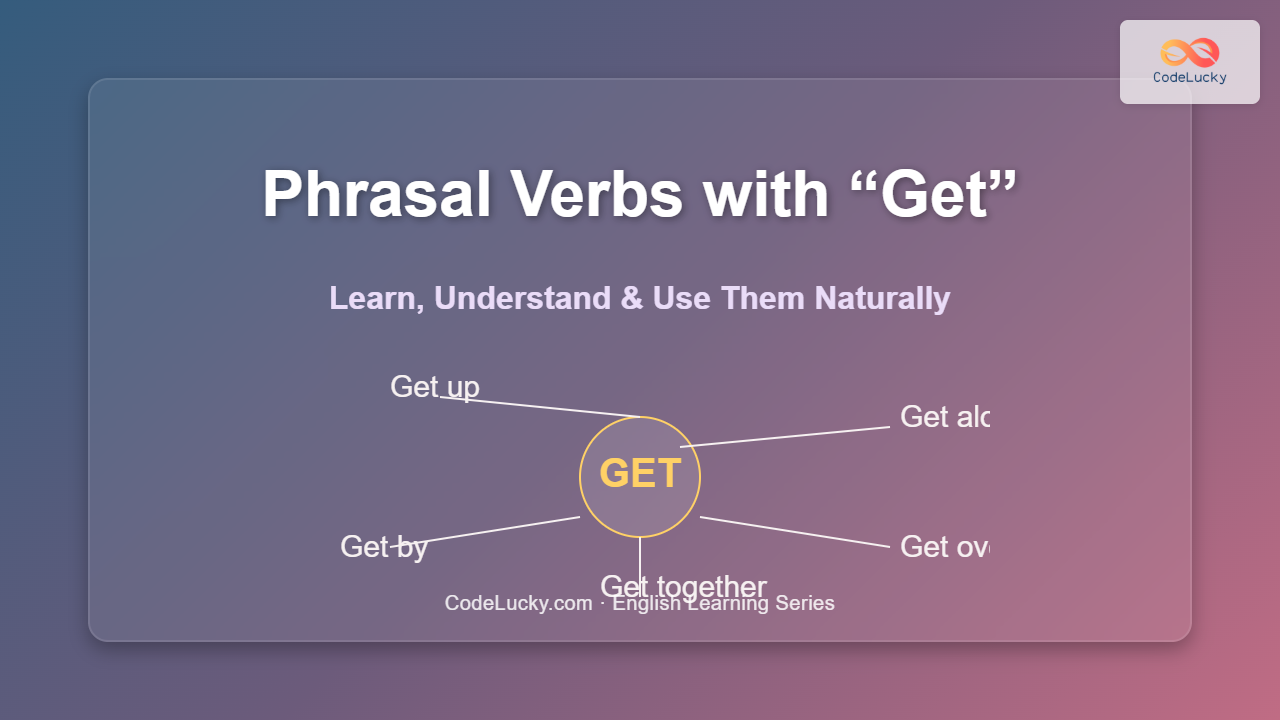
Phrasal Verbs with “Get” are among the most commonly used expressions in English. Mastering them helps you sound more fluent, natural, and confident in both speaking and writing. In this article, we’ll explore the most useful phrasal verbs formed with “get”, break down their meanings, and provide clear examples with context. You’ll also see visual aids to help you remember each one effectively.
What Are Phrasal Verbs?
A phrasal verb is a combination of a main verb and one or more particles (prepositions or adverbs) that together create a new meaning. The meaning often changes completely from the original verb, which makes them tricky for learners. For example:
“Get up” means “to rise from bed,” not just “obtain upwards.”

Why Learn “Get” Phrasal Verbs?
The word “get” is highly flexible and forms many expressions that native speakers use daily. Understanding these combinations will:
- Enhance your listening comprehension in real conversations.
- Improve your speaking fluency.
- Make your writing sound more natural and idiomatic.
Common Phrasal Verbs with “Get”
1. Get up
Meaning: To rise from bed or a sitting position.
Example: I get up at 6 a.m. every morning to exercise.
Scenario Tip: Use “get up” to describe your daily routine.

2. Get along (with)
Meaning: To have a friendly relationship with someone.
Example: I really get along with my colleagues at work.
Usage Tip: Add “with” when mentioning the person you relate to.
3. Get over
Meaning: To recover from something (an illness, difficulty, or breakup).
Example: It took him months to get over the flu.

4. Get across
Meaning: To communicate an idea clearly and make others understand.
Example: The teacher got her point across very well through a story.
5. Get away
Meaning: To escape or go on a short trip.
Example: We’re planning to get away this weekend for a short holiday.
Mnemonic: Think of escaping daily stress—“get away” from routine.
6. Get back
Meaning: To return to a place or recover something.
Example 1: I’ll get back home by 8 p.m.
Example 2: She got her lost files back after a week.
7. Get by
Meaning: To manage or survive with limited resources.
Example: Even though he doesn’t earn much, he manages to get by.

8. Get together
Meaning: To meet socially or gather with others.
Example: Let’s get together this Friday for dinner!
9. Get through
Meaning: To successfully finish something or reach someone.
Example 1: She got through the exam despite the pressure.
Example 2: I tried calling you but couldn’t get through.

Interactive Practice
Try matching the correct meanings with each phrase below. (Mentally or in your notes!)
| Phrasal Verb | Meaning Options |
|---|---|
| Get up | a. Recover from an illness |
| Get along | b. Rise from bed |
| Get over | c. Have a good relationship |
| Get by | d. Manage with little |
Check your answers: 1 → b, 2 → c, 3 → a, 4 → d
Quick Recap Table
| Phrasal Verb | Meaning | Example |
|---|---|---|
| Get up | Stand or rise from bed | She gets up early every day. |
| Get over | Recover from illness or sadness | He got over his breakup fast. |
| Get along | Have a good relationship | We get along really well. |
| Get by | Manage to survive | They get by on a small income. |
| Get through | Finish or reach successfully | She got through the tough times. |
Tips to Master “Get” Phrasal Verbs
- Learn them in context rather than in isolation.
- Use visual stories or mind maps to remember meanings.
- Practice using them in real sentences every day.
- Group them by theme or meaning (e.g., movement, emotion, communication).
Conclusion
“Get” phrasal verbs are key building blocks of spoken English. Start by using just two or three of them daily until they become natural. With consistent practice, listening, and application, you’ll soon get the hang of it!
Next Step: Explore our next article — “Phrasal Verbs with ‘Take’” to continue your journey in mastering natural English expressions.