Phrasal verbs are a core part of everyday and professional English communication. They combine a verb and a preposition or adverb (sometimes both) to create new meanings, often very different from the original verb. In business settings, phrasal verbs make language sound more natural and conversational. This article helps professionals learn, visualize, and practice phrasal verbs effectively with contextual examples.
What Are Phrasal Verbs?
A phrasal verb is formed when a verb combines with one or more particles (prepositions or adverbs) to create a unique meaning. These cannot always be translated word-for-word.
Examples:
- Bring up → To mention a topic. “She brought up an important issue during the meeting.”
- Carry out → To perform or execute. “The team will carry out the new marketing strategy.”
- Look into → To investigate. “I’ll look into this matter and report back.”

Why Phrasal Verbs Matter in Professional Settings
Phrasal verbs add fluency and confidence to workplace communication. They make your language sound natural, confident, and concise. Professionals use them in reports, presentations, emails, and meetings to convey ideas dynamically and efficiently.
Examples in Workplace Contexts
| Phrasal Verb | Meaning | Professional Example |
|---|---|---|
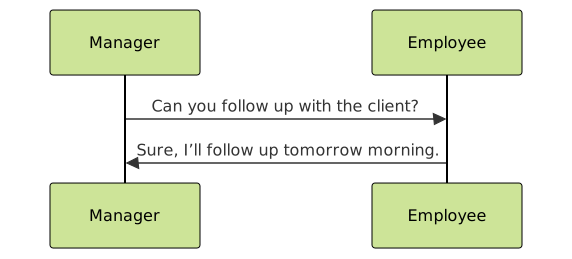
| Follow up | To check or continue communication | “I’ll follow up with the client tomorrow.” |
| Put off | To postpone | “Let’s put off the meeting until next Monday.” |
| Take over | To assume control or responsibility | “Sarah will take over the sales department next month.” |
| Set up | To establish or organize | “We’re setting up a new branch in Singapore.” |
| Work out | To find a solution | “Let’s work out a plan that benefits everyone.” |
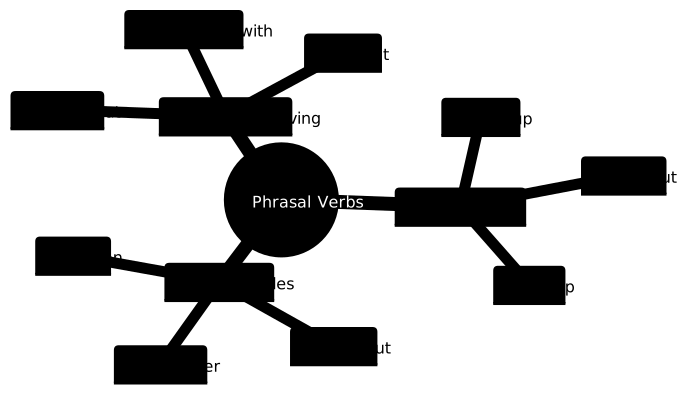
Common Professional Phrasal Verbs by Category
1. Communication-related Phrasal Verbs
- Bring up – Mention a topic: “He brought up the issue of cost efficiency.”
- Point out – Highlight something: “She pointed out a mistake in the report.”
- Sum up – Conclude briefly: “To sum up, we achieved all targets.”
2. Task and Responsibility Phrasal Verbs
- Take on – Accept a challenge: “He took on a new project.”
- Carry out – Execute or perform: “They carried out the plan successfully.”
- Hand over – Give control: “Please hand over the files before leaving.”
3. Decision and Problem-Solving Phrasal Verbs
- Figure out – Understand or solve: “We figured out a new system to track progress.”
- Come up with – Invent or create: “She came up with an innovative strategy.”
- Sort out – Resolve: “I’ll sort out the documentation today.”
Interactive Practice Section
Try this quick exercise. Fill in the blanks with a suitable phrasal verb from the options.
- I’ll ________ the client’s feedback and send a report. (look into / carry out)
- Can you ________ a meeting with the finance team? (set up / take over)
- We need to ________ a strategy before we launch. (work out / put off)
Answers: 1. look into, 2. set up, 3. work out
Tips for Remembering Phrasal Verbs
- Use context: Learn phrasal verbs in example sentences, not in isolation.
- Group them: Categorize by topic (communication, teamwork, planning).
- Practice often: Use them in emails and daily work conversations.
- Visualize: Associate verbs with images or processes for better recall.

Conclusion
Phrasal verbs may seem tricky at first, but consistent exposure and usage make them second nature. For professionals, mastering phrasal verbs creates smoother, more native-like interactions in meetings, reports, and presentations. Start integrating a few daily, and soon your business English will sound sharper and more confident.
Keep visiting CodeLucky.com for more lessons on practical English usage and workplace communication!