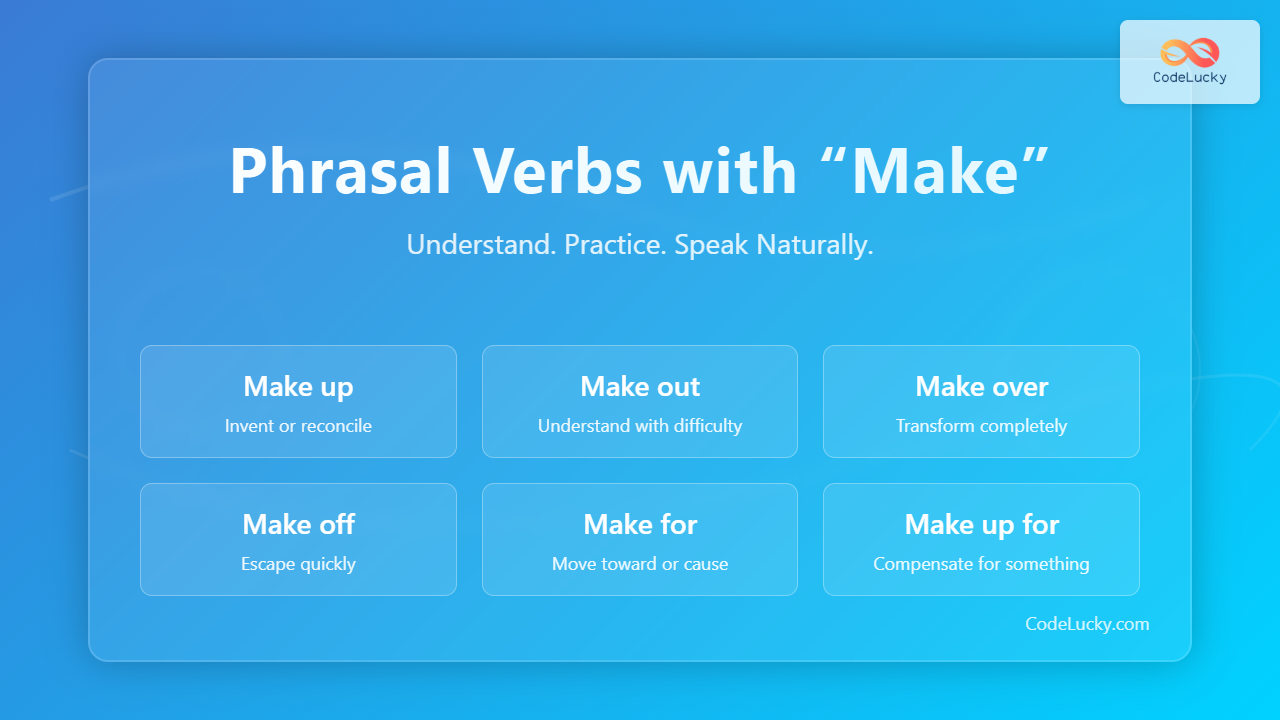
Learning phrasal verbs is a must if you want your English to sound natural and fluent. Native speakers use them constantly in everyday conversations — whether at home, work, or while chatting with friends. In this guide, we’ll explore the most common phrasal verbs used in daily English, complete with meanings, practical examples, and visual diagrams to help you remember them easily.
What Are Phrasal Verbs?
A phrasal verb is a combination of a verb and a preposition or adverb (for example, get up, turn off, or look after). The meaning of a phrasal verb often cannot be directly understood from its parts — it’s idiomatic and context-based.
For example:
- Turn up = to appear unexpectedly → “He turned up at the party without an invitation.”
- Look up = to search for information → “I looked up that new restaurant online.”
How Phrasal Verbs Work (Visual Guide)
Each phrasal verb combines two parts that create new meaning. Let’s visualize this relationship:

This interaction is what makes phrasal verbs both fascinating and challenging. Once you understand them in context, they become much easier to use.
Common Phrasal Verbs for Daily Use
1. Wake Up / Get Up
Wake up means to stop sleeping, while get up means to leave your bed.
Examples:
- “I wake up at 6:30 AM every day.”
- “I get up after hitting snooze twice.”
2. Pick Up
Pick up has many meanings — to lift something, to learn something, or to collect someone.
Examples:
- “Can you pick up some groceries on your way home?”
- “He picked up French during his trip.”
3. Look After
Look after means to take care of someone or something.
Examples:
- “She looks after her younger brother when their parents are away.”
4. Turn Off / Turn On
Turn off means to deactivate, while turn on means to activate.
Examples:
- “Please turn off the lights before you leave.”
- “He turned on the TV to watch the news.”
5. Give Up
Give up means to stop trying to do something or to quit a habit.
Examples:
- “Don’t give up on your dreams.”
- “He gave up smoking last year.”
6. Run Out Of
Run out of means to use all of something and have none left.
Examples:
- “We’ve run out of milk again.”
- “They ran out of ideas halfway through the project.”
7. Look Forward To
Look forward to means to feel excited about something that will happen.
Examples:
- “I’m really looking forward to the weekend.”
- “She looks forward to seeing her friends every month.”
Interactive Practice: Match the Meaning
Try this mini quiz. Match each phrasal verb with its correct meaning:
- Turn off
- Look after
- Run out of
- Pick up
A. To exhaust a supply
B. To take care of someone
C. To deactivate or stop working
D. To learn or collect
Answers: 1-C, 2-B, 3-A, 4-D
Phrasal Verb Categories (Visual Chart)

Tips to Master Phrasal Verbs
- Learn in context: Don’t memorize lists. Instead, notice how they appear in conversations or media.
- Group by theme: Organize phrasal verbs by context, like daily routine, travel, or emotions.
- Use flashcards: Write the verb on one side and examples on the other for quick recall.
- Practice speaking: Include phrasal verbs naturally when talking — repetition helps lock them in memory.
Visual Summary of Common Phrasal Verbs

Conclusion
Phrasal verbs transform basic English into truly expressive and natural communication. You don’t need to memorize hundreds of them — focus on understanding those most commonly used in daily contexts. Gradually, they’ll become part of your speech without you even noticing.
Next Step: Try using three new phrasal verbs today in your own sentences. The more you practice, the more fluent you’ll sound!