Phonics is the foundation of reading and writing in English. It bridges the gap between the letters we see and the sounds we hear. Through phonics blending, learners combine individual letter sounds—called phonemes—to form meaningful words. Mastering this skill strengthens reading fluency, spelling accuracy, and pronunciation confidence.
What Is Phonics Blending?
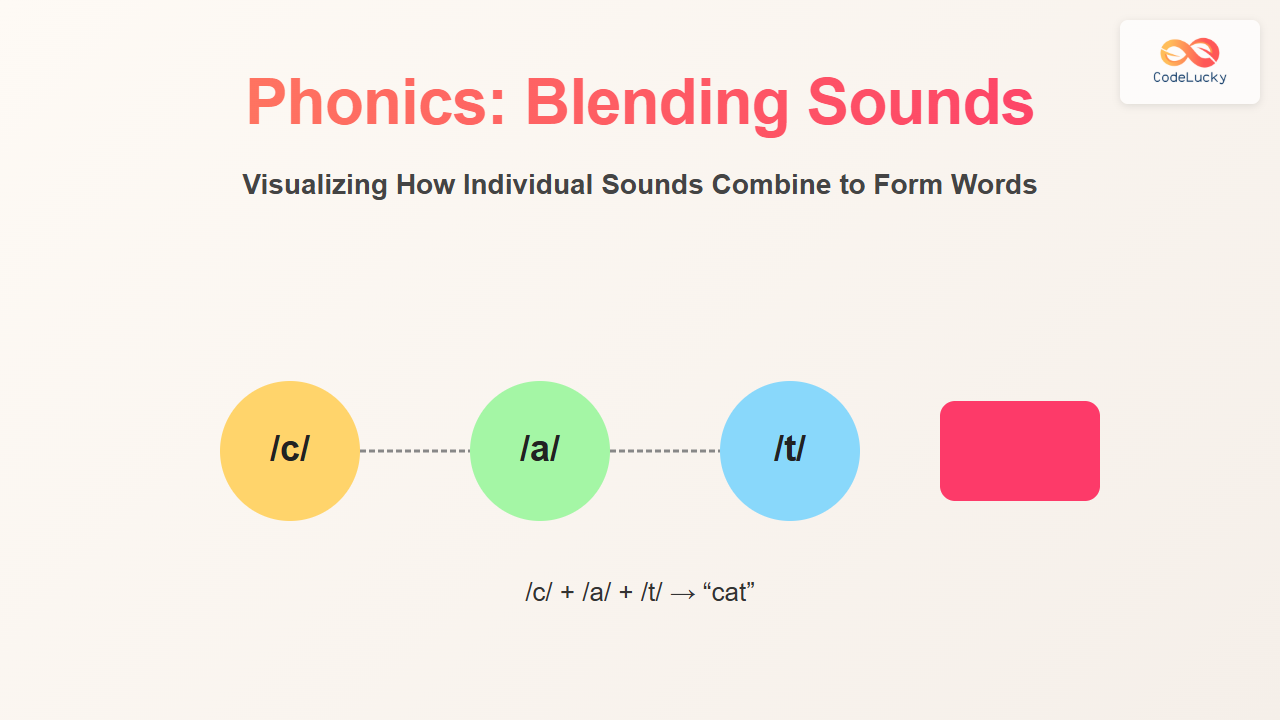
Blending is the process of smoothly joining sounds together to pronounce a word. For example, the word cat can be broken down into three sounds: /c/ + /a/ + /t/. When these are blended, we get “cat.” This technique trains the ear to recognize how separate phonemes combine to create fluent speech.
Why Phonics Is Important
- Improves Reading Fluency: Blending helps learners read whole words quickly instead of sounding out each letter individually.
- Enhances Pronunciation: Understanding the sound structure allows for clearer and more accurate pronunciation.
- Strengthens Spelling: When learners recognize sound patterns, they can spell new words more confidently.
- Boosts Vocabulary: Recognizing phonemic patterns enables faster decoding of unfamiliar words.
How to Blend Sounds Step-by-Step
Here’s a simple approach that English learners can follow to practice phonics blending effectively:
- Identify individual sounds in a word.
- Say each sound slowly, keeping them distinct.
- Blend the sounds together smoothly without pausing between them.
- Repeat the full blend several times until it sounds like a natural word.
Example 1: Blending “sun”
Sounds: /s/ + /u/ + /n/ → blended to form sun.

Example 2: Blending “ship”
Sounds: /sh/ + /i/ + /p/ → blended to form ship.

Interactive Phonics Practice
Try these fun exercises to strengthen your blending skills:
- Sound Stretch Game: Say each sound while stretching it (e.g., “ssssuuunnn”), then say it quickly to form the word.
- Blend Builder: Choose random letters or phonemes (like /b/, /a/, /t/) and combine them to create possible words.
- Phonics Matching: Match pictures with their spelled-out sounds (e.g., a picture of a cat — /c/ /a/ /t/).
Understanding Phonic Families
Phonic families, also called word families, are groups of words that share the same ending sounds. Learning them makes blending faster. For instance, the -at family includes cat, bat, hat, and mat.

Consonant and Vowel Blending Patterns
In English, blending happens both at the beginning (onset) and end (rime) of a word:
- Onset: The initial sound(s) before the vowel, like /st/ in stop.
- Rime: The vowel and following sounds, like /op/ in stop.
Combining these two parts forms the word. Here’s a simple diagram showing how this works:
Visualizing Sound Blends
The animation-like approach below shows how sounds merge step-by-step:

Practical Tips for Learners
- Start with 2- or 3-letter words before moving to longer ones.
- Listen carefully to each phoneme; pronunciation accuracy matters more than speed.
- Use flashcards with phonemes on one side and words on the other.
- Practice daily for a few minutes rather than long, infrequent sessions.
Common Challenges and How to Overcome Them
Many learners struggle with certain consonant combinations or silent letters. Here’s how to address these problems:
- Blending clusters: Practice words like flag or trap slowly, isolating each cluster sound.
- Silent letters: Learn patterns (e.g., “k” is silent in knight or know).
- Vowel confusion: Pair visual aids with sound repetition (e.g., short “a” vs. long “a”).
Advanced Blending Practice
Once basic sounds become easy, move to more complex blends and digraphs:
- Consonant blends: /bl/, /cr/, /dr/, /fl/
- Digraphs: /ch/, /th/, /sh/, /ph/, /wh/
Conclusion
Phonics is more than a reading technique—it’s the foundation of confident communication. By practicing blending every day and exploring sound patterns, learners progress from decoding simple words to understanding complex English vocabulary easily. The key lies in consistency, patience, and a bit of creative sound play.
Next Step: Try reading short stories aloud and focus on sounding out each new word using phonics blending. This active practice will turn theory into lifelong language mastery.
- What Is Phonics Blending?
- Why Phonics Is Important
- How to Blend Sounds Step-by-Step
- Interactive Phonics Practice
- Understanding Phonic Families
- Consonant and Vowel Blending Patterns
- Visualizing Sound Blends
- Practical Tips for Learners
- Common Challenges and How to Overcome Them
- Advanced Blending Practice
- Conclusion